



This Week’s Trade Exits
As soon as I exit a trade, I note that in the comments of the post where I first mentioned the trade; at the end of the week, I try to track them all in one post. Starting in July, 2024, I have also been tracking them in a spreadsheet. These are the trades I exited this week.
Clicking on one of the exit cards should take you to the original alert where we mentioned the trade; exits will be documented in the comments on the dates they occurred.
Stocks or Exchange Traded Products
None.
Options


Comments
Stocks or Exchange Traded Products
No exits this week, as I’ve focused on options instead of our basic strategy, which involves buying stocks and ETFs. Nevertheless, the performance of our Top Names remains strong, as you can see below.
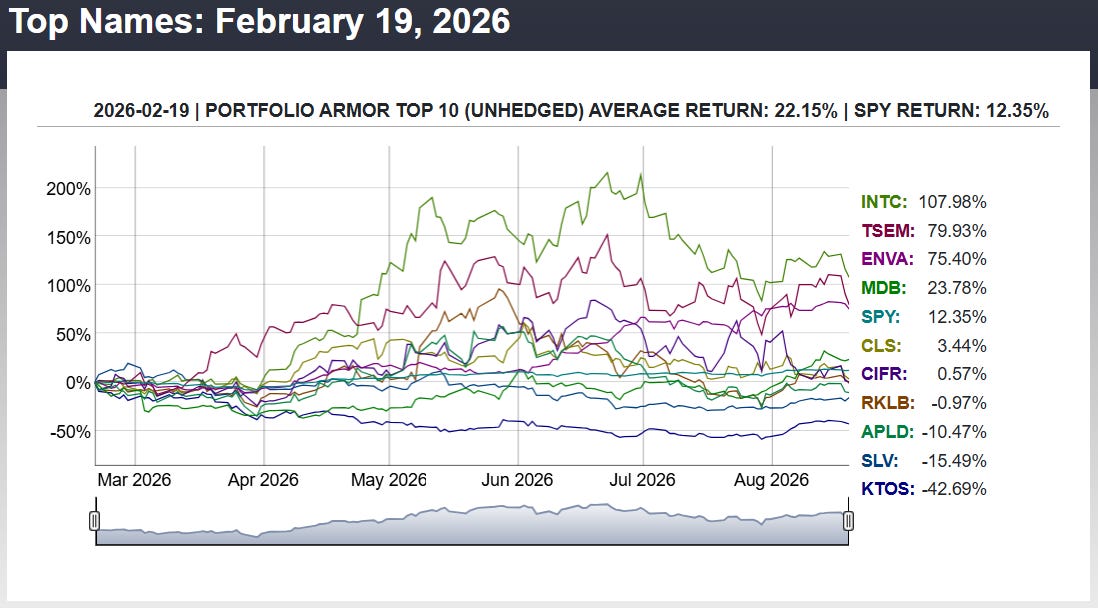
You can find the performance of our top names since I launched this Substack here.
Options
A Mixed OpEx Week
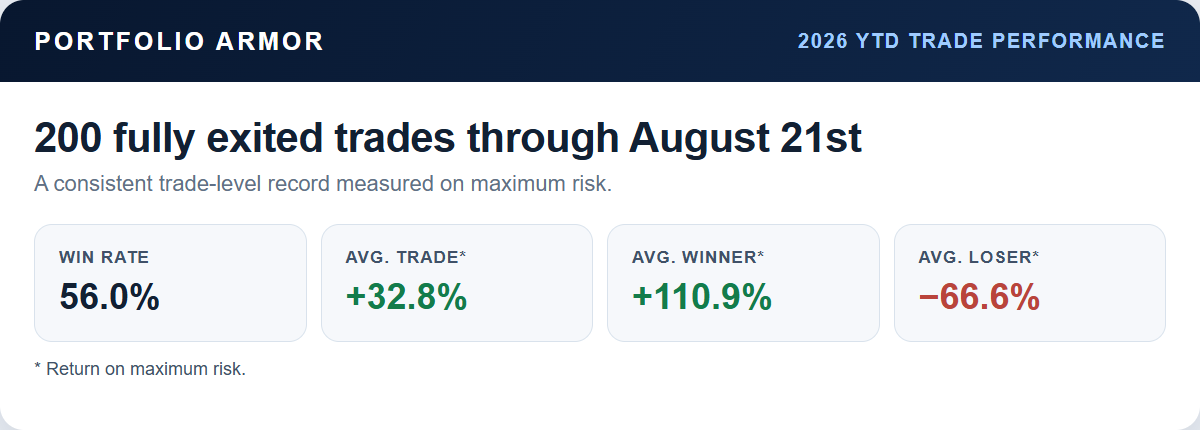
This was a mixed but more resilient batch than the loss cards at the top might suggest: 18 of 35 exits were profitable, and 10 of the 17 losing exits lost less than 50% of maximum risk.
One accounting note: the loss on Power Solutions International (PSIX) slightly exceeded the structure’s original maximum risk because the $0.10 debit we later paid to buy back its short call increased our total cash outlay after entry.
OpEx weeks still have a natural bias toward the laggards. Standing exit orders often remove winning trades before expiration, while positions still open on OpEx Friday disproportionately include the ones that never worked cleanly.
One Interrupted Review
One complication this week was operational. ChatGPT Codex lost control of Chrome on Wednesday, which kept me from completing my scheduled expiration review in the browser, and drawing our new Exit cards. That interruption may have cost me an opportunity to get out of our trade in Powell Industries (POWL 0.00%↑) at a better price.
Snatching Defeat From The Jaws Of Victory
Our exit from Robinhood Markets (HOOD 0.00%↑) produced the week’s clearest process lesson. Subscriber TL sold his August $95 call for $25; we held out for our $29.50 runner target and eventually sold ours for $1.25. We examined that mistake in the post below.

and explained why ambitious runner targets still make sense for uncapped options—and the new “compelling exit” exemption we’re adding to reduce the odds of round-tripping another large gain.
HOOD added one last twist on Friday: Bitcoin jumped, HOOD rose about 14%, and its $95 call likely could have been sold $13+ had we still owned it. That move arrived after our Wednesday exit. The process change has to rest on the information available at the time though, not on a move that only looks obvious in hindsight.
When The Thesis Doesn’t Play Out
Energy Recovery (ERII 0.00%↑) showed compelling themes don’t always pan out. We entered it in April as a postwar reconstruction play because its energy-recovery technology is used in desalination plants, including in the Persian Gulf. The stock didn’t deliver the expected move before the August options expired, and the combo lost 91% of its maximum risk.
Our August trade on uniQure (QURE 0.00%↑) was based on a prediction from one of the outside analysts we track in our Multibaggers group—a source-of-alpha category focused on stocks that could rise severalfold—that QURE could reach $70 this summer. It hasn’t done so. Because we entered that combo for a net credit and later exited its put spread for a $0.20 debit, the call spread’s expiration left us with a small gain: 2% of maximum risk, or 33% on premium collected. More importantly, we still have several other QURE trades open, including longer-dated exposure designed to give the thesis several more months to play out. Those positions give the timing more room to be early while the market tests the thesis.
An Anecdotal Sign Of AI Demand
The browser outage produced one other, more constructive observation. While Codex was unavailable, I switched to Claude and hit its usage limit despite being on Anthropic’s $200-per-month plan; I also checked China’s Moonshot AI and found its paid tiers waitlisted. These are only two consumer experiences, but both point in the same direction: demand for frontier AI still exceeds available capacity, consistent with our bullish view of the AI buildout.
> [BTC] Short Calls on MCHP Technology (MCHP)
🤦 Robinhood's "GTC" orders actually expire automatically (and almost silently) after hours at 90 days from being placed; worse yet, to renew the order, I have to manually enter the entire order *again*, as there is no "renew" or "place again" button. I've been trying to check for such shenanigans to keep on top of the problem, but I did miss this particular position's autocancelation "feature". I really do wonder how this world functions at all—everything is increasingly "designed" in a totally insane, objectively and obviously counter-productive manner.
> demand for frontier AI still exceeds available capacity, consistent with our bullish view of the AI buildout.
I'm increasingly worried that it might exceed capacity until the outcome gets interpreted as a market failure; if supply doesn't materialize toute suite, a problem compounded by global crises, S will HTF. Hopefully, we will all remain entertained at the very least.