


The Return Of The Monroe Doctrine
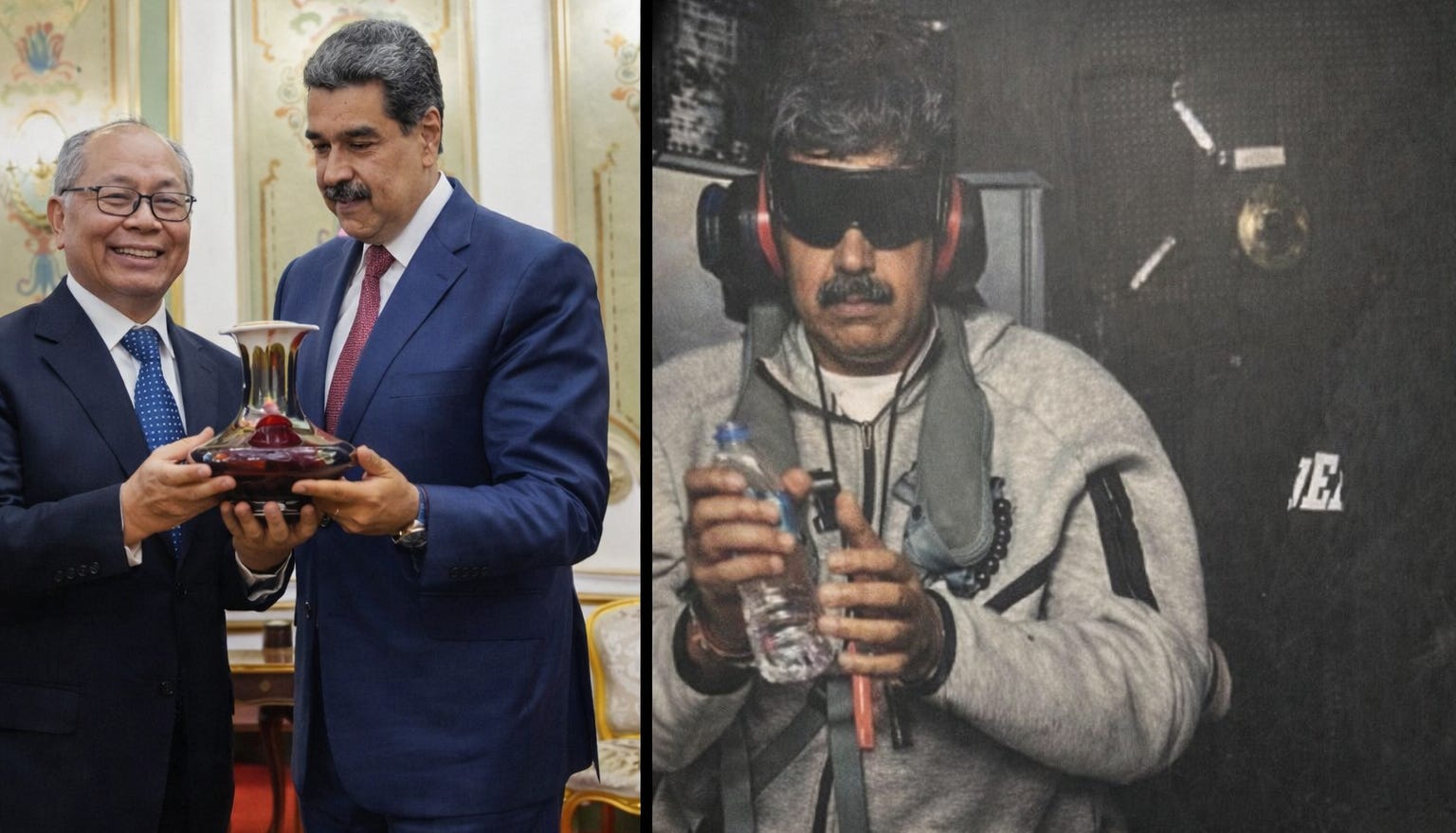
When video of Chinese envoys shaking hands with Nicolás Maduro in Caracas hit X and YouTube on January 2nd, it looked like a perfect snapshot of a changing world: China cutting hundreds of deals with a narco-petro state that sits on the world’s largest proven oil reserves.
Hours later, U.S. helicopters dropped out of the sky over Caracas and U.S. special operators flew Maduro out of the country.
Whatever you think of Trump, that’s a jarring juxtaposition: Beijing signing MOUs; Washington still deciding who actually runs the place.
I wrote on X today that Trump may have bought U.S. primacy another decade. Let me unpack why I still think that’s roughly right—and what it may mean for geopolitics and for markets.
The “Donroe Doctrine” Becomes Real Policy
In a post last February (“Trump’s Grand Strategy”), I argued that Trump’s grand strategy was essentially a revived Monroe Doctrine—a pivot back to dominating the Western Hemisphere while accepting a more multipolar world elsewhere. In September, after the administration released its National Security Strategy, I noted in a follow up post (“Back To The Hemisphere”) how its “Trump Corollary” put unusual emphasis on the Western Hemisphere as America’s primary security and economic zone. In his January 3rd Mar-a-Lago press conference on the Venezuela operation, Trump himself labeled this approach the “Donroe Doctrine.”
The Venezuela operation clearly fits that frame: a sharp, limited move to reassert U.S. influence in its near abroad.
According to open reporting, U.S. forces ran an air assault into Caracas, seized Maduro, and exfiltrated him out of the country in a single night—under Operation Absolute Resolve, the capstone to weeks of naval pressure on Venezuelan oil shipments under Operation Southern Spear. (Wikipedia)
Trump then walked into the briefing room and said, more or less, “we’re running Venezuela now.”
But are we?
Regime Change… Or A Negotiated Decapitation?
If you just watch the U.S. side, it looks like a classic regime-change op: blockade the oil, rattle sabers, insert special forces, drag out the dictator, declare victory.
Look a little closer at the facts people on the ground have been pointing to:
The Venezuelan military was supposedly on high alert for months, but the helicopters encountered only scattered small arms fire on the way in, not the dense air defenses you’d expect over a capital that’s had ample warning.
Most bases and heavy equipment appear untouched. The senior leadership is largely intact, and Caracas insiders are talking about simply following the constitutional line of succession via the vice president.
The timeline on the ground—troops in and out quickly, with minimal visible resistance—looks more like a handover that had been agreed in advance than a chaotic decapitation strike.
Those points have been made explicitly by open-source analysts such as “Armchair Warlord” and Patricia Marins, who both argued on X that the lack of serious air defense fire and the way most military infrastructure was spared suggest some kind of negotiated co-optation rather than a full-on clash. You can read their threads here:
Armchair Warlord:


Patricia Marins:

As Armchair Warlord put it, Maduro was never a one-man totalitarian state; he was a replaceable kleptocrat sitting on top of a system that can keep running without him. From that perspective, Washington removed one man and declared “mission accomplished,” while the rest of the regime shrugged and prepared to carry on.
Trump’s pattern in Iran last year fits this too: a dramatic strike on nuclear facilities, lots of victory laps at home, and then a quick pivot to the exit once he’d demonstrated resolve.
Venezuela may end up looking similar: a flashy raid plus some backstage deal-making that results in a friendlier leadership, more oil being pumped, and no long occupation.
Beijing’s “Deep Shock”
If Caracas looked staged, Beijing’s reaction did not.
As analyst Neil Thomas noted on X, China’s foreign ministry said it was “deeply shocked” by the U.S. strikes and Maduro’s removal—a phrase Chinese diplomats reserve for very serious events like major terror attacks or assassinations. They also accused Washington of trampling Venezuelan sovereignty and threatening peace in Latin America and the Caribbean. You can read his breakdown here:


That’s a sharper line than Beijing took after the U.S. strike on Iran last summer. There, they issued the usual condemnation; here, they’re signaling genuine alarm.
Two reasons:
Signaling risk to Chinese partners. China just sent a senior Latin America envoy to Caracas and inked a raft of deals. Hours later, the U.S. removed their counterpart. That makes Chinese elites revisit a question they hate: “How safe are our partners from U.S. hard power?”
Color-revolution concern. Xi has long been obsessed with preventing color revolutions—regime changes orchestrated by the West. A successful U.S. decapitation of a Chinese-aligned regime in the Americas reinforces his worst fears.
Thomas’s conclusion:
That said, I doubt Beijing will respond militarily or make a sudden move involving Taiwan, especially as Xi still wants a deal with Trump to reduce US economic threats and buy time for tech self-reliance. And Beijing will want a clear contrast with Washington to trumpet its claims to stand for peace, development, and moral leadership.
Bad News For Canada, Good News For U.S. Leverage
North of the border, this is quietly terrible news.
Venezuela’s heavy crude is a direct competitor to Canada’s in the Gulf Coast refining system. For years, Canadian politicians could comfort themselves with the idea that the U.S. had to buy Canadian crude because Venezuelan supply was offline under sanctions.
Now?
A U.S.-friendly government in Caracas can expect sanctions relief,
Venezuela’s enormous, underutilized reserves can be brought back on line over time, and
Gulf Coast refiners get an alternative source of heavy barrels.
As commentator Mario Zelaya (@mario4thenorth) pointed out on X, Canada killed Keystone XL, never really built out pipe to Asia, and now its main customer has options again. That’s exactly the kind of leverage Trump likes: more suppliers on America’s doorstep, fewer who can hold Washington over a barrel. His post is here:


Oil: Bearish Long Term, Maybe Bullish Short Term
A lot of accounts on X immediately called this bearish for oil: more Venezuelan barrels in a couple of years should mean more global supply and pressure on prices.
Over the medium term, that’s probably right. If sanctions are lifted and the blockade unwinds, production that’s been constrained by lack of capital and exports can ramp, especially if the new government is friendly to U.S. and allied firms.
But in the short term, two things cut the other way:
Exports are disrupted right now. Even before Maduro’s removal, the U.S. blockade under Operation Southern Spear had already choked off sanctioned tanker traffic, forcing PDVSA to shut in production in the Orinoco belt as storage filled.
Today’s political shock doesn’t magically restart ports and pipelines. Tanker owners, insurers, and traders will be cautious until the new government and sanctions picture are clearer.
So the near-term effect may be higher prices: supplies interrupted today, the promise of more barrels tomorrow. We’ll see what traders think after futures open on Sunday evening.
A Company Positioned To Profit From This
TechnipFMC (FTI 0.00%↑) and its predecessor Technip have been involved in key Venezuelan heavy-oil projects in the Orinoco Belt, doing front-end engineering for PDVSA upgraders. That makes them a natural contender to win refurbishment and restart work if a pro-U.S. government wants to fast-track getting production back online. Fortunately for Portfolio Armor subscribers, we already have an open position in FTI, from this trade alert in November. This is the trade we entered on it then:
Reindustrialization / offshore energy infrastructure theme
The stock is TechnipFMC (FTI 0.00%↑), and our trade is a combo consisting of these three legs:
Buying the July 17th, 2026 $50 calls,
Selling the April 17th, 2026 $40 puts, and
Buying the April 17th, 2026 $35 puts,
For a max net debit of $2.05.
The max risk per contract there was $705 (if FTI is trading below $35 in April), and the upside was uncapped. FTI closed at $47.31 on Friday.
Other Possible Beneficiaries
1. Maritime & ISR: KVHI And Friends
The U.S. has already tightened a de facto naval quarantine around Venezuelan oil, with the Coast Guard and Navy interdicting tankers in the Caribbean. That raises the demand for maritime domain awareness: satellite communications, sensors, and ISR.
We currently have a position in KVH Industries (KVHI 0.14%↑), a key player in this space. If the new Venezuelan government is shaky or there’s significant resistance, you could see an extended period of heightened naval patrols and interdiction risk in the region—another tailwind for that broader maritime/ISR theme.
2. The Broader Energy Complex
If you accept the Donroe Doctrine framing, there’s a bigger picture:
The U.S. is trying to lock up more friendly barrels in its hemisphere (Canada, Mexico, Guyana, now Venezuela) at the same time it’s trying to keep China from locking them up elsewhere.
That’s supportive of energy infrastructure in the Americas—pipelines, ports, service companies—even if spot oil prices don’t moon from here.
It’s also another reminder that energy and great-power competition are fused, not separate topics.
Names we’ve already played in this space—like FTI—and names adjacent to hemispheric security (KVHI and others) look better, not worse, under that lens.
What This Means Geopolitically
Step back and you can see three key takeaways:
The U.S. still sets the rules in its hemisphere. China can sign all the MOUs it wants; Trump just demonstrated that the Americans still control the kinetic lever. Beijing’s “deep shock” is a tell.
This is not Iraq 2.0. There’s no appetite for a massive occupation. The model is limited, theatrical shows of force plus deals with whoever is left standing in the local elite.
Energy is the real prize. This wasn’t about democracy promotion. It was about oil, shipping lanes, and denying a rival a secure foothold in the Western Hemisphere.
If Trump’s aim is to trade foreign adventures in the Middle East and Central Asia for tighter control of the Americas, Venezuela is a big move in that direction.
Whether that buys the U.S. “another decade of primacy” is an open question. But after watching Chinese envoys toast Maduro one day and seeing him on a U.S. plane the next, you can understand why Beijing—and oil traders—are suddenly re-running their models.
I no longer see China as the obviously "strong horse" that many — including myself — assumed it was even just a year ago. Of course, the future is uncertain and I could easily be wrong.
The very real looking shock to China, I think, is the realization that some sort of trade happened with the US and Russia and China is the third wheel now. And that they were in the dark about it until now.