



What We Changed
At the end of last year, we added relative strength index (RSI) to our entry and reentry process. We tightened that screen this year and recently added a 50-day exponential moving average gate: bullish candidates now need to be trading above their 50-day EMA before we advance them.
Those changes are showing up in our completed-trade record.
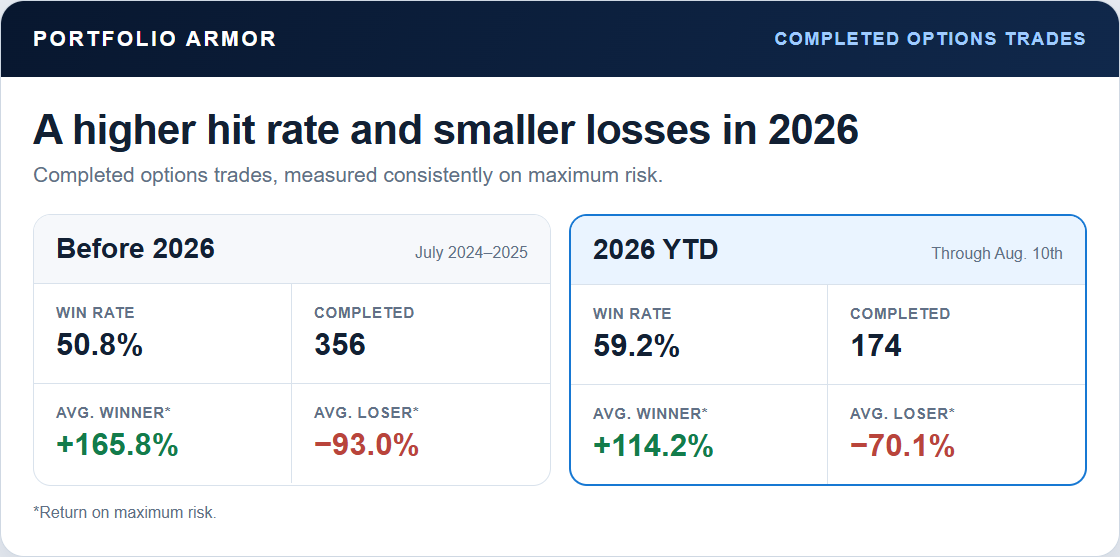
Compared with our completed-trade record from July 2024 through 2025, our win rate has risen from 50.8% to 59.2%, while our average loss has narrowed from 93.0% to 70.1% of maximum risk. Our average winner has moderated from 165.8% to 114.2%.
That last comparison needs context. We began using our standard and hybrid 4-leg combos last summer. The bullish put spreads in those structures add defined downside risk, increasing the maximum-risk denominator relative to many of our earlier trades. Part of the decline in average winning return on maximum risk may therefore reflect a change in our structure mix rather than weaker upside results. The cleaner improvements are the higher win rate and the smaller average loss.
Why So Many Trades In the First Half Of This Year
When you’re winning about 59% of your trades, making about 114% of maximum risk when you’re right, and losing about 70% when you’re wrong, you have a real edge—and when you have a real edge, you want as many at-bats as you can get. That was one reason we placed so many trades during the first half of this year. Another was that we wanted exposure across the AI stack. We built that exposure.
But along the way, we lost some of you. Some subscribers felt overwhelmed by the number of trades. Some found the structures confusing. Some weren’t sure how to place them at their brokerages. We listened.
Making the Alerts Easier to Use
Today’s alert is free so everyone can see the new format. Each trade now appears in a cleaner card that separates the idea, the complete order, our price limit, and the trade’s risk. We have also added Portfolio Armor Trade Alerts Explained so newer readers can learn how to enter and follow the structures without deciphering a wall of options notation.
Our goal is to make more money when we’re right and lose less when we’re wrong. Several recent improvements should help:
Monthly options-expiration reviews now surface positions that need action before expiration week.
A structured exit process for uncapped options changes with time to expiration and the presence or absence of a meaningful catalyst, as detailed in last week’s Exits post.
The 50-day EMA gate now works alongside our RSI and Chartmill screens to keep us from entering bullish trades while a stock is still in a broken intermediate trend.
An AI position watchdog flags positions that need management and automatically adds fresh technical alerts after profitable full exits, so we can reenter prior winners when they qualify again.
Unless an option expiring within 14 days needs adjustment, we will batch trade adjustments into one weekly chat thread, which will also be sent by email, rather than interrupting you with routine updates throughout the week.
Accountability
Starting with our weekly Exits posts, we’ll keep a running year-to-date tracker of our completed options trades: win rate, average winning return, average losing return, and total completed trades, all measured on maximum risk.
That tracker supplements our public trade ledger, where you can see every exited trade we’ve recorded since July 2024, win or lose.
Today’s Trade Alert
Power Behind the AI Buildout
This week’s earnings reinforced one of our core AI-stack themes: all of that compute needs more power and electrical infrastructure.
Babcock & Wilcox Enterprises (BW 0.00%↑), one of our current positions, reported that second-quarter revenue rose 130% to $319.7 million, adjusted EBITDA increased 57% to $21.8 million, and backlog reached $2.6 billion. The company also raised its 2026 adjusted-EBITDA target.
The next day, Hyliion Holdings (HYLN 0.00%↑), another current position that we reentered last Friday, reported $4.9 million of second-quarter revenue—more than three times its year-earlier level—and raised its full-year revenue outlook to $15 million. Its update included a $41.7 million U.S. Navy contract and growing data-center interest in its modular KARNO power technology. The shares jumped after hours.
We already have substantial AI-stack exposure, so we’re no longer trying to add every beneficiary at once. Today’s alert shows the more selective approach: one trade adds to the power-and-electrification theme after fresh operating confirmation; the other revisits a biotech idea only after a new technical trigger.
Today’s Market Watchers Trade
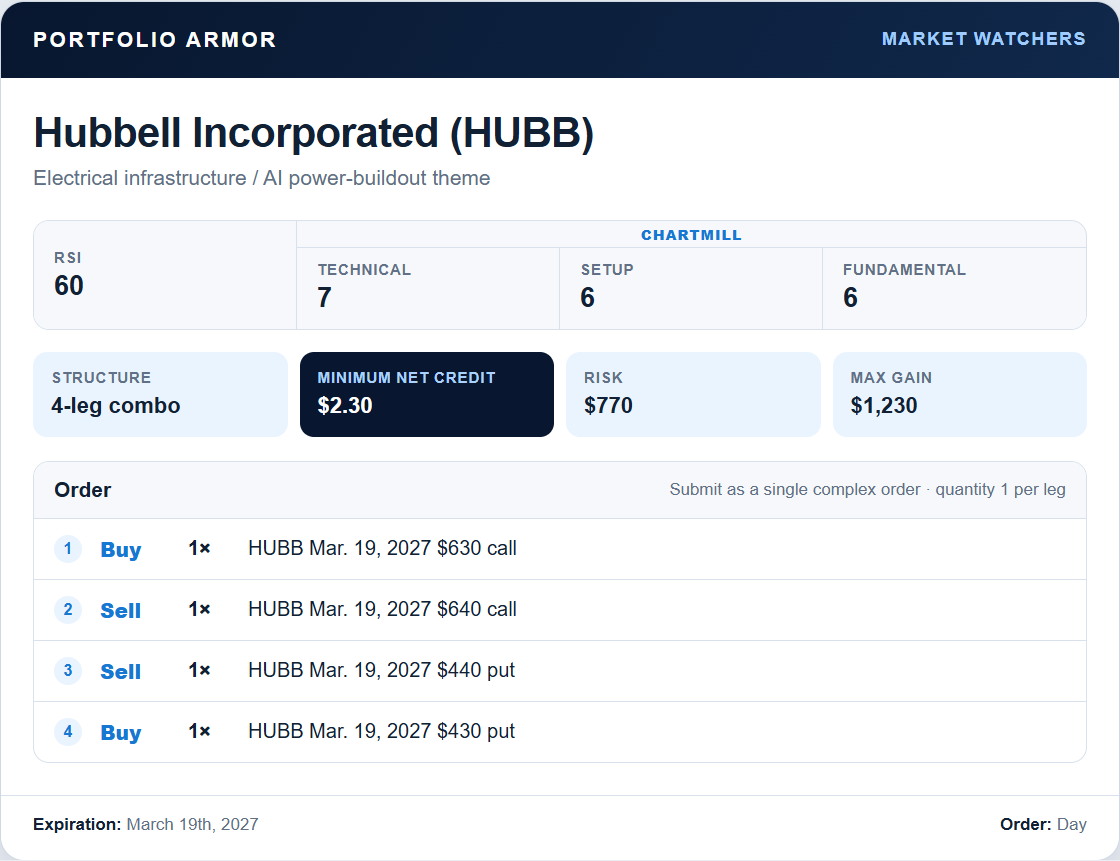
This trade hasn’t filled yet.
Hubbell Incorporated (HUBB 0.00%↑) makes the electrical and utility equipment that helps move and manage power. Its recent results strengthened the case that utility investment, electrification, and data-center demand can support growth beyond the market’s most obvious AI names.
We tried a shorter-dated HUBB call calendar in an April alert and lost 99% of maximum risk on it. The stock and the operating evidence now present a different setup: this March 2027 combo uses a $10-wide call spread financed by a $10-wide put spread, with all four legs sharing the same expiration.
The complete structure was worth a $2.19 credit under Black-Scholes, $2.23 under Bjerksund-Stensland, and $2.25 under a Cox-Ross-Rubinstein binomial model. At a minimum net credit of $2.30, the max gain on 1 contract is $1,230, and the max loss is $770.
Today’s Multibaggers Trade
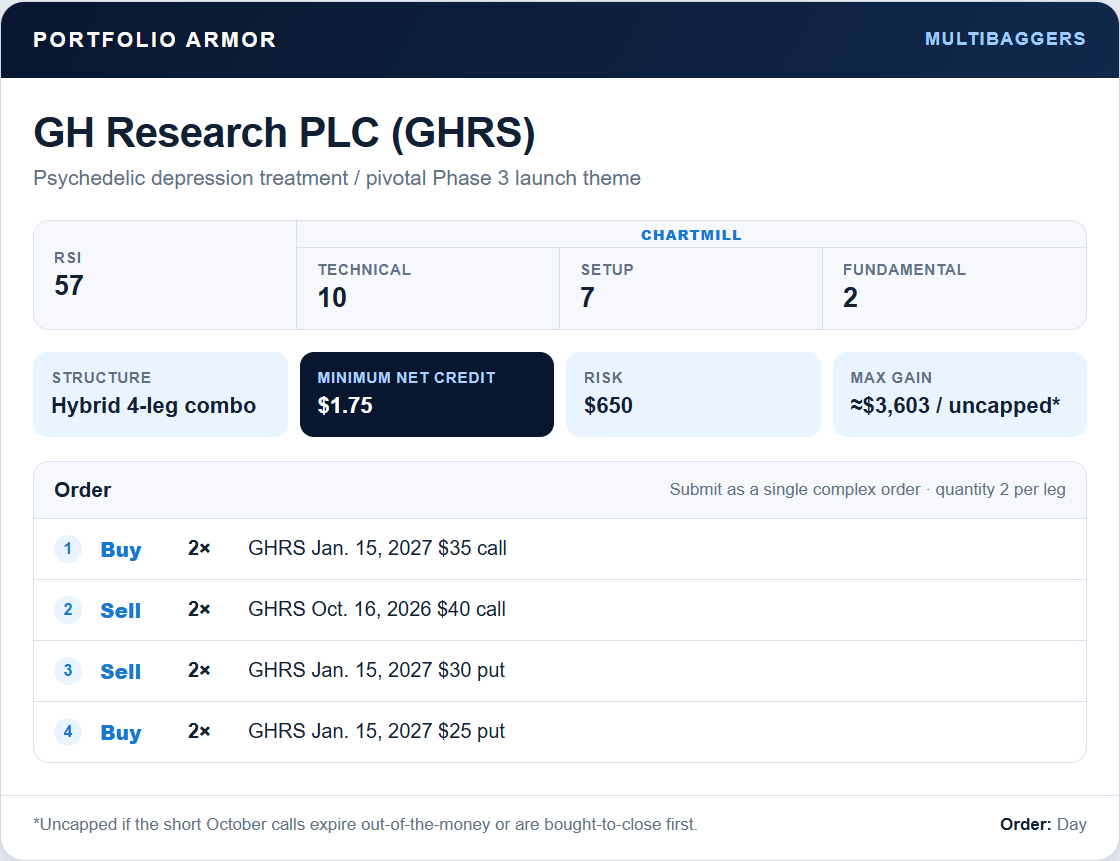
This trade hasn’t filled yet.
GH Research PLC (GHRS 0.00%↑) is developing GH001, an inhaled formulation of mebufotenin for treatment-resistant depression. Its Phase 2b trial met its primary endpoint, the company has selected doses for a global pivotal program, and it continues to target Phase 3 initiation in late 2026.
We tried to enter GHRS last month, but that order didn’t fill. A fresh Trend & Consolidation signal has now given us another technical green light. This version raises the put spread to the January 2027 $30–$25 strikes, improving the financing while retaining upside through the January $35 calls. January is the furthest listed expiration; it should cover the planned Phase 3 initiation, though not the eventual trial readout.
The complete structure was worth a $1.67 credit under Black-Scholes, $1.69 under Bjerksund-Stensland, and $1.70 under a Cox-Ross-Rubinstein binomial model. At a minimum net credit of $1.75, the max gain on 2 contracts is about $3,603 if the short October calls expire in-the-money (uncapped if they expire out-of-the-money or are bought-to-close before then), and the max loss is $650.
Unless otherwise indicated, all trades are day orders and will be canceled at the end of the day if they don’t fill.
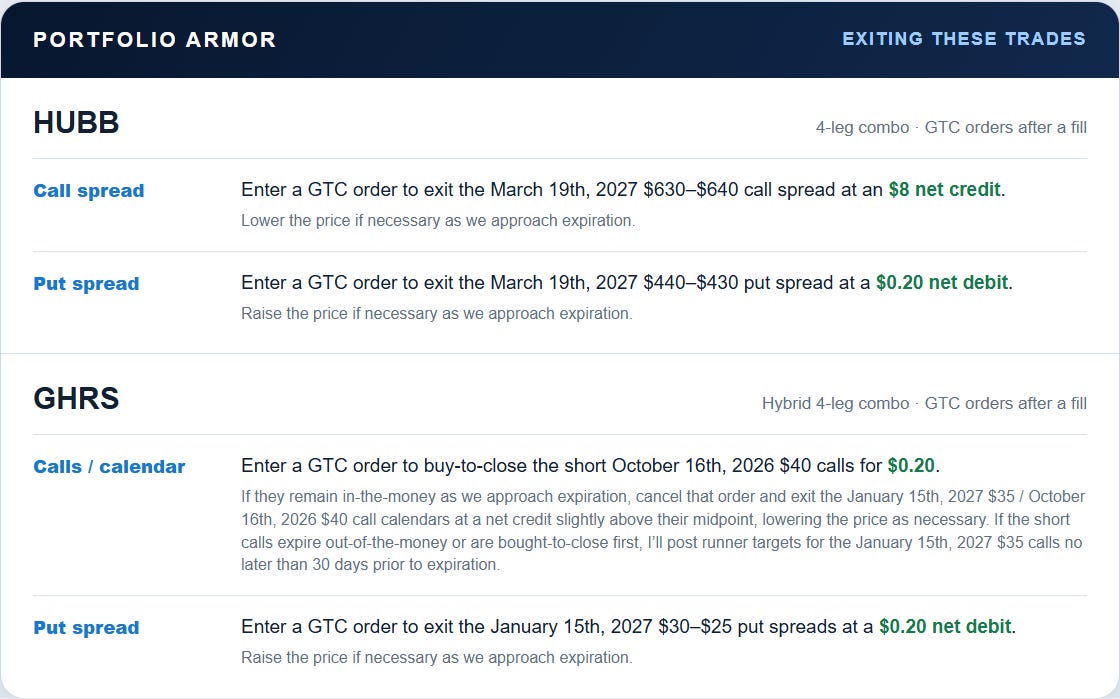
Exiting These Trades
My plan:
THANK YOU!🙏🏼