



A Lack Of Situational Awareness
On Thursday, Axios reported that Situational Awareness had sold its entire public-equity portfolio to Citadel. The news came one day after the Financial Times reported that the fund had sought fresh capital following heavy losses in the rout in AI stocks.
Former OpenAI researcher Leopold Aschenbrenner founded Situational Awareness after publishing his influential 2024 essay series of the same name, which argued that rapid AI advances could produce artificial general intelligence before the decade’s end. Backed by Stripe’s Collison brothers and AI investors Nat Friedman and Daniel Gross, the fund reportedly grew to about $20 billion.
The irony in the name wasn’t lost on observers: a fund called Situational Awareness appears to have had a blind spot about its own leverage, liquidity, and crowded positioning. Aschenbrenner may still be right about AI’s trajectory, but a sound long-term thesis couldn’t prevent short-term financing pressure from dictating the exit.
Its latest public filing offers a snapshot. As of March 31st, its two largest disclosed common-stock positions were Bloom Energy, worth $878.7 million, and SanDisk, worth $724.4 million; it also disclosed call positions in both. A quarterly SEC filing can’t tell us what the fund still owned when it sold its equity book.
Both companies appeared in our June 5th hedged portfolios, making the difference in risk architecture especially instructive.
The Same Stocks, Hedged
The Hedged Portfolio Method is, to oversimplify, a hedged momentum strategy. Portfolio Armor starts with its current top names—the securities it estimates will generate the highest returns over the next six months, net of hedging cost. The investor chooses a “threshold,” the largest decline he’s willing to risk over that period, and our system builds the portfolio.
Because every security is hedged, the portfolio can concentrate in the names with the highest expected returns instead of diluting them through broad diversification. When one sector dominates the rankings, that lets us participate in more of its upside while strictly limiting the downside. On June 5th, at the start of the recent momentum massacre, our system created such a portfolio for an investor with $3 million who was unwilling to risk a drawdown of more than 20% over the next six months.
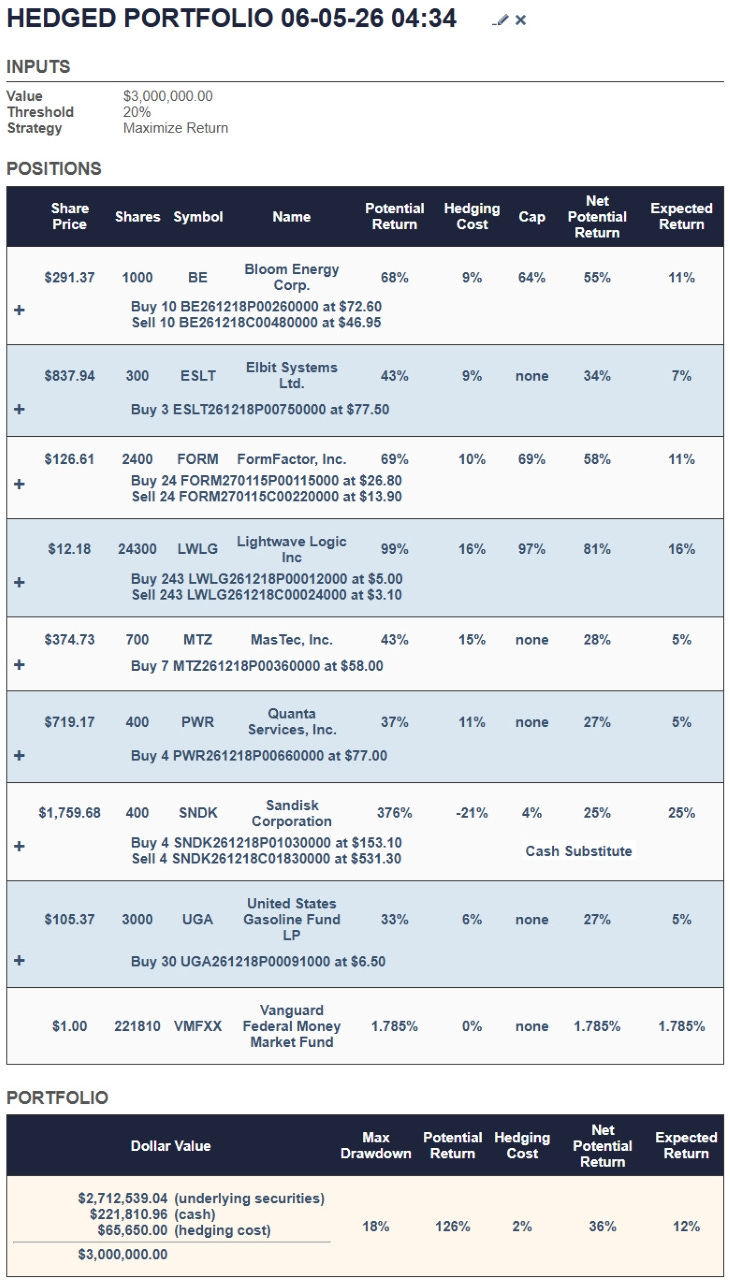
SanDisk (SNDK 0.00%↑) was one of the leading memory and storage names in the AI stack. It had been the Russell 1000’s strongest stock during the first half of 2026, rising as much as 858%, before leading the retreat among the index’s 25 biggest first-half winners.
Bloom Energy (BE 0.00%↑) was another marquee name among investors betting on the AI buildout, because data centers need enormous quantities of reliable power. Together, Bloom and SanDisk represented nearly $1 million of the portfolio’s $3 million starting value.
By late July, calling the reversal a “correction” almost seemed inadequate. Goldman Sachs’s High-Beta Momentum basket was on pace for its worst month on record. In individual AI-stack names, it looked more like a momentum massacre.


Putting The Hedge To The Test
Could investors have owned a group of momentum stocks caught in this historic unwind without getting blown up?
The June 5th portfolio gives us a real-time answer.
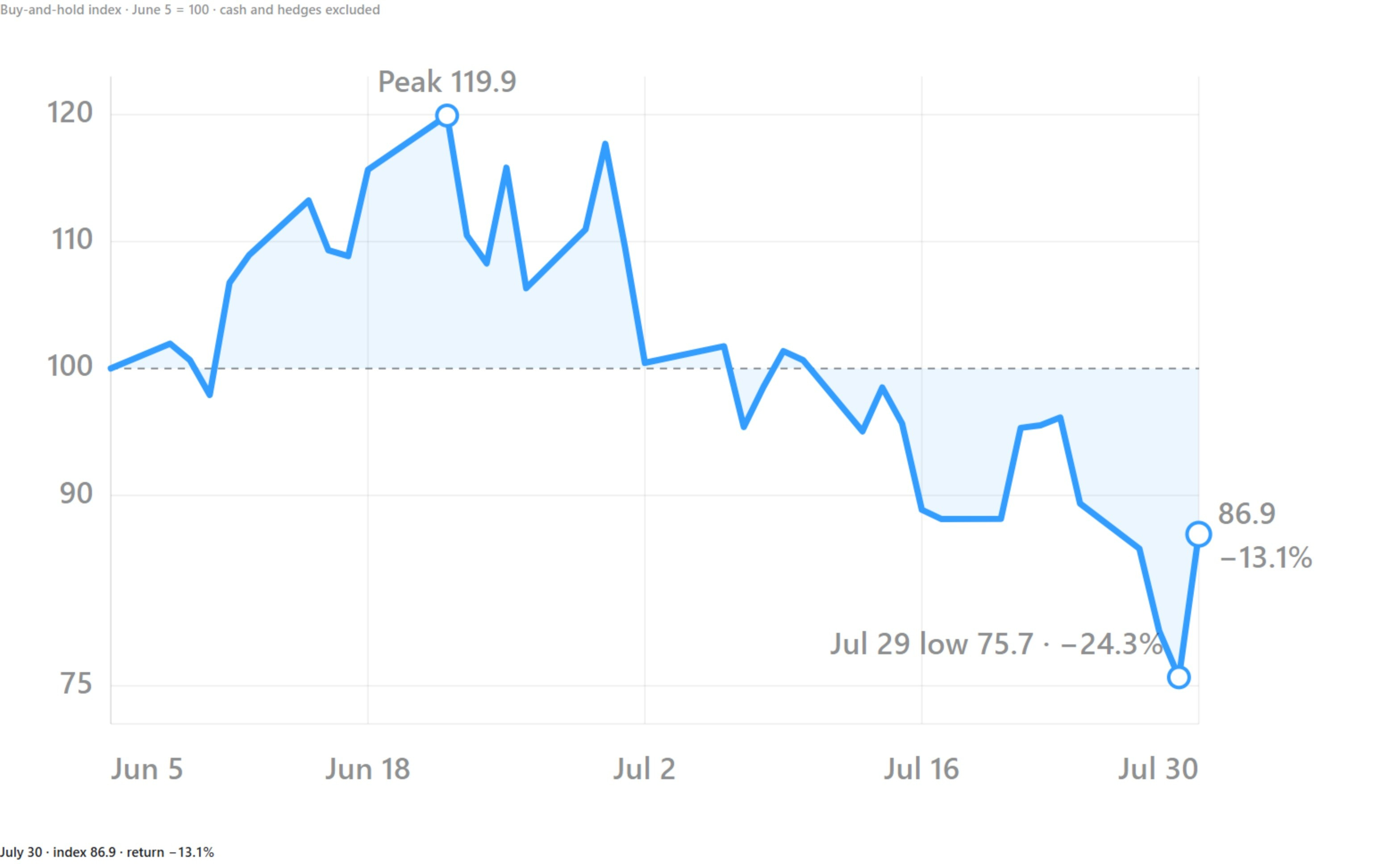
As of Wednesday’s close, the portfolio’s securities would have been down 24.3% as an unhedged basket.
The hedged portfolio was down 9.38%.
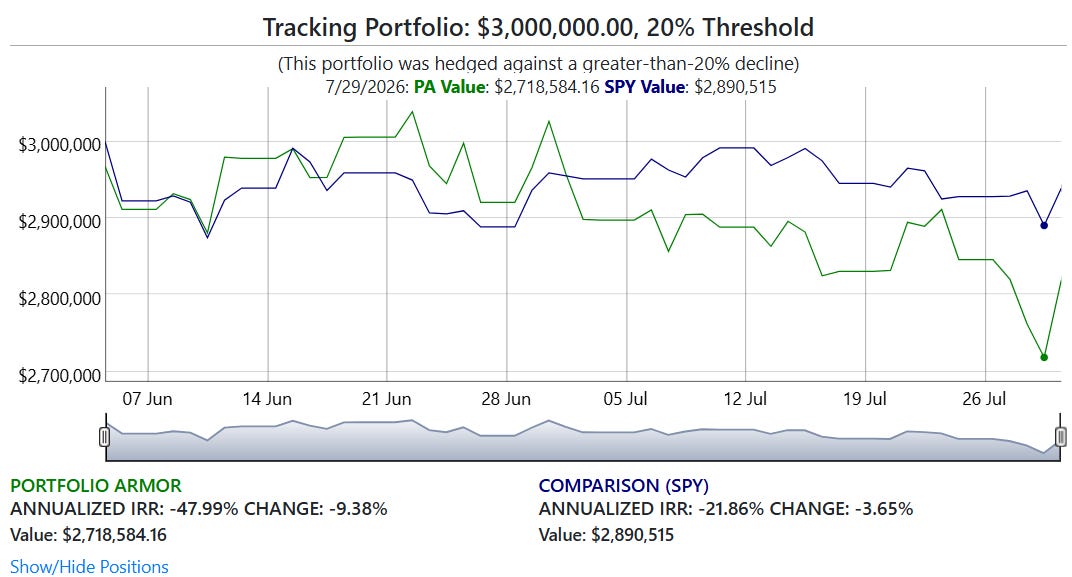
SPY was down 3.65%.
After Thursday’s rebound, the unhedged basket remained down 13.1%. The hedged portfolio was down 6.04%, while SPY was down 2.03%.
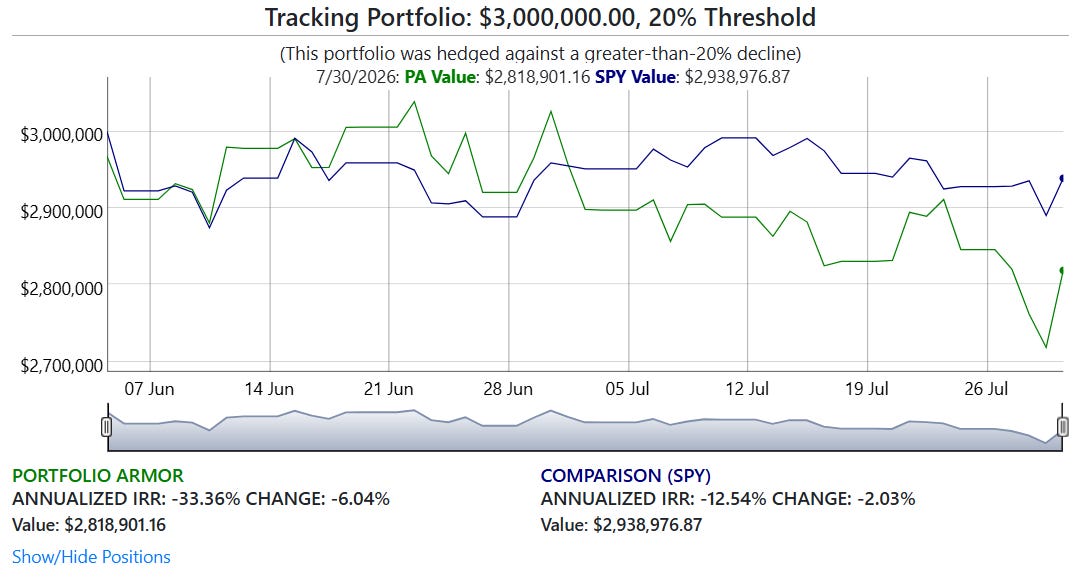
At Wednesday’s close, the hedges reduced the loss by approximately 14.9 percentage points relative to owning the same securities unhedged.
SPY performed better during this period, as we’d expect from a broad-market index. The hedged portfolio participated in the momentum selloff because it contained several of the stocks at its center, but it turned a potentially devastating drawdown into a survivable one.
Leverage likely magnified the massacre. Concentrated funds such as Situational Awareness, leveraged investors in Korea, and single-stock leveraged ETFs can all become forced or mechanical sellers as prices fall, turning an initial decline into a reflexive one. The precise exposures often become visible only after the unwind is underway.
The Hedged Portfolio Method sidesteps that opacity by defining each position’s risk in advance. We’ve explained the method in “Rough Seas, Smooth Ride” and “The Death Of Index Investing.”

The Longer Record
The June 5th snapshot shows the downside protection. The completed record shows that strictly limiting risk hasn’t required giving up the upside.
In June 2022, we updated the process we use to select securities. Since then, completed portfolios with higher risk tolerances have beaten SPY on average over their six-month lifespans:
Portfolios hedged against declines greater than 20%: 9.24%, versus 8.72% for SPY.
Portfolios hedged against declines greater than 25%: 10.81%, versus 8.82% for SPY.
Portfolios hedged against declines greater than 30%: 10.76%, versus 8.80% for SPY.
Portfolios hedged against declines greater than 40%: 11.48%, versus 8.76% for SPY.
The full record is available on our performance-tracking page.
An Intentionally Harsh Snapshot
We’re examining the June 5th portfolio before its six-month run is complete and stopping the clock during a historic momentum unwind—the harshest reasonable test of how the hedges behave when investors need them most.
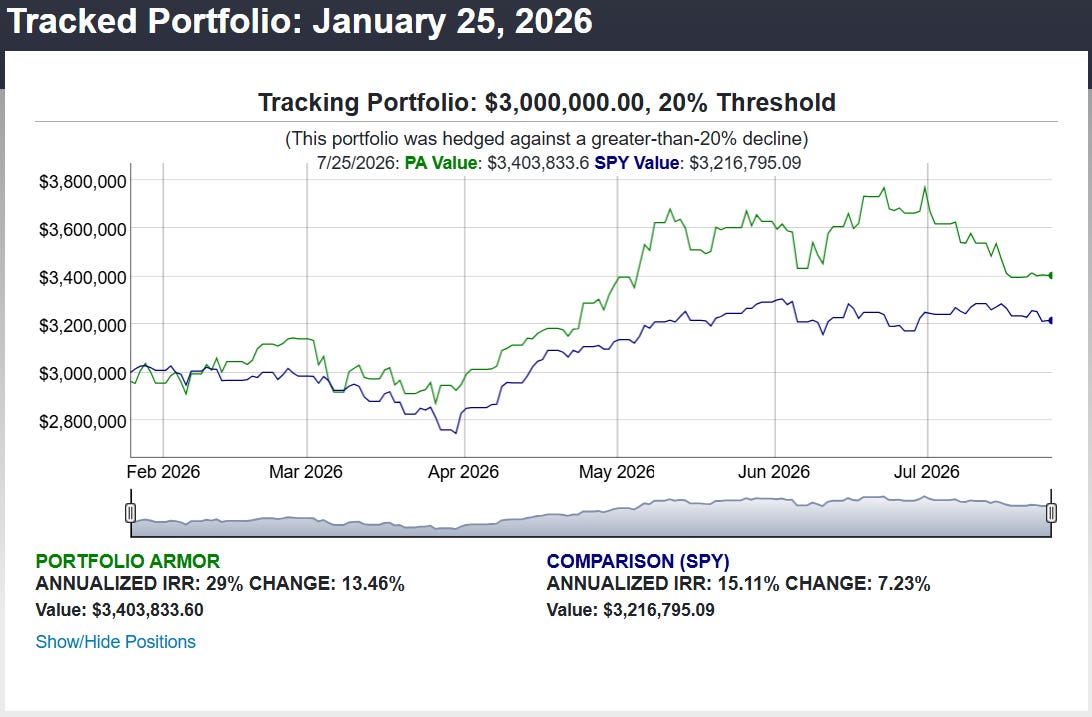
The most recent portfolio hedged against a greater-than-20% decline to complete its full six-month run offers a useful perspective. It began on January 25th and finished on July 24th, near the nadir of the momentum massacre. The portfolio gained 13.46%, versus 7.23% for SPY—nearly twice the market’s return.
Situational Awareness will likely ultimately be right about the AI buildout. We remain bullish on it too. The lesson of the massacre is to pair exposure to AI and momentum stocks with strict risk limits.
The Hedged Portfolio Method lets investors capture more of the upside when one sector dominates while strictly limiting the downside risk of each position to their chosen threshold. That keeps us in the game for the gains that follow.