



Stocks or Exchange Traded Products
None.
Options
Call calendar on Calumet (CLMT 0.00%↑). Entered at a net debit of $2.98 on 5/1/2026; exited the calendar at a net credit of $5.53 on 7/18/2026. Profit: 86% on premium outlay. Signal: PA Top Names.
Short calls on VivoPower (VIVO 0.00%↑). Sold-to-open the October 16th, 2026 $12.50 calls for $0.97 per contract as part of a 4-leg hybrid combo on 6/22/2026; bought-to-close those calls for $0.20 per contract on 7/20/2026. Profit: 79% on premium collected. Signal: Market Watchers.
Put spread on 10x Genomics (TXG 0.00%↑). Entered the November 20th, 2026 $20/$15 put spread at a net credit of $1.70 on 5/15/2026; exited the spread at a net debit of $0.20 on 7/22/2026. Profit: 88% on premium collected (21% of max risk). Signal: Multibaggers.
Short calls on Wolfspeed (WOLF 0.00%↑). Sold-to-open the September 18, 2026 $80 calls for $9.21 per contract as part of a 4-leg hybrid combo on 6/8/2026; bought-to-close those calls for $0.20 per contract on 7/24/2026. Profit: 98% on premium collected. Signal: Market Watchers.
4-leg hybrid combo on Frequency Electronics (FEIM 0.00%↑). Entered at a net debit of $2.70 on 2/11/2026; bought-to-close the May 15th, 2026 $65 call for $0.20 on 4/29/2026; exited the May 15th, 2026 $45/$40 put spread at a net debit of $0.20 on 5/5/2026; sold the August 21st, 2026 $60 call for $17.55 on 7/21/2026. Profit: 535% on net debit (188% of max risk). Signal: Market Watchers.
Comments
Stocks or Exchange Traded Products
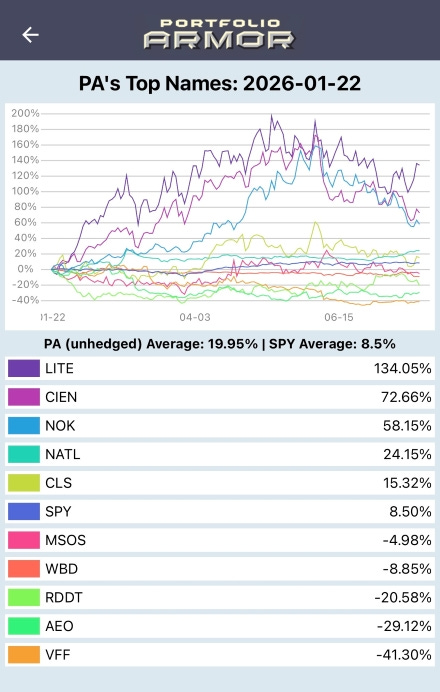
No exits this week. I’ve focused on options instead of our basic strategy, which involves buying stocks and ETFs. Nevertheless, the performance of our system’s top names over the next six months continues to be strong, as you can see below.
Options
Five Exits, Five Winners
As I noted in Thursday’s market commentary, investors were repricing AI capital spending, $100 oil, and a 10-year Treasury yield near 4.7%. Against that backdrop, all five options exits this week were profitable, ranging from 79% to 535% (our losing options exits tend to collect on OpEx days, because our winners tend to trigger our pre-set exit orders before expiration; you can see examples of those in July’s OpEx day Exits post).
Only one of the five—the Frequency Electronics hybrid—closed an entire position. The other four harvested gains from individual legs while preserving exposure we still wanted.
Letting Each Leg Do Its Job
We bought back VivoPower and Wolfspeed short calls for $0.20 after selling them for $0.97 and $9.21, respectively. Those 79% and 98% gains removed the upside caps from our original trade structures.
We exited the 10x Genomics put spread at $0.20 after opening it for a $1.70 credit, locking in 88% of the premium while leaving the November $25 call open. Calumet’s calendar nearly doubled, returning 86% on premium outlay.
FEIM’s Full Arc
Frequency Electronics shows the full hybrid arc. We entered for a $2.70 net debit in February. We later paid $0.20 to remove the short May $65 call and $0.20 to exit the May $45/$40 put spread. This week, we sold the August $60 call for $17.55. The completed trade earned 535% on net debit and 188% on max risk.
The short call and put spread financed and defined the trade at entry. Closing them cheaply let the long call keep compounding through FEIM’s rally.
This wasn’t the first time we’ve traded FEIM; before it had options traded on it, we bought the shares last year:
Frequency Electronics (FEIM -1.22%↓): Bought at $20.60 on 7/14/2025; sold at $38.00 on 12/12/2025. Profit: 84%.
Orders Before Headlines
The week’s debate—oil supply risk, higher yields, and whether AI spending will earn an adequate return—remains unresolved. Standing orders handled the parts we could control: harvesting short premium near its floor, removing caps when they became cheap, and selling long options or calendars when they reached attractive prices.
Five exits, five winners. The larger lesson is the sequence: define risk at entry, let the financing legs work, and give the remaining upside time to develop.
FEIM was a good trade for us. The company is up 53% this year and may someday become a good investment, not just a trade. Earnings in September. Beta of 2.4. Will you please keep this name on your watchlist? Thanks.