



A Hypersonic Message
Russia’s Oreshnik strike on the Lvov State Aviation Repair Plant last week looked like something out of a sci-fi movie: a string of multiple independently targetable reentry vehicles (MIRVs) from a hypersonic intermediate-range ballistic missile, streaking in at roughly Mach 10 and slamming into the plant near the Polish border. Russian officials said they used inert warheads—kinetic energy alone did the work.


Moscow framed the strike as a reply to a Ukrainian drone attack on the residence where Vladimir Putin had been staying in late December. But it was also a message to everyone watching: Russia can now hit hardened, high-value targets across Europe with a new class of intermediate-range missile.
If you’ve seen the footage, the most unnerving thing isn’t the explosion at the end; it’s the sense that you don’t get a lot of warning when something like that is inbound.
From “Super-Soldiers” To Unplugged Air Defense
Contrast that with how the U.S. has looked over the last couple of weeks.
First, there was the Venezuela raid, where U.S. special operations forces snatched Nicolás Maduro in a nighttime operation that left his security forces stunned. The mission—Operation Southern Spear—was ruthlessly efficient and instantly mythologized: anonymous accounts of “super-soldiers,” impossible tech, and near-magical dominance started ricocheting around social media and cable news.
Then came the Russian-flagged tanker. The U.S. Coast Guard boarded and seized the Marinera (formerly Bella 1) in the North Atlantic, and early coverage implied this happened right “under the noses” of Russian naval escorts. American media huffed about submarines and surface ships shadowing the tanker; the boarding video shows no such thing.
And just to add another layer, The New York Times recently reported—echoed by OSINT analysts like Rob Lee—that some of Russia’s much-touted air defense gear in Venezuela didn’t fail because of exotic U.S. jamming, but because it was never turned on in the first place. Not exactly the stuff of Hollywood narratives.


The common thread isn’t that the U.S. isn’t capable. It clearly is. The problem is what happens when impressive tactical wins get wrapped in a layer of self-congratulatory myth: people start to believe the U.S. is unstoppable and near-peer adversaries are hopelessly outclassed.
That’s a dangerous mindset to trade with—and an even more dangerous one to make policy with.
The “Vacuum Tube” That Wasn’t
Which brings us back to Oreshnik.
When wreckage photos from the Lvov strike started circulating, one component in particular went viral: a glass bulb, about half the size of an old-school radio tube, sitting in a cradle. Many Western observers immediately decided this proved Russian tech was “stuck in the 1950s.”
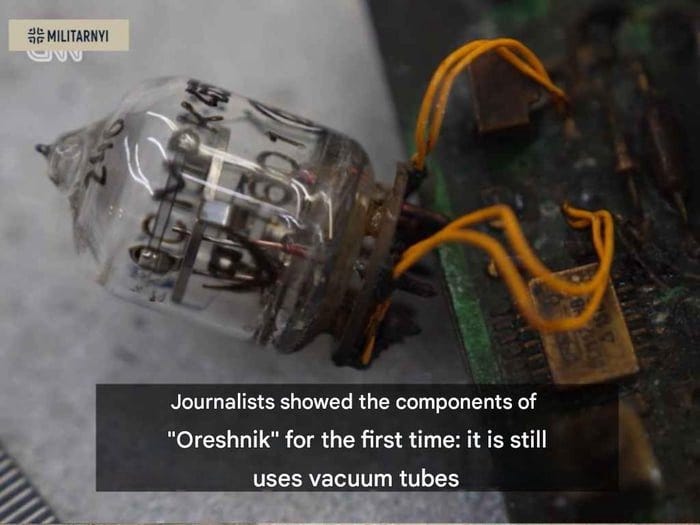
Except it wasn’t a vacuum tube.
A Russian-language breakdown identified it as a quartz frequency generator—a precision timing component—made by Morion, a St. Petersburg firm whose logo (a tuning fork) was visible on the metal “pill” inside the glass envelope. The glass wasn’t nostalgia; it was part of a vibration and temperature-stabilized package designed to survive the acceleration and thermal stress of a hypersonic flight profile.

In other words: this was not a joke. It was Russia shipping high-grade timing hardware in a deliberately old-fashioned, very robust container.
America’s Own Hypersonic Scramble
On the U.S. side, there’s a startup now openly pitching its own hypersonic system as an answer to Oreshnik and its cousins.


The company is talking about closing the “missile gap” with Russia using a mix of new propulsion, guidance, and materials—but however fancy the design, you don’t get hypersonic precision without very good clocks. Somewhere in that kill chain, you need rock-solid frequency references.
And A Niche American Precision Timing Play
The U.S. doesn’t buy those from St Petersburg.
It buys them from a handful of niche suppliers—including one small American company that specializes in high-stability quartz and related timing products for aerospace and defense. We bought shares in that name last summer at $20 and change and exited around $38 last month as the story started to get noticed. The stock is now pushing $60—and only now does it finally have listed options.
That opens the door to do something more interesting than just chase the stock higher.
Instead of levering up at sixty bucks and hoping momentum keeps going, we’ve designed a hybrid options structure that assumes a perfectly normal thing happens in a hot story stock: a pullback.
Using a Fibonacci retracement framework and some volatility work, we asked: “What if this drifts back ~10–15% on no news before its next earnings (in March)?” Then we used Black-Scholes with current implied vols to estimate a fair price for our combo at that lower spot price. That fair value—not today’s—is where we’re putting our limit buy order.
If the stock never pulls back and we don’t get filled, that’s fine. We already rode one round-trip in the commons. If it does air-pocket into that higher Fib zone, we get a second shot at the story with defined risk.
One More Asymmetric Bet: ABVX
We’re pairing that timing-hardware trade with another asymmetric idea: a follow-on options bet on an eventual buyout of Abivax (ABVX 0.00%↑).
Yesterday, we laid out why ABVX has attracted serious M&A chatter—including French reporting about Eli Lilly preparing a bid in the ~$200 range.

That structure didn’t fill yesterday—but ABVX reappeared in Portfolio Armor’s Top Names list last night, and the fundamental thesis hasn’t changed. So today we’ve teed up a new ABVX combo:
It’s still explicitly a buyout-driven, “binary-ish” thesis,
But with a longer-dated call leg so we’re not dead in the water if the deal slips into the post-maintenance-data window,
And with a cheap put floor underneath, so we’re not just lighting premium on fire if the stock wobbles around on more rumor headlines.
If the buyout lands sooner—including this week—the structure should still participate meaningfully in the upside. If the conference passes without a deal, but the bigger data and Crohn’s optionality keep the bull case intact, we still have time.
In the paid section below, I’ll walk through:
The exact options structure we’re using on the U.S. timing company tied to the hypersonic race, and
The new ABVX structure that replaces yesterday’s unfilled idea.
In both cases, the goal is the same: take the world as it actually is—messy, contested, and technologically competitive—and use options to build asymmetric payoffs with clearly defined downside, rather than trade on comforting myths about anyone’s invincibility.
Today’s Market Watchers Trade
Defense / precision timing theme
The stock is Frequency Electronics (FEIM 0.00%↑), and our trade is a hybrid combo consisting of these four legs:
Buying the $60 strike call expiring on August 21st, 2026,
Selling the $65 strike call expiring on May 15th, 2026,
Selling the $45 strike put expiring on May 15th, 2026, and
Buying the $40 strike put expiring on May 15th, 2026,
For a max net debit of $2.70. The max gain on 1 contract is $1,263 if the May $65 call expires in the money, and uncapped if it expires out of the money, the max loss is $770, and the break-even is with FEIM at $43.58. This trade hasn’t filled yet. I am keeping it open until it fills or March 6th’s close, whichever comes first. This trade filled at $2.70 on 2/11/2026.
Today’s Top Names Trade
Biotech / GLP-1 competitive threat theme
The stock is ABIVAX Société Anonyme (ABVX 0.00%↑), and our trade is a hybrid combo consisting of these four legs:
Buying the $185 strike call expiring on June 18th, 2026,
Selling the $220 strike call expiring on June 18th, 2026,
Selling the $110 strike put expiring on February 27th, 2026, and
Buying the $105 strike put expiring on February 27th, 2026,
For a max net debit of $3.10. The max gain on 1 contract is $3,146, the max loss is $810, and the break-even is with ABVX at $109.89. This trade hasn’t filled yet. This is a day order. This trade never filled.
Exiting These Trades
My plan (assuming these trades fill):
FEIM
Calls / calendar (legs 1 & 2): Open a GTC limit order to buy back the May 2026 $65 call at $0.20, and raise that price if necessary as we approach expiration. If the May $65 call expires in the money, I’ll sell the August 2026 $60 calls and use part of the proceeds to buy-to-close the May 2026 $65 calls; if it expires out of the money, I’ll post a GTC limit sell price for the August 2026 $60 calls in the comments here and via chat/email.
Put spread (legs 3 & 4): Open a GTC limit order to exit the May 2026 $45/$40 put spread at a net debit of $0.20, and raise that price if necessary as we approach expiration.
ABVX
Call spread (legs 1 & 2): Open a GTC limit order to sell the June 2026 $185/$220 call spread at $28. If a buyout is announced above $220, I may raise my limit to $34; in any case, I will lower that limit, if necessary, as we approach expiration.
Put spread (legs 3 & 4): Open a GTC limit order to exit the February 2026 $110/$105 put spread at a net debit of $0.20, and raise that price if necessary as we approach expiration.
Out of the FEIM short call at $0.20 yesterday.
What do you have in mind for a closing price for the FEIM August long call?