



The Edge Starts With The Stocks
Portfolio Armor’s Top Names have been a persistent source of outperformance. Across all 171 completed weekly cohorts selected from December 29th, 2022 through April 2nd, 2026, they averaged 17.98% over six months, versus 9.89% for SPY. These are average unhedged stock returns across overlapping six-month periods.
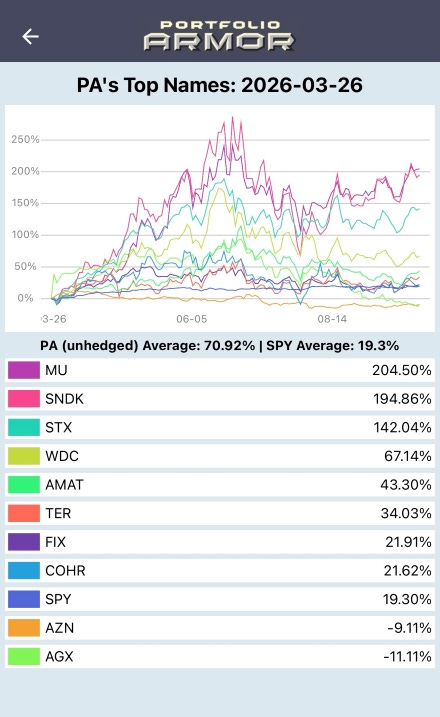
Our March 26th, 2026 cohort returned an average of 70.92% over its six-month tracking period, versus 19.30% for SPY. The chart below shows each member’s result.
Two Ways To Use The Edge
In The Edge Starts With The Stocks, we outlined two ways to use that stock-selection edge: buy shares or place options trades on those names. For our options trades, we apply additional setup checks and choose the structure, entry price and management plan.

One member of that March 26th cohort became an options trade that returned 114% on the capital originally at risk in 68 days. Here’s how it worked on the order ticket.
We opened the Western Digital (WDC 0.00%↑) position on March 27th, 2026. It combined a September call spread with a May put spread, with one contract on each of four legs. The historical entry card shows the complete four-leg structure and the terms we published before the order filled: a $1.45 maximum net debit, $839 maximum gain and $645 maximum loss.

This trade filled at a $0.97 net debit.
Set One Net Price
The ticket below is a reconstruction of our closed March 27th, 2026 trade. It groups the four actions, expiration dates and strikes in one custom multi-leg order, with one contract on each leg: a 1:1:1:1 ratio. The layout shows a net-debit limit order good for the day.

The original alert set a maximum net debit of $1.45, slightly below our estimate of the structure’s fair value. We tried to get a better price first, and the order filled at $0.97.

With the 100-share option multiplier, our fill meant a $97 opening outlay before fees. Check the filled order’s net price and all four quantities before entering its closing orders.
Know The Dollars At Risk
The May put spread was $5 wide, representing $500 for one contract on each leg. Add the $97 opening debit and the original maximum risk was $597, before fees, with both spreads kept intact. At the alert’s $1.45 maximum debit, the corresponding figure was $645.
Before placing a comparable trade, confirm that your account supports the complete strategy and review the broker’s buying-power requirements. Short options can be assigned before expiration, creating a stock position that requires attention.
Enter The Exit Plan
The original alert specified two separate good-til-canceled closing orders. Each closed a complete spread:
For the September calls: sell to close one $340 call and buy to close one $350 call, together, for an $8.00 net credit.
For the May puts: buy to close one $245 put and sell to close one $240 put, together, for a $0.20 net debit.
Those were the initial targets. The alert also called for adjusting them if necessary as expiration approached. An unfilled closing order leaves the position open, so following the fills and subsequent management updates is part of the process.
What The Process Produced
We closed the puts for $0.20 on April 14th and the calls for $8.00 on June 3rd. The exit card shows the result: $683 gross profit, or 114% on original maximum risk, in 68 calendar days, before fees.

We record all trade exits, win or lose, in our weekly Exits posts and public spreadsheet. This example shows the practical work behind an alert: enter the complete structure at an acceptable net price, establish its exits, and follow the position through its closing fills.
We’ll keep looking for attractive setups and publishing the entry and management plans that turn them into actionable trades.
Paid subscribers receive our trade alerts before the market opens, with entry limits and exit plans. We follow up with fill updates and subsequent management. Subscribe below to get our next setup and its execution plan.
For a public sample alert and our execution guide, see Start Here:
