


A Memorable Correction For Memory Stocks
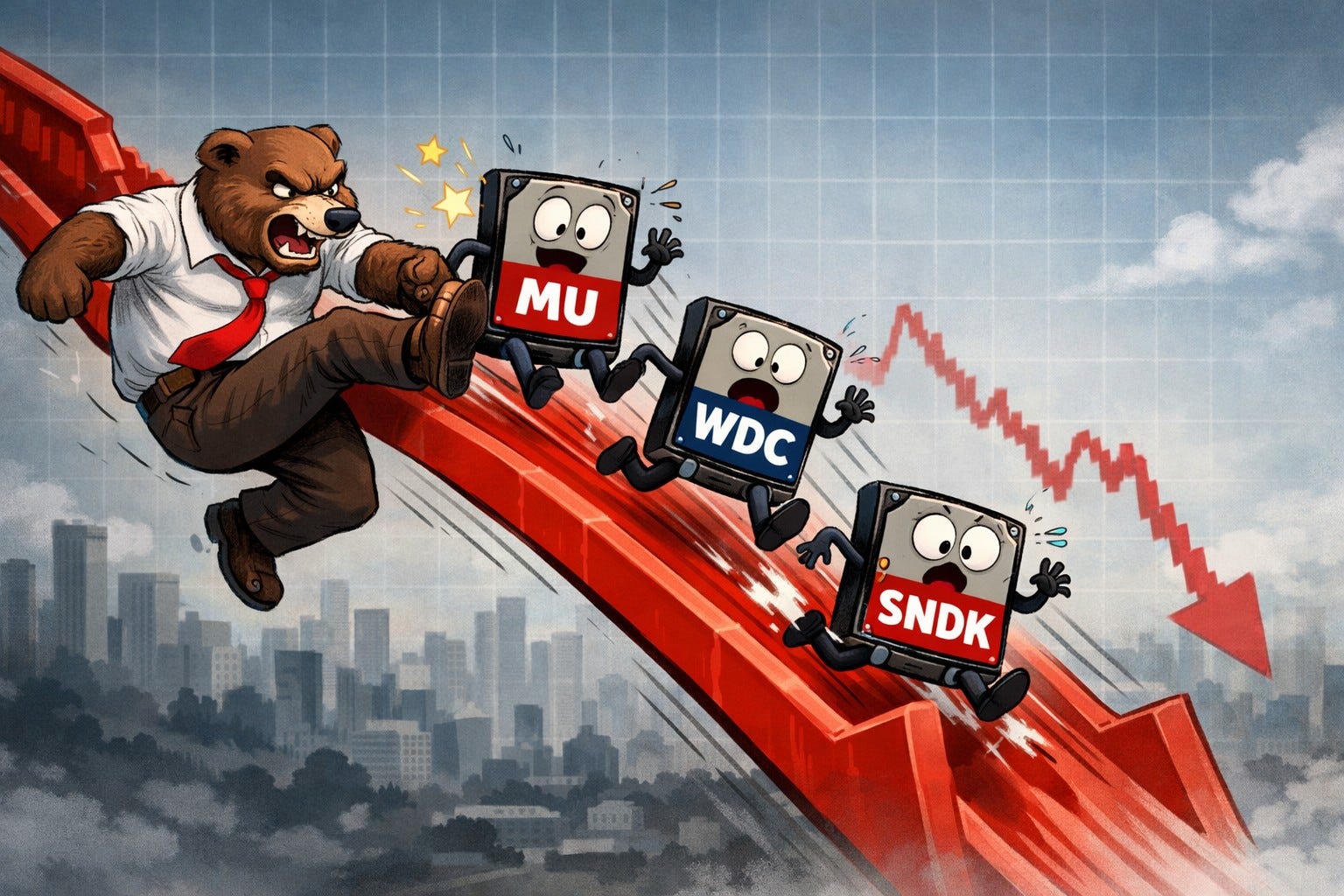
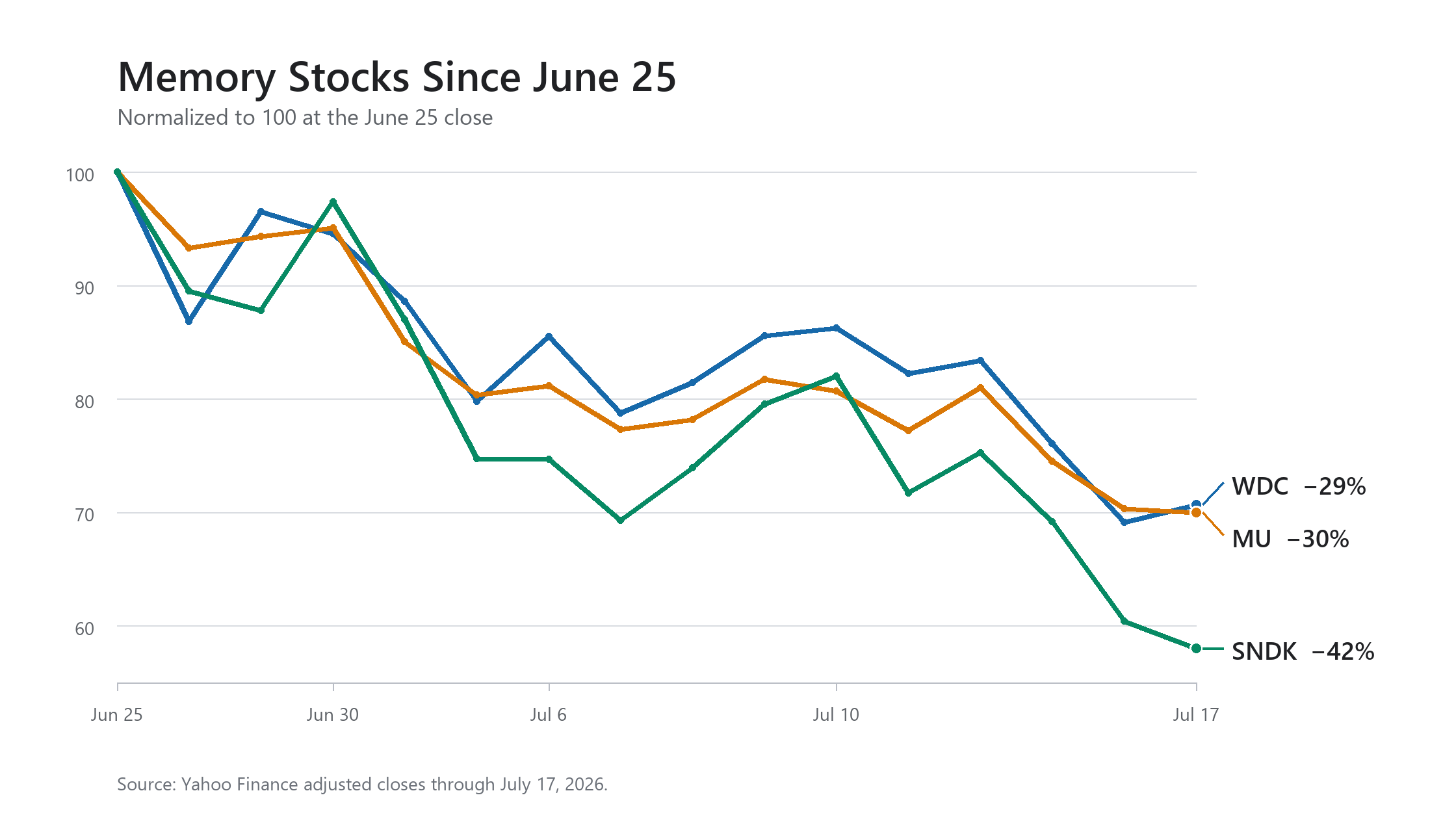
Memory and storage stocks have gotten hammered since June 25. Through Friday’s close, Western Digital (WDC) had fallen 29%, Micron (MU) 30%, and Sandisk (SNDK) 42%.
Keeping The Schadenfreude In Perspective
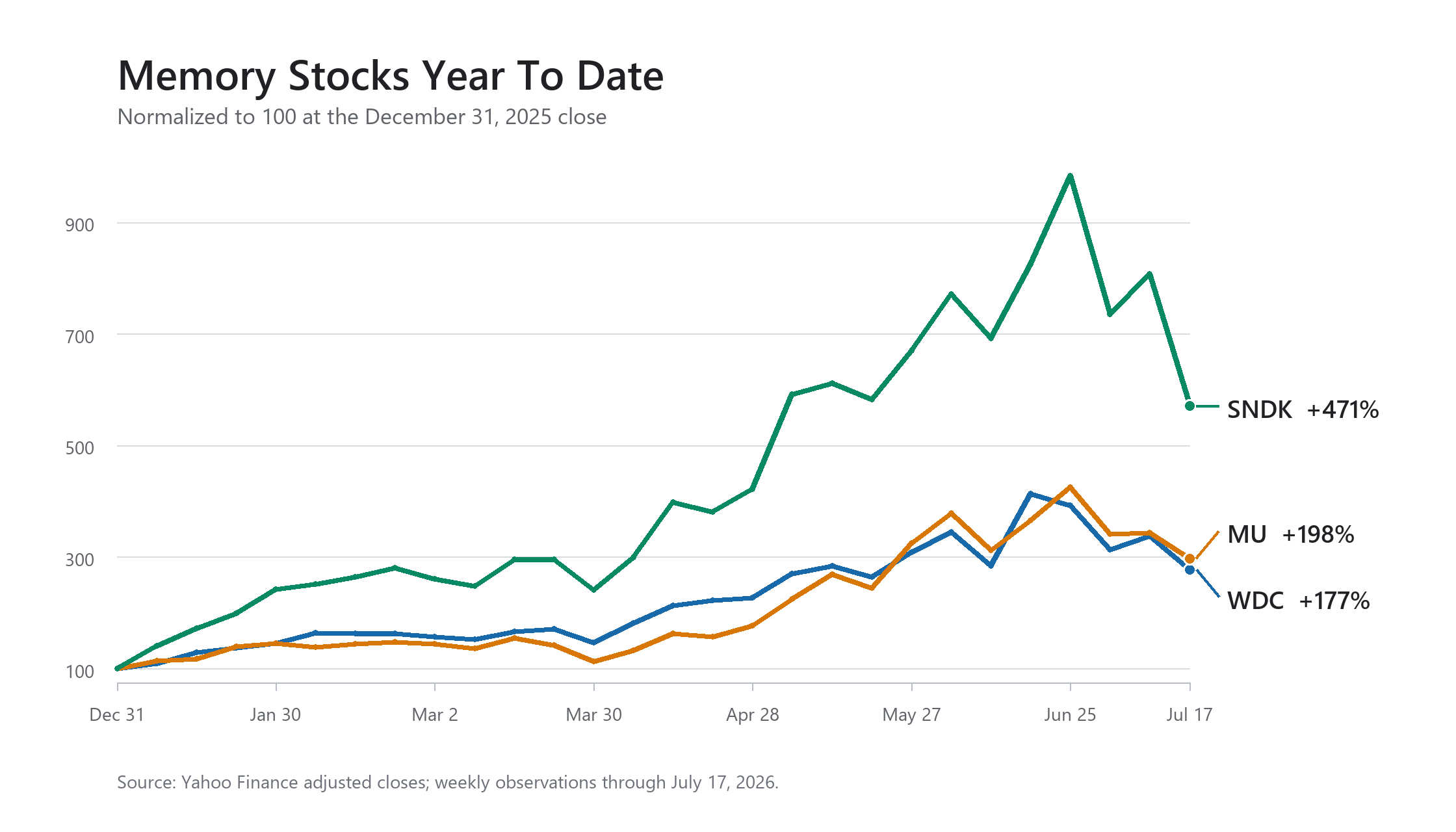
Finance X now has plenty of investors who missed the runup reveling in the reversal. The longer view puts that schadenfreude in perspective: as of Friday, WDC, MU and SNDK were still up 177%, 198% and 471% year to date, respectively.
This cycle is unfolding inside what may be the largest technological and economic transformation since the railroads—a new industrial revolution built around AI.
The smarter bears make two accurate points: memory is cyclical, and share prices tend to peak before earnings. Many have taken this correction as evidence that the cyclical share-price peaks are behind us. That conclusion turns on one question: How far away are peak earnings?
Evidence From Past Cycles
In 2018, Micron shares peaked in late May, three months before non-GAAP quarterly EPS reached a then-record $3.53 in the quarter ending on August 30th. In 2022, the shares peaked in mid-January, five months before non-GAAP EPS peaked at $2.59 in the quarter ended June 2nd; EPS fell to $1.45 the following quarter.
That history explains why a low trailing P/E can be a trap in a memory stock. If current earnings are the highest the company will produce for years, the stock can look cheapest immediately before the “E” collapses. Stock prices discount earnings months in advance, so the central task is to estimate the earnings peak and watch for evidence that it is moving closer.
Does This Look Like A Peak?
Micron guided to approximately $50 billion of revenue, an 86% gross margin and $31 of non-GAAP EPS for the August quarter. Analysts now expect $56.59 billion of revenue in the November quarter and $234.11 billion in fiscal 2027—81% growth from fiscal 2026. The fiscal 2027 normalized EPS estimate has risen to $150.77 from $114.59 in the past 30 days.
Management expects DRAM and NAND supply-demand conditions to remain tight beyond calendar 2027. The capacity timeline supports that forecast: first output from Micron’s first Idaho fab and meaningful shipments from its Tongluo expansion are slated for mid-2027, with its second Idaho fab following in late 2028.
Demand is unusually visible for a commodity cycle. Micron has signed multiyear take-or-pay agreements with binding volume commitments, and most include fixed prices or floors and ceilings; the floor economics should still produce gross margins well above any prior cycle’s quarterly peak. Industry data group World Semiconductor Trade Statistics (WSTS) expects the memory market to grow another 32% in 2027. Together, rising estimates, tight supply beyond 2027, delayed capacity and committed demand support an estimate that peak earnings remain at least 18 months away.
AI Demand Is Hitting Capacity Limits
After releasing Kimi K3, Moonshot AI said demand had pushed close to its capacity limits. It temporarily paused new subscriptions to protect existing users while it added capacity.

Alibaba Group (BABA), a major Moonshot investor, has provided Moonshot with cloud infrastructure. Alibaba Cloud’s external revenue grew 40% in the March quarter, while AI-related product revenue grew at a triple-digit rate for the eleventh consecutive quarter.
Together, Moonshot’s capacity constraint and Alibaba Cloud’s growth show cheaper, better AI driving enough usage to strain compute capacity—supporting continued demand for the memory and storage that power it.
Margins Are The Early-Warning System
Margins are one of the best ways to test our estimate that peak earnings are at least 18 months away. The cause of any decline will determine its significance: product-ramp costs, a less favorable mix or accelerated investment carry different implications from falling DRAM and NAND prices and weaker orders.
We would bring our peak-earnings estimate forward if we saw several of the following:
Gross-margin compression driven by lower DRAM or NAND prices.
Downward revisions to 12- to 24-month EPS estimates.
Slower revenue, bit-shipment or data-center demand guidance.
Faster-than-expected capacity ramps from Micron, Samsung, SK hynix or Chinese producers.
A material reduction in hyperscaler AI infrastructure spending.
Memory stocks repeatedly failing to respond to genuine beat-and-raise reports.
At an 86% guided gross margin, even a modest rollover ahead of expectations can pressure the stocks. We will use margins to update our earnings-peak estimate.
When We Plan To Re-Enter
Earlier this month, after Micron pulled back from its post-earnings spike, we re-entered it through a defined-risk options trade.

In hindsight, we were a little too early, but at the time, the coast looked clear. Micron appeared on our main ChartMill technical screen, the Trend & Consolidation Screen, which looks for companies that are in an uptrend, with share prices that have been consolidating, and are neither overbought nor oversold:
RSI (Relative Strength Index) between 40 and 60
Technical rating of 6 or higher
Setup rating (a measure of price consolidating) of 6 or higher
Micron on July 2nd had an RSI of 51, a technical rating of 10, and a setup rating of 6.
Our July 2nd Micron trade may still turn out to be profitable, but the subsequent correction ran materially deeper than we expected, prompting us to refine our re-entry process.
That refinement builds on two profitable earlier Micron trades:
4-leg combo on Micron Technology (MU 2.83%↑). Entered at a net debit of $2.62 on 3/3/2026; exited the put spread at a net debit of $0.20 on 4/8/2026; exited the call spread at a net credit of $16.00 on 5/5/2026. Profit: 504% (return on max risk: 173%). Signal: PA Top Names.
4-leg combo on Micron Technology (MU 6.20%↑): Entered at a net debit of $1.70 on 12/16/2025; exited the put spread at a net debit of $0.20 on 12/18/2025; exited the call spread at a net credit of $8.00 on 12/19/2025. Profit: 359% on premium outlay (88% on max risk). Signal: PA Top Names.
Disciplined structures and exits have helped us trade the theme profitably, while each result gives us data we can use to improve our entry timing.
We entered the two winning trades above when Micron appeared in Portfolio Armor’s Top Names. We entered our July 2nd trade when it appeared on our Trend & Consolidation Screen. We could wait for it to appear in our Top Names or that screen again, but if we do, we may miss much of the recovery from the bottom.
So we created a new screen to catch Micron and other profitable AI stack names earlier on their way back up: our AI Profitable Recovery Screen (We also have an AI Speculative Recovery Screen for currently unprofitable AI-adjacent names).
The AI Profitable Recovery Screen
These are the components of our AI Profitable Recovery Screen:
U.S. listing and listed options.
ChartMill Setup Rating of at least 5 (a 0-to-10 measure of entry and exit quality).
ChartMill Relative Strength (CRS) of at least 50 (performance versus the rest of the market).
A price above the 5-day moving average and a rising 200-day moving average.
A rising 14-day RSI between 30 and 50.
A ChartMill Health Rating of at least 5.
A next-fiscal-year revenue estimate that is unchanged or higher over the previous month.
Unlike our Trend & Consolidation Screen, this one doesn’t include an overall technical rating. That’s because a sharply corrected leader can rebound before rebuilding every part of its chart. The other requirements balance early timing with evidence of stabilization.
The screen complements the cycle analysis above. A memory stock must pass both tests: the evidence must support earnings growth well ahead, and the chart must show that the decline is losing force.
When a memory name triggers our recovery screen, we’ll reassess the earnings-peak evidence and the available option structures. If the thesis still holds and an attractive defined-risk trade is available, we’ll place new trades in beaten-down memory and other AI stack names, and share them in a new trade alert.