



A Rough Week For Tech So Far
Last week, markets received a geopolitical tailwind as the U.S.–Iran agreement lowered oil prices and eased fears of a prolonged disruption in the Strait of Hormuz.
This week, investors found something else to worry about.
Through Thursday’s close, the Nasdaq was down 4.4% for the week, versus a 1.9% decline for the S&P 500. The weakness was concentrated in growth and tech: the Dow and Russell 2000 were both positive for the week through Thursday, while the technology sector and semiconductor stocks were still down despite Thursday’s rebound.
The worst of the damage came Tuesday. The semiconductor index fell about 8%, the Nasdaq lost more than 2%, and nearly $1 trillion was erased from the Nasdaq’s market value that day.
The concerns weren’t new: stretched valuations, debt-funded AI spending, higher bond yields, a stronger dollar, and a Fed with less room to ease. But after the extraordinary run in AI-related stocks, investors were suddenly less willing to overlook them.
The selling continued into Wednesday, leaving Micron’s earnings report after the close as an important test of whether the fundamentals could still justify the enthusiasm.
Micron Passes The Test
Micron passed that test emphatically.
As we discussed in today’s trade alert, its results showed that the AI boom has legs.

Revenue and earnings surged, customer commitments strengthened, and management said it still had no line of sight to when memory supply would catch up with demand.
Micron soared Thursday, and the strength spread across memory and semiconductor stocks.
The broader market reaction was more complicated. The semiconductor index rallied, but the Nasdaq still finished lower as Apple, Nvidia, Microsoft, and Alphabet fell.
That divergence sums up the week so far. Investors haven’t abandoned the AI trade, but they’re becoming more selective. Micron’s report rewarded companies tied directly to near-term AI bottlenecks, especially memory supply. At the same time, the market remained willing to sell crowded mega cap AI leaders and the companies most exposed to questions about the scale, timing, and returns on AI capital spending.
Hormuz Risk Returns
The geopolitical picture followed a similar pattern.
For most of the week, oil continued to fall as tanker traffic through the Strait of Hormuz increased. By Wednesday, Brent had dropped below its pre-war level, providing some relief from the energy shock that had driven inflation and interest-rate fears earlier this year.
Then, on Thursday, a cargo ship near Oman reported being struck by a projectile.
U.S. officials attributed the attack to Iran. Iran’s Revolutionary Guards said ships would only be guaranteed safe passage through routes designated by Tehran and warned that it would act against vessels that failed to comply. Secretary of State Marco Rubio said the U.S. would have a problem if Iran threatened or blocked shipping.
The U.N.’s International Maritime Organization responded by temporarily pausing its operation to help stranded ships leave the Gulf, and oil rose on the news.
The preliminary U.S.–Iran agreement has reduced the immediate risk of a broader oil shock, but Thursday’s events showed how fragile that improvement remains.
Inflation Complicates The Picture
Thursday’s economic data gave the market another reason for caution.
The Fed’s preferred inflation measure rose 4.1% from a year earlier in May, its highest reading in three years. First-quarter GDP was revised higher to 2.1%, while jobless claims fell more than expected.
A resilient economy is generally positive for earnings, but persistent inflation gives the Fed less room to ease and increases the risk of additional rate hikes. Renewed pressure on oil would make that problem harder.
Following The Scarcity
Against that backdrop, our latest rankings continue to favor companies tied to scarcity and physical bottlenecks.
AI infrastructure and semiconductors remain prominent, particularly the companies supplying the components and capacity behind the buildout. Power and energy infrastructure are also well represented, along with exposure that can benefit if oil remains firm.
That mix fits the market we saw this week.
Investors are still willing to reward genuine growth and scarcity, but they’re no longer lifting every AI-related stock together. Geopolitics and inflation remain capable of disrupting the broader tape, making selectivity more important than ever.
We remain bullish, but selective.
Our Basic Strategy
Our basic strategy is to buy equal dollar amounts of the Portfolio Armor web app’s top ten names, put trailing stops of ~20% on them, and replace them with names from the current week’s top ten when we get stopped out of a position—there are no options involved in this strategy.
Another Use For Our Top Names
We also use our top names in options trades, such as this one we exited last week:
4-leg combo on Lam Research (LRCX -1.25%↓). Entered at a net debit of $0.84 on 4/2/2026; exited the put spread at a net debit of $0.20 on 4/13/2026 and exited the call spread at a net credit of $8.00 on 6/15/2026. Profit: 829% on premium outlay (return on max risk: 119%). Signal: Top Names.
A Top Names Performance Update
Before we get to this week’s top ten names, let’s look at the final, 6-month performance of our top ten names from December 24th of last year.

Over the next 6 months, our top ten names from December 24th, 2025 returned +25.60%, versus +6.29% for the SPDR S&P 500 Trust ETF (SPY 0.23%↑).
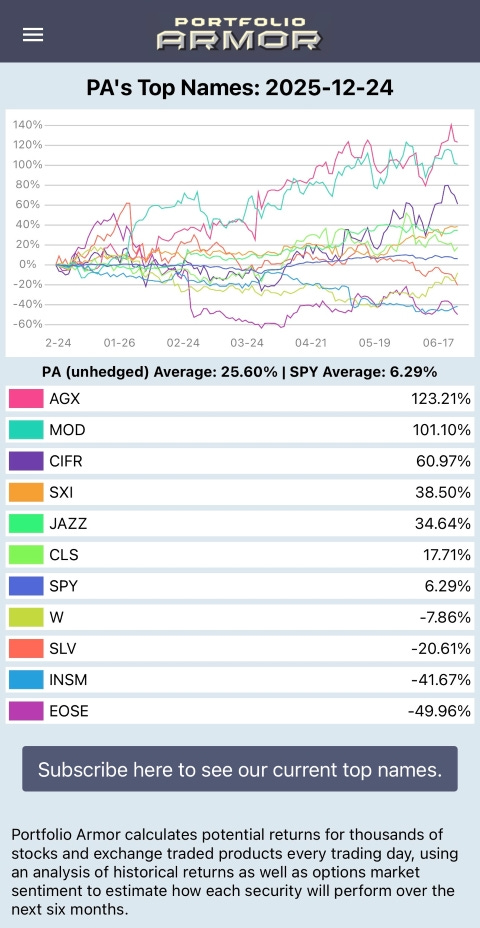
So far, we have 6-month returns for 157 weekly top names cohorts since we started this Substack at the end of December, 2022.

[Skipping ahead so this post doesn’t exceed email length—you can see the top names returns for every week here]
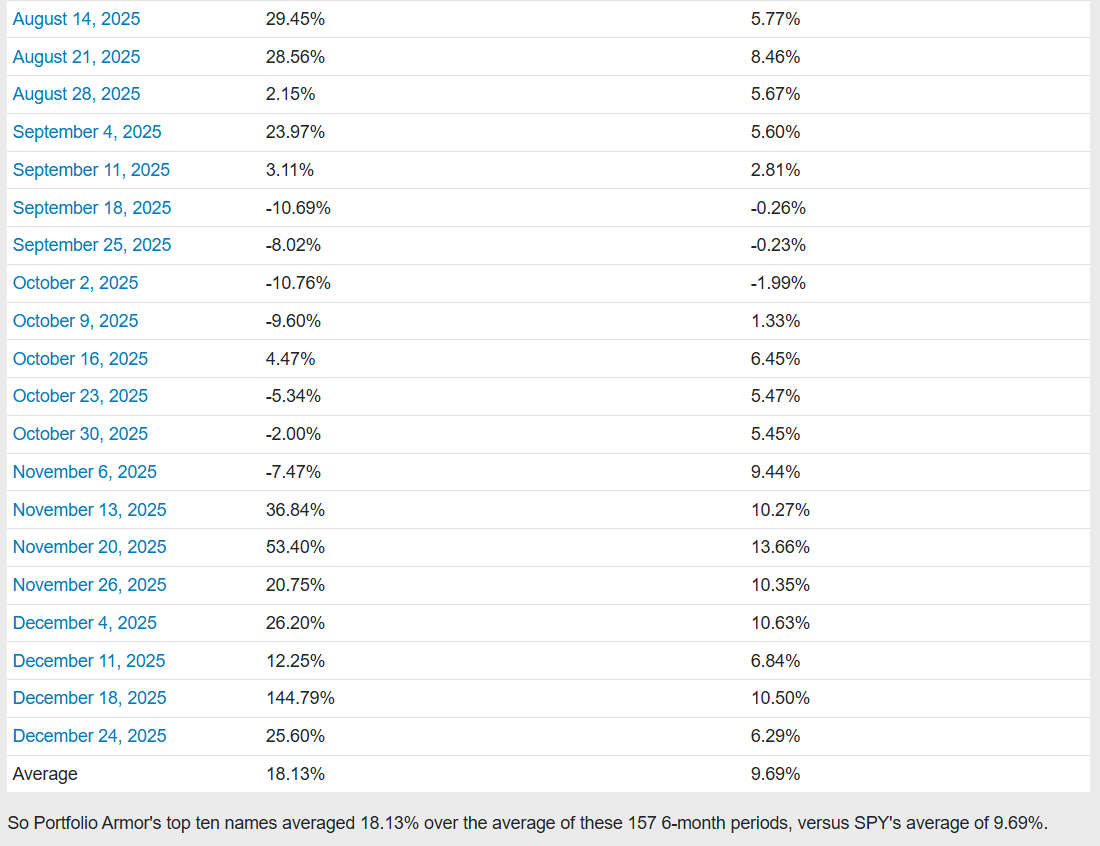
And as you can see above, our top names have averaged returns of 18.13% over the next six months, versus SPY’s average of 9.69%. You can see an interactive version of the table above here, where you can click on each date and see a chart showing each of the holdings that week.
This Week’s Top Names
Below are Portfolio Armor’s current top ten names as of Thursday’s close.
