


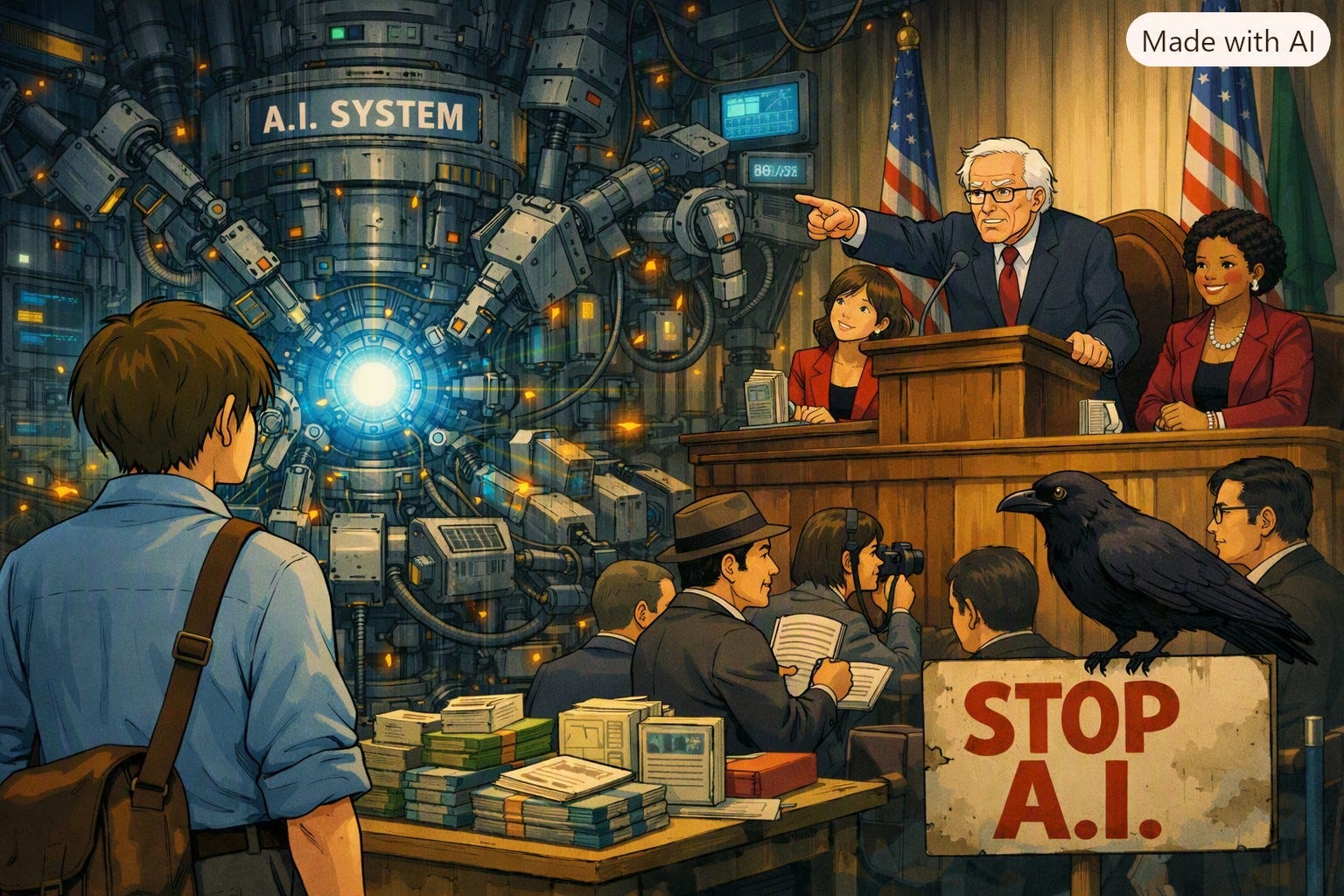
The Warning And The Machinery Behind It
In a Zero Hedge post yesterday, the pseudonymous contributor “Quoth the Raven” shared a warning about stopping AI. His article centered on Jacob Coxon, a researcher who resigned from Anthropic after working on pretraining at Anthropic and OpenAI.
Coxon said the labs were racing toward self-improving superintelligence and “gambling with our lives.”

Coxon’s warning went viral, then spread through the Associated Press, Axios, and other outlets.
Axios reported that Coxon said he left before any Anthropic equity vested and still holds equity in OpenAI. Axios’s four-month tenure claim conflicts with reporting of his July move from OpenAI to Anthropic, making the “two months before vesting” detail unreliable.
Given typical vesting schedules (with time frames measured in years, not months), the implied selflessness of Coxon’s resignation warrants skepticism—particularly when a viral public stance can become a career asset, opening paths to books, paid speaking, consulting, media work, or positions in the well-funded advocacy ecosystem documented below.
Will AI Kill Us All?
We don’t expect AI to kill us all, and neither, apparently, do the employees at the big AI labs.
Their retirement plans offer a useful check on the most apocalyptic rhetoric. Anthropic’s 2024 Form 5500 data show $10.7 million in employee contributions and $34.3 million in year-end assets. OpenAI’s plan data show $37.6 million in participant contributions and $112.8 million in year-end assets for 2024. Anthropic and OpenAI continue to advertise retirement plans to prospective employees.
The filings show long-horizon behavior inside the labs building frontier models. That’s revealed preference: people who work close to the technology are saving for futures measured in decades.
The Bill Predates The Blowup
A Senate Legislative Counsel draft dated March 24 carries Senator Bernie Sanders’s name and the title “Artificial Intelligence Data Center Moratorium Act.” Its operative language would stop construction or upgrading of covered AI data centers until Congress enacted a much broader regulatory framework.
The draft defines covered facilities expansively. It reaches sites used for AI at scale, along with certain facilities above 20 megawatts or using high-density racks or liquid cooling. Ending the moratorium would require federal premarket approval of AI products, protections against job displacement, a mechanism for sharing AI-generated wealth, local approval of data centers, limits on subsidies, and labor and environmental conditions.
The moratorium would directly affect the physical AI stack: chips, memory, networking, power equipment, cooling, construction, and the data centers that buy them.
This week’s media moment coincided with a fresh political push. Maria Curi reported on X that Sanders plans a bipartisan Senate briefing on AI’s “extraordinary dangers” featuring Geoffrey Hinton, Future of Life Institute co-founder Max Tegmark, and researcher Ajeya Cotra. Brian Chau highlighted the timing. Curi’s post is the current public source for those briefing details.


The sequence matters. A bill written months earlier now has a viral messenger and a reported Senate forum. That’s how an issue moves from technical debate to a political campaign.
Follow The Funding
Parker Thayer argued that Coxon’s launch looked like a sophisticated public-relations operation. He traced the earliest amplification to people associated with Encode, the AI Policy Network, and the AI Futures Project.


Brian Chau’s later thread surfaced a direct political-technology link. Newspeak House’s own residency page lists Jacob Coxon among its residents and describes his work as “applying mathematics and data science to inefficient markets.” Newspeak calls itself the London College of Political Technology. Its current calendar advertises Campaign Lab sessions aimed at helping the progressive left “campaign more effectively.” The residency places Coxon inside that political-technology network.


Some of the underlying funding links are public. The Survival and Flourishing Fund’s 2025 grant table lists $2.035 million for the AI Futures Project, $516,000 for Encode AI, and $1.635 million for the AI Policy Institute. The fund attributes those grants to Jaan Tallinn. Anthropic says Tallinn led its Series A financing in 2021.
Encode identifies the Survival and Flourishing Fund as one of several foundations supporting its work. It also says it refuses funding from corporations, foreign governments, and executives at frontier AI companies. Its general counsel, Nathan Calvin, is one of the early amplifiers named in Thayer’s thread.
Those disclosures establish a funded, interconnected AI-policy ecosystem.
Two AI Policies, Two Clocks
The Sanders draft and the Trump administration’s policy point in different directions. The White House’s March 2026 AI legislative framework calls for streamlined permitting, removal of barriers to deployment, and a uniform national framework. A June executive order says the administration will promote AI innovation and security while deploying advanced systems rapidly.
This is a contest between two concentrations of power. Continued AI development reinforces the companies building the systems. A moratorium transfers more authority to the politicians, regulators, and advocacy groups deciding which models and data centers may operate. Lukas (“computer”) put that tradeoff plainly.


That makes the political calendar part of the AI trade. The White House’s published policy points toward continued federal support for the buildout, and President Trump’s current term runs through January 2029. Our base case is that federal policy remains broadly supportive through then.
Moratorium supporters can still affect permitting fights, state policy, utility regulation, and the valuations assigned to long-duration projects. Those risks matter on a multi-year horizon.
Time Horizon Matters
Our options trades on AI-stack names go out months, not years. Our Micron trade from earlier this year offers a good example.

As you can see below, the average duration of all of our completed trades year-to-date has been 139 days, or less than five months. At that pace, we’ll be out of our AI trades long before a president who shares Jacob Coxon’s views could take office in January 2029.

Good summary. I hope it informs readers of the actual reality of most of social media “news”. It is nothing but garden-variety, agenda-driven, propaganda