



The FDA Blinks
In early May on Zero Hedge, we shared Peter Mantas’s post on Huntington’s disease, uniQure (QURE)’s AMT-130, the FDA, and the patients waiting for the first real treatment for this devastating inherited neurodegenerative disorder.
The title was “The Biology Will Win.”


Today, it did.
The short version: the FDA reversed course on uniQure’s drug. After previously taking a much harder line on AMT-130, uniQure’s one-time gene therapy for Huntington’s disease, the agency now says the company can submit a Biologics License Application for accelerated approval based on its existing three-year Phase I/II data.
That’s a big deal.
For Huntington’s patients and families, this is the first real regulatory opening toward a therapy designed to slow the underlying disease, not merely manage symptoms.
What Changed
When Peter wrote “The Biology Will Win,” the FDA’s position was an obstacle.
AMT-130 had data suggesting a meaningful slowing of disease progression. It had patient advocates. It had physicians and researchers who understood the stakes. But it also had a regulatory agency that, at least under the prior posture, seemed unwilling to accept the kind of evidence rare-disease patients actually have available.
Under the FDA’s previous leadership, the agency had pushed uniQure toward a prospective, randomized, double-blind, sham surgery-controlled trial. In plain English, that meant some Huntington’s disease patients would undergo a sham brain-surgery procedure, including superficial skull drilling, without receiving AMT-130 while their disease continued to progress.
That was the ethical problem at the center of this fight.
This isn’t a cold, abstract trial-design question. Huntington’s disease patients don’t have decades to wait. They don’t have a long list of disease-modifying alternatives. And they shouldn’t have been asked to undergo a sham neurosurgical procedure just to satisfy a regulatory preference for a cleaner control arm.
The question was whether the FDA would treat that as a reason to block a promising therapy, or as a reason to apply judgment.
Today’s news suggests judgment won.
The staff and posture at the FDA changed. The agency moved away from the earlier hard line and toward a more flexible path for AMT-130. uniQure now plans to submit its BLA in the third quarter of 2026, seeking accelerated approval for AMT-130 in Huntington’s disease.
That doesn’t mean approval is guaranteed. It does mean the door is open again.
For Huntington’s patients, that’s what matters most.
Why ClearPoint Neuro Moved Too
QURE wasn’t the only stock that ripped today.
ClearPoint Neuro (CLPT 0.00%↑) surged too, and for good reason.
AMT-130 isn’t a pill. It’s a gene therapy delivered directly into the brain. ClearPoint provides the navigation and delivery infrastructure used in procedures like this, including its MRI-guided navigation platform and SmartFlow cannula.
That makes CLPT a picks-and-shovels beneficiary of the AMT-130 story.
QURE owns the therapy. CLPT helps enable the delivery.
That’s why this wasn’t just a QURE move. The market understood that if AMT-130 moves closer to approval and eventual commercialization, ClearPoint can benefit too.
What Happened To The Stocks
When we published “The Biology Will Win,” both QURE and CLPT were already on our radar.
They weren’t random biotech lottery tickets. They were high-conviction names for us, which is why we had multiple trades on both.
Since that post, both stocks have climbed sharply.
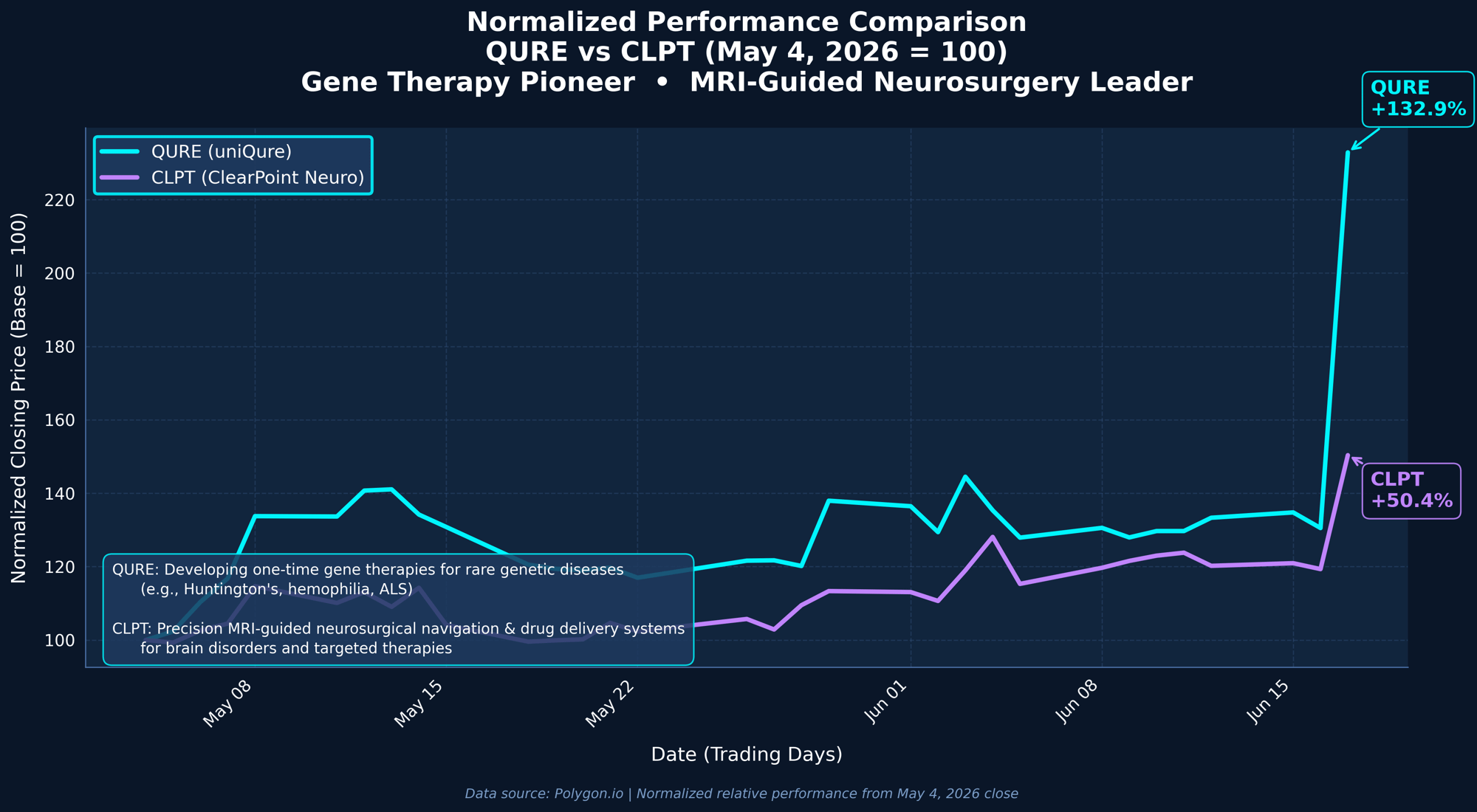
Today’s move was the kind of move you wait for in asymmetric biotech trades: a regulatory inflection point that changes the market’s view of a company almost instantly.
QURE exploded higher after the FDA update.
CLPT followed because the same news improved the market’s perception of its role in neuro/gene-therapy delivery.
That’s the setup we were looking for.
Hope First, Profits Too
The most important thing here is that Huntington’s patients now have hope.
This is a brutal disease. It runs through families. It takes people apart physically, cognitively, and emotionally. It gives patients and their children a genetic clock they never asked for.
So yes, the human side comes first.
But it’s even better when the same development that gives patients hope also rewards investors who got in early.
We have multiple trades open on QURE and CLPT, entered between last fall and this month, that are now positioned to profit handsomely from today’s developments.
For example, in this trade alert from last December,

We opened this trade on QURE:
Today’s First Multibaggers Trade
(Regulatory Re-rate / Gene Therapy)
The stock is uniQure (QURE 11.37%↑), and our trade is a combo consisting of these four legs:
Buying the $30 strike call expiring on January 15th, 2027,
Selling the $27 strike call expiring on April 17th, 2026,
Selling the $19 strike put expiring on April 17th, 2026,
Buying the $17 strike put expiring on April 17th, 2026,
For a max net debit of $2. The max gain on 2 contracts is $1,294 (and is uncapped, if the short call expires OTM), the max loss is $1,000, and the break-even is with QURE at $17.64.
This trade filled at $1.60.
We entered that trade at a net debit of $1.60, and we now have an open order to sell one of the January $30 calls at $43. That potential move from $1.60 to $43 on the first tranche gives you a sense of the kind of torque a well-built options structure can add to a trade like this.
The Lesson
This is why we keep looking for asymmetric setups.
Most stocks don’t have this kind of embedded optionality. Most trades don’t have the possibility of a regulatory reversal that can reprice a company in a single morning.
But when we find names where the science, the market setup, and the options market can give us a way to define our downside while magnifying our upside exposure, we want to be there before the news hits.
That’s what happened here.
The biology won.
Patients got hope.
And our trades were positioned to benefit.
How are you sizing these trades? I take it you are usually not holding the stocks, and trading only options?