



The Bottlenecks Are Becoming Earnings
SiTime’s (SITM 0.00%↑) second-quarter report added an exclamation point to a trend we’ve been following for months: demand for AI infrastructure is still outrunning supply. SITM’s revenue rose 127% year over year to $157.4 million, and the stock spiked nearly 34% after hours Wednesday.
As we wrote in July, the AI buildout keeps accelerating, and demand is reaching increasingly specialized parts of the infrastructure stack. You could see that too in SiTime’s results. Every segment grew at least 50%, while communications, enterprise, and data-center revenue rose 181%. Management again pointed to AI data centers as a key high-growth application. Precision timing is becoming another beneficiary of the AI infrastructure cycle.
Memory Is Still the Constraint
SpaceX’s (SPCX 0.00%↑) August 4th call showed how quickly the next wave of AI demand could expand. Elon Musk described plans to build around Nvidia’s (NVDA 0.00%↑) next-generation Vera Rubin platform and scale compute aggressively. He also described memory as a bottleneck. As one of our Market Watchers argued, capacity needs more than money: new fabs also require scarce engineers, equipment, intellectual property, supply chains, and acceptable yields.
The next day, Sandisk (SNDK 0.00%↑) reported a spectacular quarter. Revenue was up 51% quarter-over-quarter, and 372% year-over-year. Adjusted EPS was up 68% quarter-over-quarter, and 13,434% year-over-year.
Yet Sandisk fell after hours. Earnings reactions measure the gap between results and expectations. After the stock’s run into the report, the market focused on the future margin path even as the operating results showed extraordinary demand and pricing power.
New Bottlenecks Create New Markets
Aeva (AEVA 0.00%↑) adds a more speculative layer to the theme. Its new optical-connectivity business is aimed at AI data centers, where faster links and lower power consumption are becoming increasingly important. The company says it’s working with a major customer on a co-packaged-optics program for a hyperscaler, with initial deployment targeted for the second half of 2027 and production in 2028.
The market welcomed the news: Aeva rose about 18% after hours. Revenue was $6.1 million, but the signed development agreement gave investors a concrete path from Aeva’s photonics technology to hyperscaler deployment.
We already have exposure to that possibility. In May, we opened a hybrid combo on Aeva, paying $0.40 per contract for it.
Lidar / perception-stack theme
The stock is Aeva Technologies (AEVA 14.29%↑), and our trade is a hybrid combo consisting of these four legs:
Buying two of the December 18th, 2026 $17.50 calls,
Selling two of the October 16th, 2026 $20 calls,
Selling two of the December 18th, 2026 $10 puts,
Buying two of the December 18th, 2026 $7.50 puts,
For a max net debit of $0.75. The max gain on 2 contracts is $800 if the October $20 calls expire in-the-money, the max loss is $650, and the upside will be uncapped if the October $20 calls expire out-of-the-money or we buy-to-close them before then. This trade filled at $0.40.
AEVA traded at $22.46 overnight. If it fades below $20 by October, we’ll have uncapped upside on through its November earnings report; if it stays above $20, we’ll exit the trade for nice profit in October.
How We Traded SiTime
SiTime presented a different challenge than AEVA for us because of its high share price relative to our risk budget, which we try to keep between $500 and $1,000 on most trades. When SITM hit Portfolio Armor’s Top Names at the end of June, we entered a standard (same expiration) 4-leg combo on it, designed to straddle two SITM earnings reports:
Precision timing / AI infrastructure bottleneck theme
The stock is SiTime (SITM 28.03%↑), and our trade is a combo consisting of these four legs:
Buying the November 20th, 2026 $980 call,
Selling the November 20th, 2026 $990 call,
Selling the November 20th, 2026 $530 put,
Buying the November 20th, 2026 $520 put,
At a minimum net credit of $2.80. The max gain on 1 contract is $1,280, and the max loss is $720.
This trade filled at $3.
We collected a net credit of $3 per contract, or $300, when we opened that SITM trade. The stock traded at $719 overnight; as long as it’s over $530 at expiration in November, we’ll keep that $300; if it’s trading at over $980 then, we’ll make more, maxing out at $1,280 if it’s trading at over $990 at expiration.
A Lesson From the Momentum Correction
The momentum correction that hammered AI infrastructure stocks through last week offered a warning that still applies. Some of the companies with the strongest earnings growth and cheapest valuations on PEG and other growth-adjusted measures still fell sharply as crowded positioning and forced selling overwhelmed the fundamental case.
That experience makes Wednesday’s note from The Market Ear timely. Index put/call ratios are collapsing as investors stop buying protection and chase upside. The same enthusiasm that drives post-earnings surges can leave the market more exposed when momentum reverses.
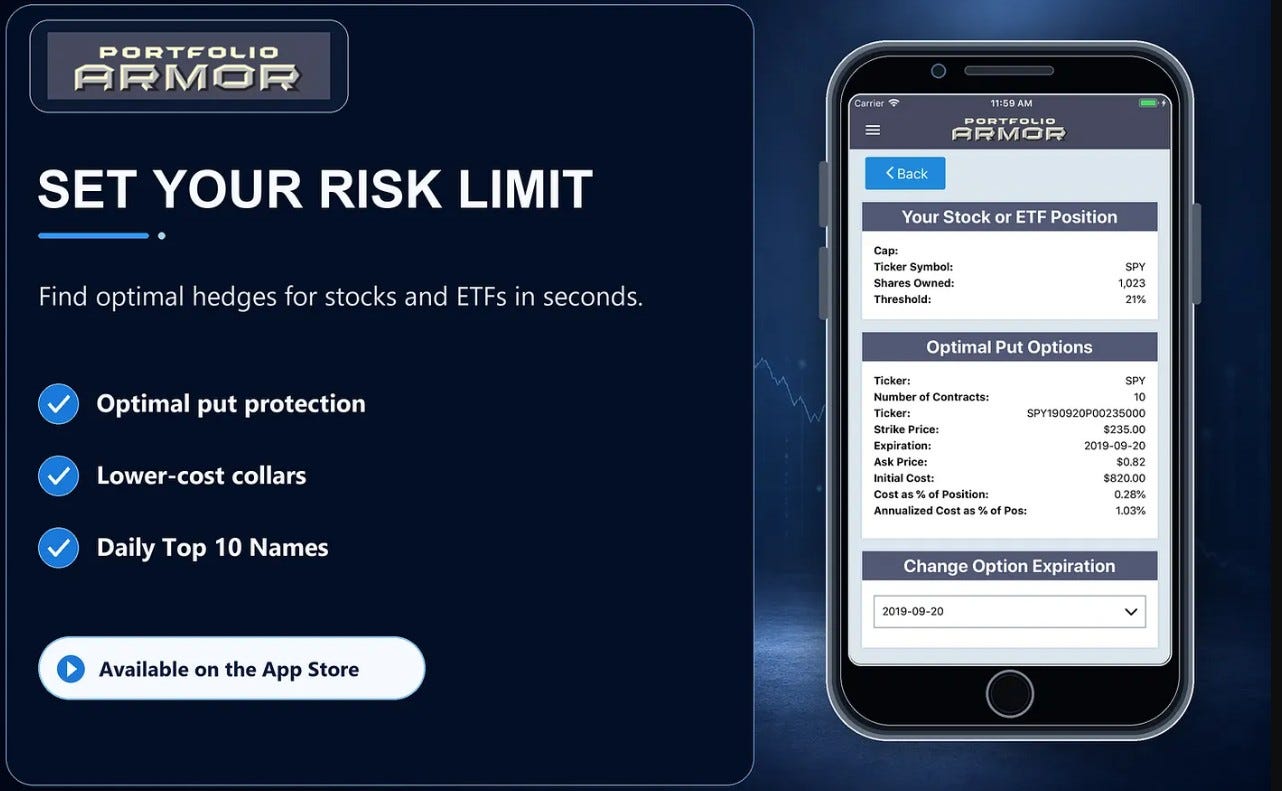
For investors who want to keep participating while limiting their downside risk, the Portfolio Armor iPhone app can scan for the optimal puts and collars based on your underlying exposure and your risk tolerance. It helps translate an abstract concern about market risk into an actionable hedge that gives you the precise level of protection you want at the lowest possible cost.
What We’re Watching Next
The common thread across SiTime, SpaceX, Sandisk, and Aeva is that the AI buildout is colliding with physical constraints: memory, timing, networking, power, equipment, and skilled labor. Those constraints are creating pricing power and new markets across the infrastructure stack. We’ll keep looking for promising trades in this space, including among less well-known names like SiTime.
The Portfolio Armor Substack is a reader-supported publication. To receive new posts and support my work, consider becoming a free or paid subscriber.