


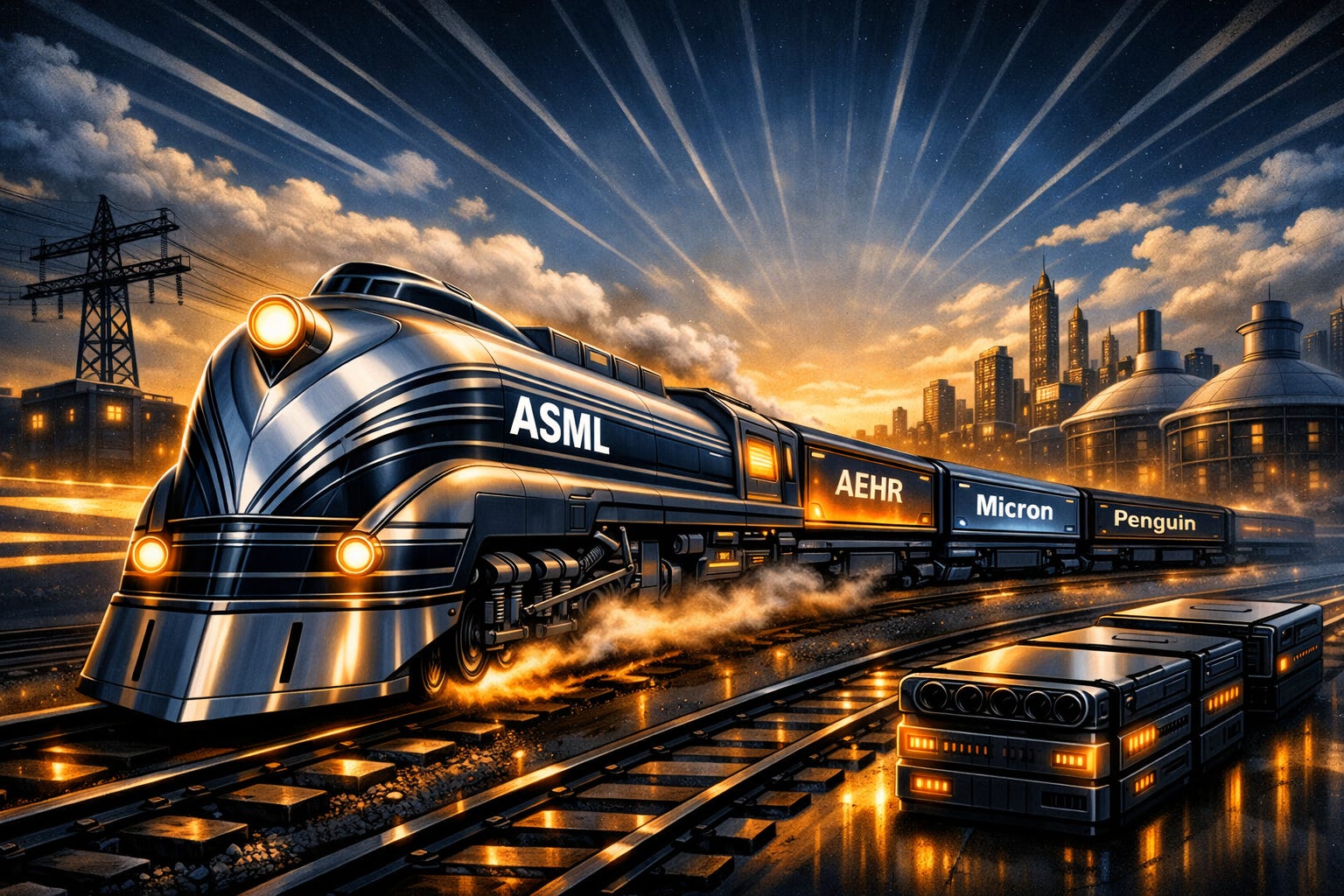
Did The AI Bubble Just Burst?
Memory stocks recovered somewhat Tuesday, but the bounce didn’t erase the damage from Monday’s sharp selloff—or the renewed claims that the AI bubble had burst.
Price action alone can’t settle that question. Orders, production equipment, capacity plans, revenue, and forward guidance offer better evidence.
The latest data from four different parts of the physical AI stack all point in the same direction: the infrastructure buildout is still accelerating.
ASML’s Customers Are Expanding Capacity
ASML Holding (ASML) sits at one of the semiconductor industry’s critical chokepoints. The Dutch company makes lithography systems used to manufacture advanced chips, including the EUV systems required for the most advanced semiconductor processes.
ASML reported second-quarter sales of €9.3 billion, a gross margin of 54%, and net income of €2.9 billion. Sales and margins both came in above the company’s guidance.
The outlook was even stronger. ASML guided for third-quarter sales of €11 billion to €12 billion, with a gross margin of 55% to 57%. It also raised its full-year revenue forecast from €36 billion–€40 billion to €43 billion–€45 billion.
ASML said ongoing AI investment is driving demand for advanced logic and memory chips, prompting its customers to accelerate their capacity-expansion plans. The company now plans to increase both its Low-NA EUV and DUV immersion capacity by 30% in 2027. It is investigating another 30% increase in 2028.
When ASML’s customers reserve more capacity years in advance, they are committing real capital to future chip production.
AEHR Sees The Ramp Before The Revenue
Aehr Test Systems (AEHR) makes equipment for testing and burning in semiconductors at the wafer and package levels. That equipment helps manufacturers identify early failures before devices enter volume production. In photonics, burn-in also stabilizes the output of components containing lasers before they ship.
Aehr reported record quarterly bookings of $60.7 million and an effective backlog of $100.6 million—more than twice its entire fiscal 2026 revenue.
The company expects fiscal 2027 revenue of $130 million to $150 million, representing growth of roughly 160% to 200%. Demand is coming from AI processors, silicon photonics, power semiconductors, and related test and burn-in applications.
Aehr’s results are particularly useful as a leading indicator. Burn-in systems must be ordered, delivered, and installed before customers can begin volume production.
As optical-industry analyst Damnang put it:
“AEHR’s order data serves as a progress indicator for the entire optical value chain.”
Aehr’s customers are moving beyond evaluations. One new networking customer progressed from its initial contact with Aehr to ordering and receiving four systems within months. Aehr’s lead AI customer has moved its production burn-in screening entirely from the system level to the wafer level.
As silicon photonics, optical I/O, and higher-speed interconnects move into production, burn-in becomes part of the manufacturing infrastructure.
The equipment is already being ordered and installed.
Micron And Penguin Said The Same Thing
The signals from ASML and Aehr reinforce what we recently heard from two other layers of the AI stack.
Memory-chip manufacturer Micron Technology (MU) reported record fiscal third-quarter revenue of $41.46 billion, up from $9.30 billion a year earlier. It guided for fourth-quarter revenue of approximately $50 billion and said DRAM and NAND demand continues to exceed supply significantly.
Micron expects those tight conditions to persist beyond calendar 2027, driven by AI demand and structural supply constraints. Its data-center revenue exceeded $25 billion during the quarter, an annualized run rate of more than $100 billion.
Memory remains one of the AI buildout’s central bottlenecks.
Then there is Penguin Solutions (PENG), which we wrote about last week.
Penguin reported record quarterly revenue of $479 million, up 48% year over year. Adjusted earnings per share rose 79%, Integrated Memory sales more than doubled, and management raised full-year guidance.
Penguin operates closer to the deployment layer. It combines memory, compute systems, infrastructure software, and services to help customers build and scale AI factories.
That demand is showing up in completed systems and current revenue.
Four Layers, One Direction
These companies occupy different positions in the physical AI stack.
ASML supplies the lithography equipment needed to manufacture advanced chips.
Aehr supplies the test and burn-in systems needed before AI processors and optical components enter volume production.
Micron supplies the memory and storage capacity that increasingly determines AI-system performance.
Penguin helps assemble and deploy the resulting infrastructure.
Those are four independent signals from four different layers of the buildout. Together, they show capital moving from plans to equipment orders, from equipment orders to production capacity, and from production capacity to deployed AI systems.
How We’re Trading It
The underlying AI buildout keeps advancing.
AI-related stocks have been volatile, but our trading approach can use that volatility to our advantage. We’ve successfully traded a number of these names before, including Micron and ASML:
4-leg combo on Micron Technology (MU). Entered at a net debit of $2.62 on 3/3/2026; exited the put spread at a net debit of $0.20 on 4/8/2026; exited the call spread at a net credit of $16.00 on 5/5/2026. Profit: 504% (return on max risk: 173%). Signal: PA Top Names.
4-leg combo on ASML Holding (ASML). Entered at a net debit of $2.45 on 3/19/2026. Exited the put spread at a net debit of $0.20 on 4/14/2026, and exited the call spread at $8.00 on 4/20/2026. Profit: 218% (return on max risk: 72%). Signal: PA Top Names.
We have more bullish trades on AI-related names teed up for later today. I’m enabling Substack’s one-post unlock on today’s trade alert, so free subscribers will be able to unlock and read it when it goes live.