



Stocks Recovered, Money Stayed Expensive
The S&P 500 set a record on Tuesday, stumbled as an AI revenue headline hit technology stocks, and rose 0.6% on Friday. The Dow rose 0.8% Friday and the Nasdaq Composite added 0.6%. The chart below puts the week’s equity gains alongside the change in Treasury yields.
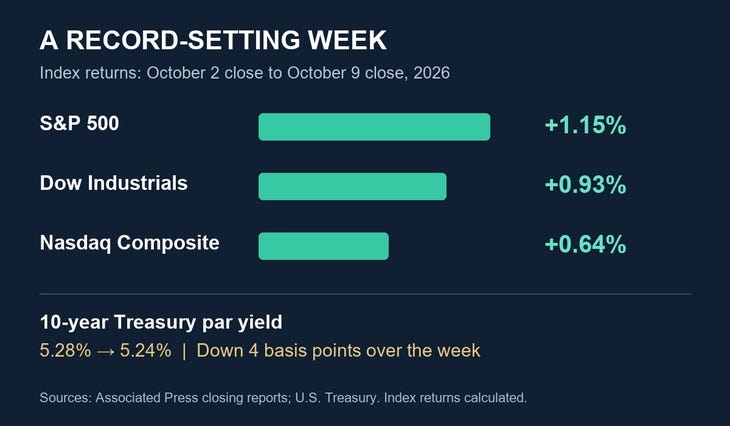
The Treasury’s official ten-year par yield ended Friday at 5.24%, down four basis points from a week earlier. Capital remains expensive, even as stocks recover.
The AI Headline Needed A Reconciliation
Thursday’s selloff followed reports putting OpenAI’s annualized revenue near $50 billion, versus an earlier $68 billion figure that included gross partner revenue. Subsequent reporting explained the different treatment of those sales. Our AI accounting analysis separates that presentation issue from the financing hurdle facing the buildout.
That distinction matters for stock selection. Suppliers’ orders, delivery schedules and customers’ ability to pay tell us more about their earnings prospects than two differently constructed revenue headlines. Our new ideas this week also reached beyond infrastructure, into businesses putting AI to work and companies with their own adoption or turnaround catalysts.
How We Traded It
Monday: Our first alert focused on turning AI capabilities into recurring software revenue. The proposed call diagonal didn’t fill; we returned to that setup on Wednesday.

Tuesday: Growth and growing pains identified three ideas: expanding customer assets at a financial platform, a medicine’s commercial launch and a bearish setup in a business with weakening margins. We opened the two bullish trades.

Wednesday: We entered the software trade we’d attempted on Monday and added a medical-imaging position centered on partners’ adoption of the technology. The Wednesday alert explains both setups.

The Week’s Final Two Sessions
Thursday: Our four opportunities covered specialty-food distribution, a Bitcoin rebound, a bearish profitability trend and a chipmaking earnings catalyst. The Bitcoin call diagonal filled; the other three orders were canceled.

Friday: A turnaround and a return paired business communications with AI tools and improving finances with a biotech we’ve profitably traded before. We opened the communications trade; the biotech order remained unfilled.

Closing The Robotics Trade
Ouster makes lidar sensors that help robots and autonomous machines see their surroundings. We exited the remaining put spread in our May trade on October 5th, completing an exit that began with the sale of its call diagonal in August.
Here’s the original entry card from our May 21st alert. The trade is now closed.

We entered at a $1.45 net debit, below the card’s $1.85 limit. The completed trade earned $857, or 132.9% on its $645 original maximum risk, before fees. The exit card shows both stages.

Our weekly Exits post lists the week’s full and partial exits.

Our 2026 Trade Record
Across 261 completed trades this year, the average return on original maximum risk is 25.0%, with an average holding period of 142 days. On an equal-risk, continuously deployed basis, that implies an illustrative 64.3% annualized return before fees.
The card summarizes every completed 2026 trade through October 9th and links to our public exits record.

What We’re Watching Next
September’s consumer-price report arrives Wednesday, October 14th, at 8:30 a.m. Eastern, followed by producer prices on Thursday. We’ll watch how inflation and earnings affect financing costs and company-specific opportunities.
Our next entries will continue to combine business evidence with quantitative screens and the available options prices. This week’s ideas ranged from AI software and medical innovation to a turnaround and a bearish profitability trend; we’ll keep looking wherever a compelling setup emerges.
Want a heads-up when we place our next trade? We pair security selection with asymmetric options strategies and track every completed result publicly.
For an introduction to our approach and how the alerts work, start here:
