


The Other Explanation
Last week, Anthropic CEO Dario Amodei called for frontier AI labs to slow the improvement of their models. He wants the government to mediate an industry agreement and grant it a narrow antitrust waiver.
The public argument is about safety. Nic Carter has offered a more cynical interpretation: the campaign may be preparing investors for a world in which Anthropic keeps its most capable models—and the discoveries they produce—inside the company.


Under Carter’s theory, Anthropic would continue advancing the real frontier while holding the public frontier six months or a year behind it. Customers could rent useful models. Anthropic’s own researchers would use the best ones to create valuable intellectual property in biology and other fields.
That would turn “pacing the frontier” into pacing access to it.
From Tokens To Intellectual Property
The economics make Carter’s theory worth considering.
The leading labs have spent extraordinary sums training their models. Their current businesses depend heavily on selling subscriptions, API access and tokens. Competition from open-weight models threatens to make inference cheaper, while distillation lets rivals reproduce capabilities without paying the original development cost.
Anthropic has been explicit about the second problem. In February, it said three Chinese labs had used more than 24,000 fraudulent accounts to extract over 16 million exchanges with Claude. Anthropic described those campaigns as industrial-scale distillation attacks.
A private frontier offers different economics. Anthropic could use its strongest models internally to generate patents, drug candidates and other discoveries, then own the resulting intellectual property. Carter predicts that open-weight models may eventually handle most ordinary inference while frontier labs make enormous sums from bespoke work at the edge of capability.
He put the implication bluntly in a follow-up: Anthropic’s eventual intellectual-property portfolio could have a larger addressable market than its token business.
The Pieces Are Already Visible
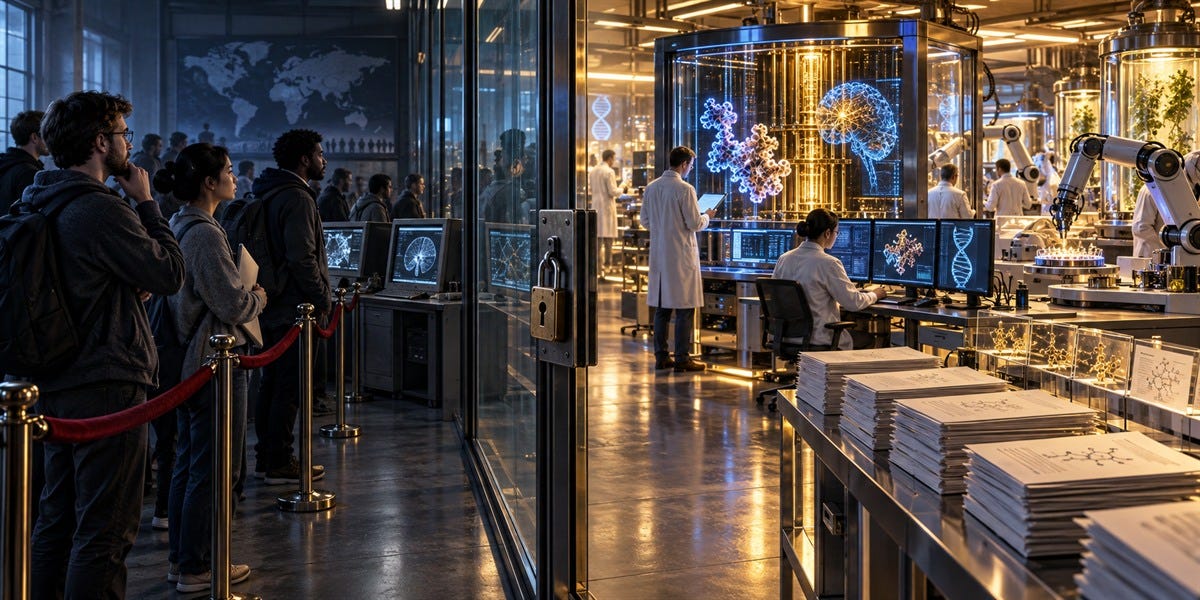
Anthropic is moving from software into physical research. It has opened a Bay Area wet lab as it works toward letting Claude direct automated experiments, and it recently launched a verification program that gives qualified life-sciences professionals more permissive access to its strongest biology models.
Those programs have a stated safety rationale. They also establish the architecture Carter’s theory requires: one level of capability for general users, another for approved researchers, and potentially a still more capable frontier reserved for internal work.
OpenAI has built a similar structure. GPT-Rosalind, its specialized model for biology and drug discovery, is available to eligible organizations through a trusted-access program. OpenAI also uses frontier models internally to accelerate its own research. Carter focused on Anthropic, but the commercial logic applies to both labs.
Too Dangerous To Fail
Izabella Kaminska extended Carter’s theory in a revealing direction.

Kaminska connects the current campaign to Leopold Aschenbrenner’s 2024 call to “lock down the labs” and build a government-backed AI project on the scale of the Manhattan Project. In her reading, the labs’ immense financing needs create pressure for public support. Anthropic raised $65 billion at a $965 billion post-money valuation in May. Safety warnings strengthen the claim that the labs have become “too dangerous to fail”: institutions the government must underwrite because their collapse—or uncontrolled use of their technology—would threaten the country.
Kaminska also identifies the pressure point. This strategy requires government approval. If the Trump administration declines to underwrite it, the financing gap could push the labs toward the proprietary model Carter describes: lock down their strongest systems and monetize the discoveries internally.
Carter’s commercial theory and Kaminska’s political one lead to the same place. Government coordination could protect a small group of approved frontier labs. Access controls could protect their most valuable capabilities. The public would be asked to accept a slower frontier while the incumbents kept advancing behind the wall.
Carter labels his theory speculation. The wet lab, tiered access, distillation concerns, internal research and request for government-mediated coordination fit its incentives.
Sincere fear and commercial advantage can coexist. A lab can believe advanced AI is dangerous and still benefit from rules that keep the strongest systems inside an incumbent-controlled perimeter.
The Anthropic Proxies We Traded
Our OpenAI-related trades have focused on suppliers and partners. We haven’t presented them as pre-IPO equity exposure. Anthropic has offered cleaner public-market proxies through companies with disclosed equity stakes.
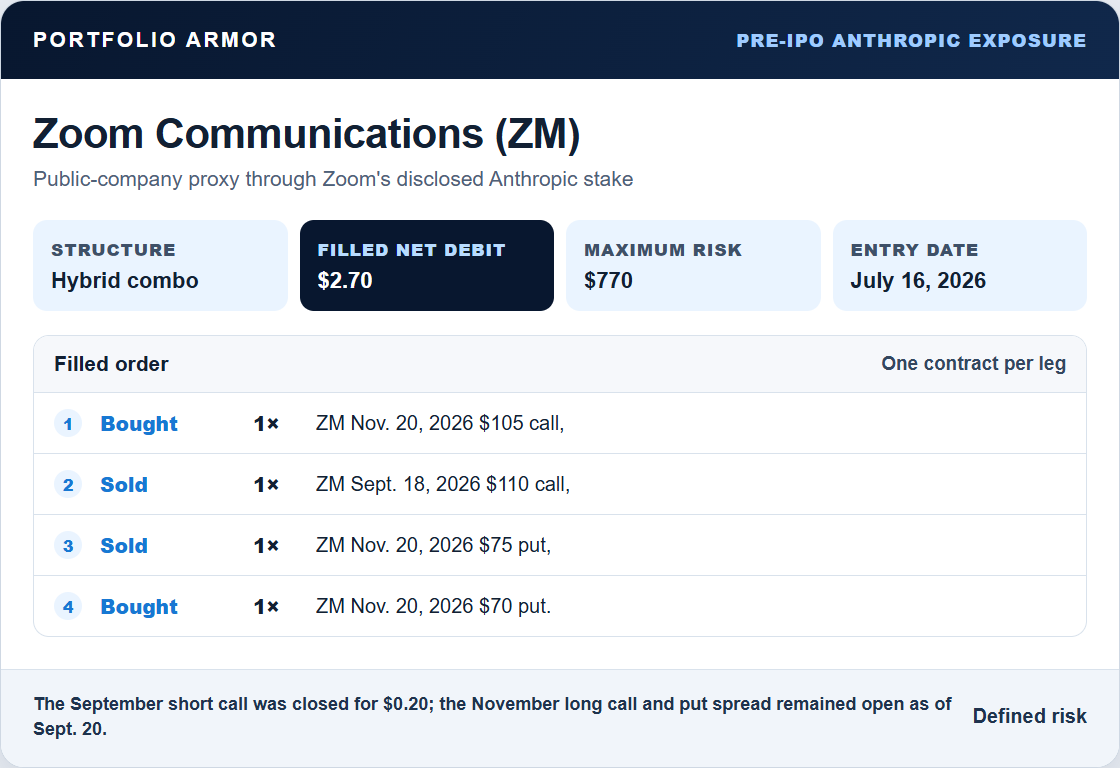
The clearest is Zoom Communications (ZM 0.00%↑). Zoom’s latest quarterly filing puts the carrying value of its Anthropic stake at $3.13 billion as of July 31. We opened the Zoom trade below on July 16. Its short call has since been closed, leaving the structure with uncapped upside through its remaining long call.
SK Telecom (SKM 0.00%↑) is another direct proxy. The company invested an additional $100 million in Anthropic after an earlier investment by its venture-capital arm. We opened our SKM trade on June 18. Its short call has since been closed as well, leaving the structure with uncapped upside through its remaining long call.
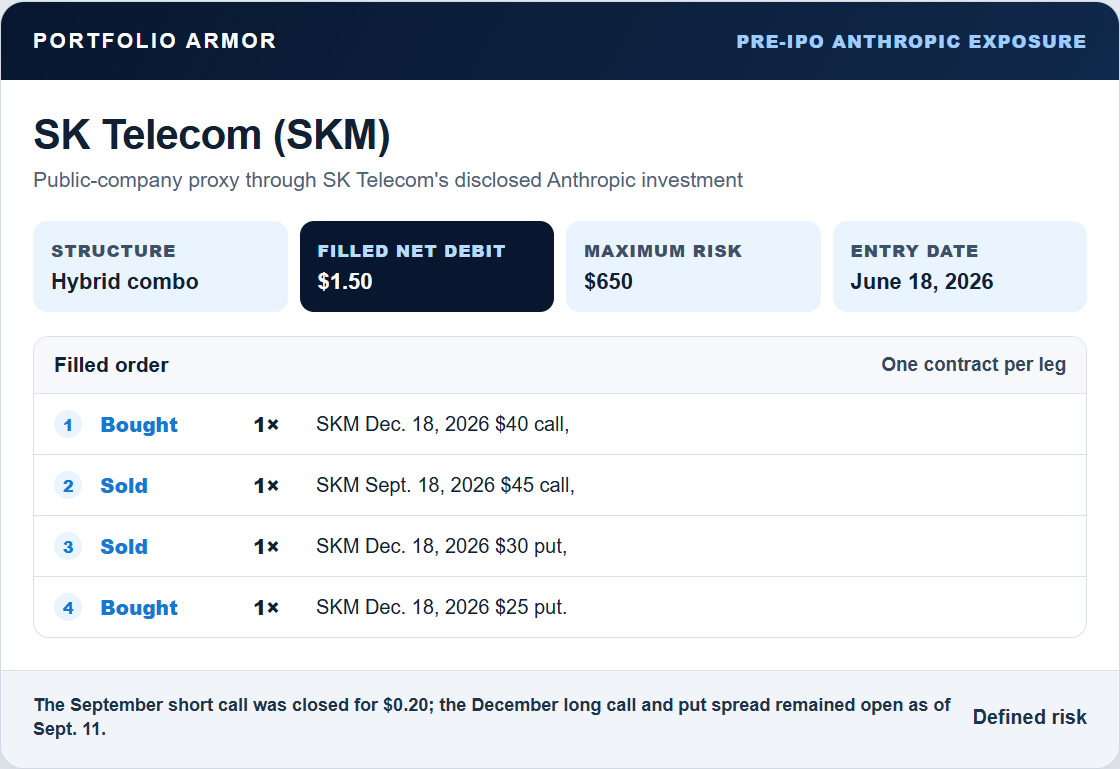
Current reporting points to a trading debut as soon as November for Anthropic. Our bet is that a successful offering at a higher valuation will prompt investors to assign more value to the Anthropic stakes held by Zoom and SK Telecom, giving both stocks room to rerate before our remaining options expire.
Staying Ahead Of The Curve
The AI labs’ business models are still evolving. So are the political arrangements around them. We’ll keep looking for clean public-market routes to the labs and the companies that profit from their buildouts, and we’ll structure trades when the options market gives us compelling asymmetry.
If you’d like a heads-up when we place our next trade, our Start Here page explains how we find, structure and track them.
