



Tuesday Strengthened The Demand Case
Tuesday’s Nvidia (NVDA 0.00%↑) results strengthened the case we’ve been making in The War Over Nvidia and The Show Goes On: demand for AI infrastructure remains enormous, while the leadership and financing behind that growth deserve close attention.
The company’s third-quarter results included record revenue of $115.8 billion, up 103% from a year earlier. Data Center revenue reached $107.6 billion, up 110%.
The company beat expectations on guidance as well.
Powering The Rest Of The Stack
In Tuesday’s post, we focused on Powell Industries (POWL 0.00%↑), which supplies electrical equipment needed by datacenters and other power-intensive facilities.

Powell’s November 16th results showed quarterly revenue up 33% to $397 million, new orders of $710 million, and backlog up 96% to $2.7 billion. An approximately $85 million datacenter order was part of that quarter.
That order book supports our physical-buildout thesis. Customers still have to finance and complete their projects for backlog to become revenue. Electrical infrastructure gives us another place to look for opportunities as AI capacity expands.
The Jensen Advantage
Nvidia’s reported quarter ended on October 25th. Co-founder Jensen Huang resigned on November 12th. The results measure the business before his departure; the transition’s operating effects will become clearer in future quarters.
Huang spent decades cultivating the people who make Nvidia’s chips, memory and servers. This May, at Taipei’s Brick Kiln restaurant, he stood on a stool to toast more than 30 supplier-company CEOs, then moved from table to table. In Seoul, he ate Korean barbecue and traded toasts with technology chiefs. Those relationships matter when Nvidia needs scarce capacity, faster deliveries or a partner willing to accommodate a difficult request.
Interim CEO Colette Kress’s Mad Money appearance had the stiff, impersonal tone of an HR harridan. It gave us little confidence that she could reproduce Huang’s personal diplomacy. Fireside Alpha’s post below includes the clip.

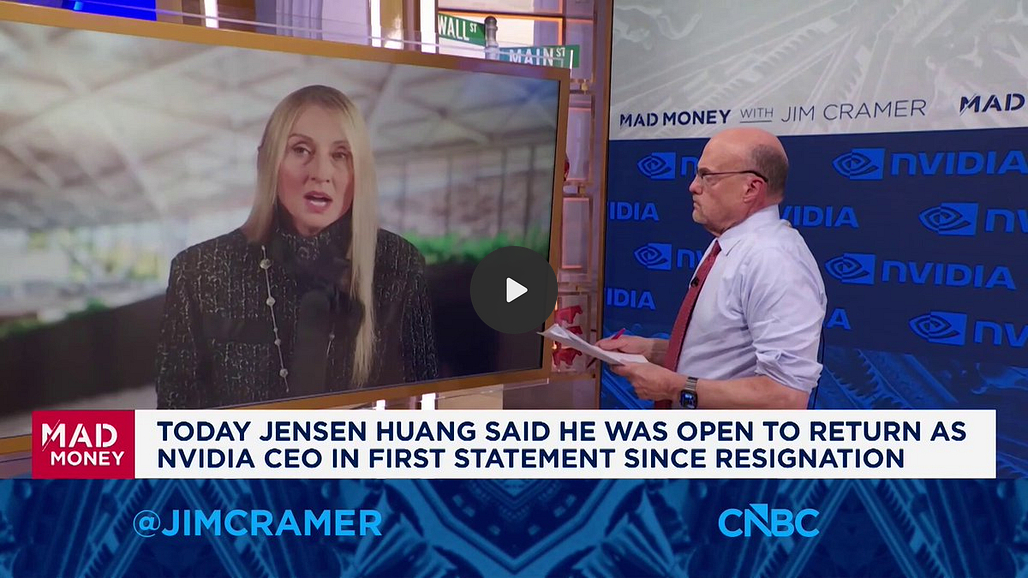

As one commenter on X noted:
No way you’re inspiring anyone or retaining talent with that tone, look and callous attitude.
Customers And Competitors
A Chinese-language post by @ZondarkAI puts the customer risk more sharply. Its author argues that Huang’s commercial clout helped keep cloud giants such as Google and Amazon buying Nvidia’s hardware even as they developed competing chips. With Huang gone, he expects them to shift more work to their own chips and other alternatives, cut Nvidia orders and squeeze its margins.
That competitive route already exists: Google is expanding its TPUs, and Amazon offers Trainium. These are hyperscalers—giant cloud operators with the money and technical resources to develop alternatives to Nvidia’s chips.
The AI buildout can keep expanding while Nvidia loses some of the orders and pricing power that made it so profitable.
The Next Test Is Financing
Nvidia’s latest financial commentary describes customers growing faster than their balance sheets can support. It reports $118 billion in maximum gross guarantees at the end of the quarter. That includes $105 billion of SB Energy support agreed in August, taking effect building by building, with the first expected in fiscal 2029. No guarantee payments had been made.
Financing also matters for the chip designers competing with Nvidia. Taiwan’s Commercial Times reported on November 16th, citing industry sources, that TSMC sets customer credit limits using their balance sheets. Orders above those limits require cash, and some customers prepay to reserve capacity, according to the report. That funding burden could slow smaller rivals’ expansion.
Zero Hedge’s financing analysis notes a Goldman forecast of $545 billion in AI project financing next year, including $320 billion for compute. Its central question is who will provide the support lenders require for those future deals.
That’s a concrete channel through which leadership could affect the buildout. The terms offered by chipmakers can help determine which projects obtain financing. Huang’s dealmaking experience could have economic value in securing those agreements.
Where We’re Looking Next
The operating evidence and guidance support continued AI spending, with financing and profitability providing important tests.
Our search spans the stack: the software businesses we discussed in Software’s AI Winners, the hardware that runs their workloads, and the electrical infrastructure that powers them. We’re looking for names that have fallen significantly, are beginning to show signs of a bottom, and have recent results supporting an intact bullish case.
Follow Our AI Recovery Search
We combine our Early Recovery screens with research into the latest earnings, orders and financial strength. When those conditions line up and an attractive trade is available, paid subscribers receive the name, maximum entry price and exit plan.
If you’d like to follow our search for the next AI-stack opportunities, subscribe below.
New to our alerts? Start Here explains how the service works.

> The operating evidence and guidance support continued AI spending
Well, that same evidence got us throwing dice at the peak of the bubble. For the sake of the process, I would like to see an article that details a little more introspection about past failures to predict the future.