


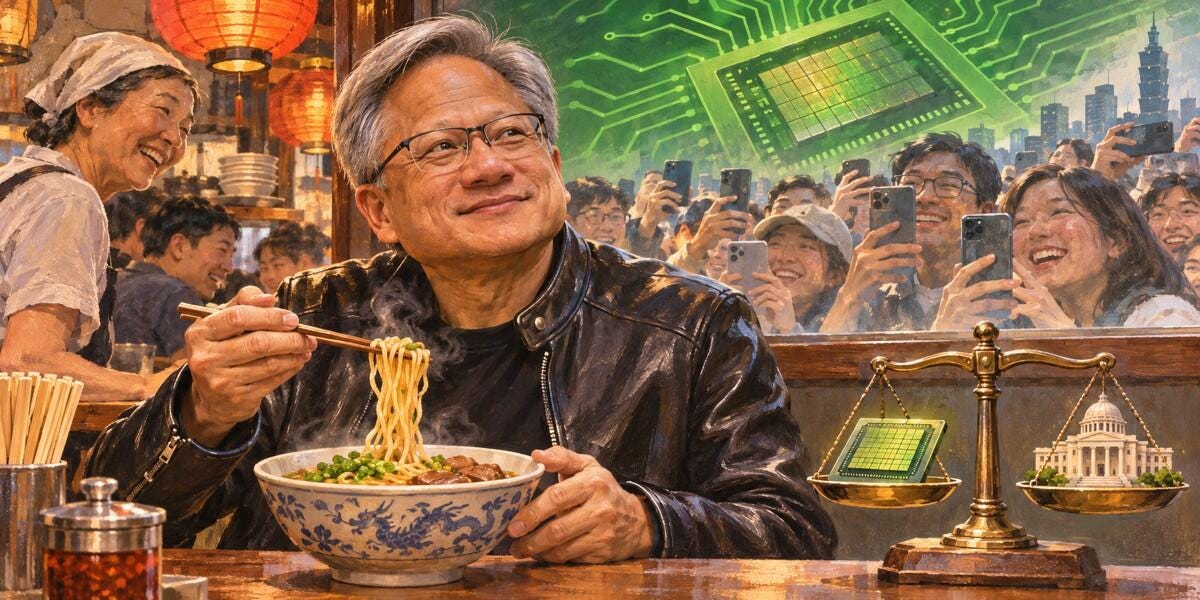
A Rock Star Meets A Reckoning
Jensen Huang, the cofounder and CEO of Nvidia (NVDA 0.00%↑), gets the sort of reception in Asia that most chief executives can only dream about. Fans follow him to restaurants. Cameras track his meals. At Computex in Taiwan in June 2024, a woman asked him to autograph the clothing across her chest, and he obliged.
Zero Hedge resurfaced that episode on Sunday with the caption, “There were signs”:


The celebrity treatment extends to noodle runs. During his Beijing visit in May, onlookers filmed his restaurant outing. Huang has become a recognizable face of the AI boom—and now its most conspicuous source of gossip.
The Confession And The Investigation
On Sunday, the Nvidia founder admitted being unfaithful to his wife. His apology followed Financial Times reporting that U.S. intelligence believed he had a romantic relationship with Megaspeed executive Alice Huang, an alleged Chinese intelligence operative. Zero Hedge covered that report and Sunday’s developments.
Huang’s admission establishes the infidelity. The security questions are the subject of an independent board investigation, overseen by independent directors with outside counsel. The board says it currently has no reason to believe national security or company secrets were compromised.
Our expectation is that Huang remains CEO. The more interesting market question is what a politically weakened Huang might be willing to do to keep Washington on his side.
Why We Expect Him To Stay
Nvidia’s board expressed confidence in Huang and his leadership team while announcing the inquiry. Its directors are investigating while supporting his continued leadership.
Replacing the founder would create its own risk. Huang’s value includes his product judgment, relationships with customers and suppliers, and ability to sell a vision of where computing is going. Our assessment is that directors will need a substantial business or security reason to incur the disruption of replacing him.
Trump also defended Huang on Sunday. Both the company and the administration have an interest in keeping America’s leading AI chip business successful. That gives Huang considerable protection, subject to what the investigation uncovers.
Elon Musk also agreed with Shaun Maguire, who called Huang “irreplaceable for America’s AI leadership.” Here’s Musk’s post endorsing that argument:


The China Problem Predates The Affair News
The relationship with Megaspeed was already drawing scrutiny months ago. On May 13, short seller Culper Research published a thread questioning the company’s connections to China and highlighting Huang’s proximity to Alice Huang. John Hempton pointed readers back to it on Sunday. Here’s the original May post and its photographs:


Culper disclosed a short position in Nvidia, giving it a financial interest in a falling share price. Its thread is useful evidence that questions about the business relationship were public months before this weekend. The photographs establish public proximity; the intelligence allegations require their own evidence.
Congressional scrutiny is concrete, too. Three Republican committee chairmen requested a closed-door briefing on Huang’s interactions with Alice Huang and Nvidia’s security procedures. They asked for November 18, with a response or alternative availability by November 11.
That creates a plausible outcome in which Huang keeps his job but faces more constraints on China business. Presidential support for Nvidia can coexist with tougher scrutiny of its customers, intermediaries and export compliance. The incoming Democratic Congress could intensify that scrutiny, even with Trump’s backing.
What Trump Could Ask For
Huang’s interests and Trump’s could converge on more American production. The company wants political support and a dependable supply chain. Trump wants visible investment and jobs he can claim as an economic win.
Nvidia already announced American manufacturing plans in April 2025: Blackwell chip production in Arizona and supercomputer manufacturing with partners in Texas. It outlined up to $500 billion of U.S. AI infrastructure production over four years through those partnerships.
There’s a more recent benchmark, too. In its October 21 supply-chain announcement, Nvidia committed a $1.1 billion capacity reservation advance to KYEC for new U.S. testing facilities and equipment, targeting high-volume production in April 2027. An acceleration or expansion would give Trump something concrete to point to, measured against a plan already on the record.
We see a possible political bargain here: Huang helps Trump deliver a more tangible American manufacturing success, and Trump continues backing Nvidia’s role in the AI race.
What Investors Should Watch
The next scheduled business checkpoint is Nvidia’s November 17 earnings call, followed by the date congressional chairmen requested for their briefing. Investors will be able to compare the company’s business outlook with the evolving political and security risks.
Our base case is continuity at the top, coupled with greater pressure on Huang’s dealings with China. A concrete security finding could change the leadership calculation. A specific increase in American manufacturing could show how Huang intends to strengthen his position in Washington.
Keeping Exposure While Limiting Downside
If you own Nvidia and want to keep your shares while the investigation unfolds, Portfolio Armor can help you hedge. Our iPhone app and Portfolio Armor Basic website find optimal puts and collars for stocks and ETFs you already own, using the maximum decline you’re willing to accept.

Our Start Here post explains how we trade and links to our public record:
