



This Week’s Trade Exits
As soon as I exit a trade, I note that in the comments of the post where I first mentioned the trade; at the end of the week, I try to track them all in one post. Starting in July, 2024, I have also been tracking them in a spreadsheet. These are the trades I exited this week.
Clicking on one of the exit cards should take you to the original alert where we mentioned the trade; exits will be documented in the comments on the dates they occurred.
Stocks or Exchange Traded Products
None.
Options


Comments
Stocks or Exchange Traded Products
No exits this week. I’ve focused on options instead of our basic strategy, which involves buying stocks and ETFs. You can find the performance of our top names since I launched this Substack here.
Options
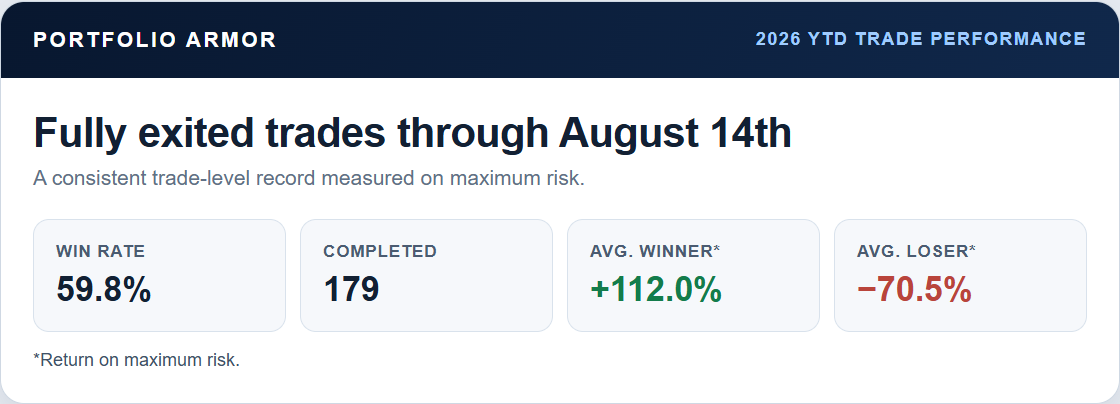
Two of this week’s full exits illustrate how we refine the process: discard a signal when the evidence turns against it, and stick with a defined exit method when the market gives us a chance at an exceptional payoff.
Retiring a Failed Signal
Palantir Technologies (PLTR 0.00%↑) came from Bearish Rally Failure, a screen we’ve retired after backtesting showed that it didn’t identify bearish setups consistently. The trade lost 98% of its maximum risk. We’re currently conducting research to develop a more effective bearish screen.
Letting a Runner Run
10x Genomics (TXG 0.00%↑) showed the other side of the process. After we exited its put spread, we left a $31.90 good-’til-canceled (GTC) sell order on the remaining November $25 call. The price looked ambitious, but it followed our runner method.
For a call runner, we add 75% of the current at-the-money (ATM) straddle to the share price, price the call at that target using current implied volatility, dividend yield, and remaining time, and compare Black-Scholes, Bjerksund-Stensland, and Cox-Ross-Rubinstein binomial valuations. We use the most conservative model-consistent result.
The $31.90 order filled this week, completing the TXG trade for a 380% return on maximum risk. We’ll keep applying the same framework to uncapped long options: define the target from the option market’s implied move, price the option conservatively, and adjust the timetable as we approach expiration.