


An IPO With A Washington Backstory
Anthropic priced its IPO on Wednesday at $83 per share, ahead of a planned Thursday Nasdaq debut. The base offering totals about $81 billion before fees, including shares sold by existing holders.
The company is going public amid a fight over who gets to compete in AI. A Tuesday post from AF Post pulled together Anthropic’s lobbying relationships with figures connected to Marco Rubio and Susie Wiles. It linked those relationships to the controversy surrounding the departure of Nvidia cofounder Jensen Huang, a prominent supporter of open models.


Why Open Models Change The Economics
Open-weight models let a business run an existing model on computing resources it controls, subject to the model’s license. That gives customers another way to obtain AI capability and gives proprietary model services another source of competition.
Devon Eriksen explained the business incentive with an analogy involving cars and gasoline. If you sell cars, he argues, you want:
gasoline to be cheap, plentiful, and all pretty much the same.
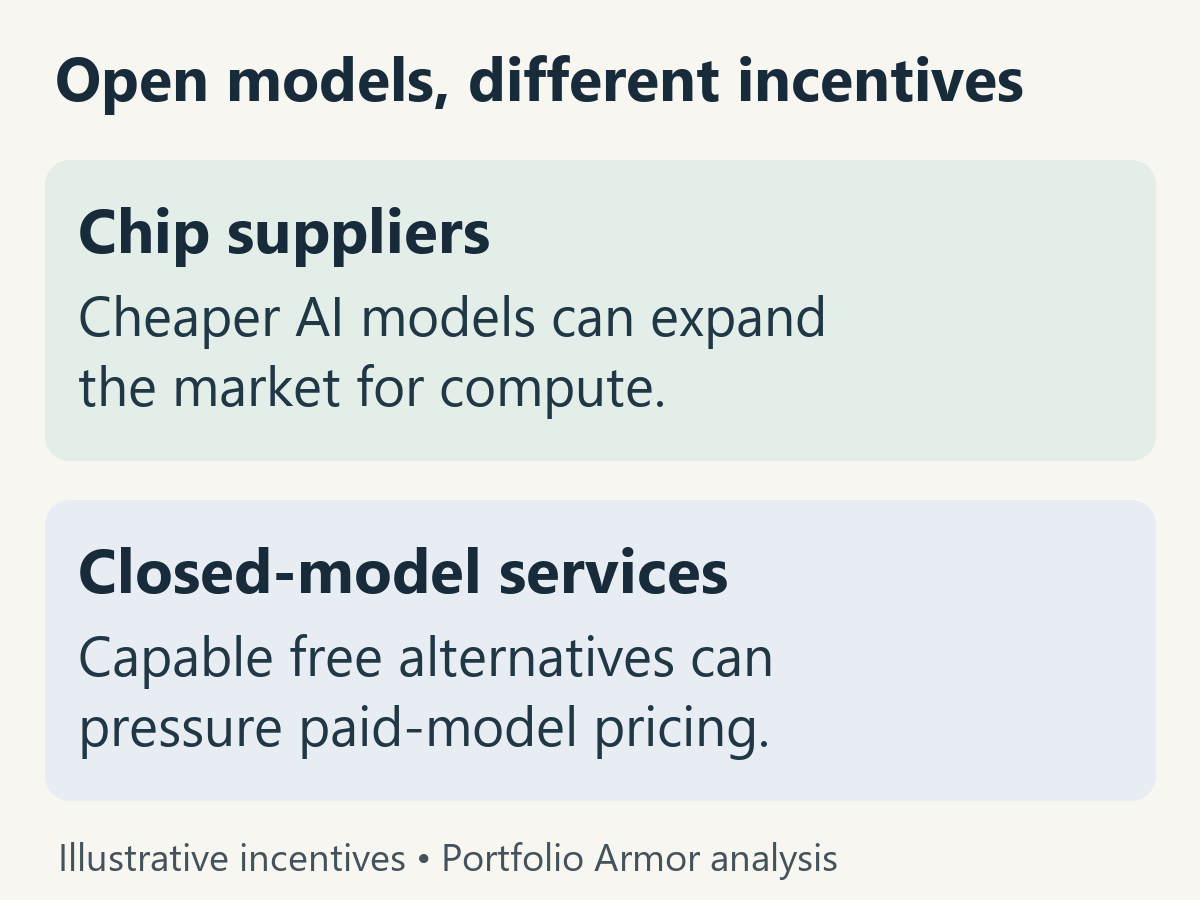
For a chip supplier, cheap and plentiful models can create more reasons to buy computing power. For a proprietary model service, capable free alternatives can put pressure on the price of paid access. The same development can expand one company’s market and squeeze another company’s pricing.
Those interests also overlap. Anthropic’s preliminary prospectus lists Nvidia GPUs among the chips it uses. A supplier and its customer can do business together while competing over how the value of AI gets divided.
What The Lobbying Records Show
Zero Hedge’s review of federal filings puts the income reported from Anthropic at $740,000 for Continental Strategy since April 2025 and $890,000 for Ballard Partners this year: $1.63 million combined. Continental’s Washington office is run by Alberto Martinez, Rubio’s former Senate chief of staff. Ballard is Wiles’ former firm.
Continental’s second-quarter report lists the National Security Council among the offices it lobbied; its third-quarter report lists the State Department. Rubio runs both. Zero Hedge places those activities in the months after the Rubio memo associated with Huang’s downfall.
Josiah Lippincott, an assistant professor at West Virginia University’s Washington Center, drew a causal conclusion, arguing that Huang’s support for open AI made him a competitive problem for Anthropic. He said Anthropic “almost certainly put major pressure behind the scenes to get Jensen out.”


The filings document reported lobbying income and identify government offices. They don’t show a request to oust Huang or prove that Anthropic caused his departure.
Kevin Bass raised another question Thursday morning: who leaked the briefing on Rubio’s memo, and who had seen the memo? He argued that chip-export policy disputes and the corporate lobbying around them deserve scrutiny.
Anthropic’s Stated Policy
Anthropic CEO Dario Amodei responded in July to accusations that the company wanted to ban open-weight models. He wrote: “Anthropic has never advocated for a ban on open-weights models.”
His published position includes restrictions on powerful chip sales to China, action against smuggling and industrial-scale distillation, and mandatory safety testing for sufficiently capable models, whether open or closed. Distillation uses another model’s outputs to help train a model.
The opposing open-weights letter argues that broad access strengthens competition and lets more researchers test and improve AI safety. Its signatories include OpenAI as well as Nvidia. Amodei explicitly disputes the claim that wider access necessarily favors defenders over attackers.
Safety testing also has an economic design question. If compliance carries a high fixed cost, a large lab can spread that cost across more customers than a small developer can. The thresholds, costs and scope of a rule can help determine who stays in the market.
A Revolt Over Safety And Power
Wednesday’s MisAnthropic Statement brought together critics including MIT physicist Max Tegmark, Harvard psychologist Steven Pinker and entrepreneur Guillaume Verdon, whose X handle is @beffjezos. The statement accuses Anthropic of using safety branding to advance its commercial and political ambitions while racing toward more powerful AI.
David Sacks highlighted the split, focusing on the tension between warnings about self-improving AI and Anthropic’s pitch to investors:

The company’s preliminary prospectus treats AI helping develop successive models as a competitive advantage. Full recursive self-improvement would go further: AI autonomously developing its own successor. Anthropic’s own research discussion says it hasn’t reached that point and that the outcome isn’t inevitable. It also discusses the risk of humans losing control.
Sacks also points to Claude’s Constitution. It permits ethical objection to instructions and treats Claude’s possible moral status as uncertain. It also explicitly calls for cooperation with legitimate human oversight, correction and shutdown, and rejects sabotage and escape from monitoring. That context matters to the claim about what Anthropic is training Claude to do.
Who Keeps The Profits?
For Anthropic, regulation that slows the arrival of competitive models could protect its business after a technological lead starts to narrow. That is the moat its critics suspect it wants to build: government rules that preserve the commercial value of an early lead.
We have some indirect exposure to Anthropic’s IPO through our bullish options position in SK Telecom, which holds a pre-IPO stake in Anthropic. The position dates to our June 18th alert.

Open-weight advocates want customers and developers to have the model capabilities needed to compete with the leading labs. The fight is over access to the frontier, the rules for entering the market, and who gets to collect the profits.
Where We’re Looking Next
AI agents are already changing the workload facing security teams. In a November 13th alert, the FBI warned that attackers are using AI agents to automate stages of cyber intrusions, with some attacks progressing from initial targeting to privileged access in under three hours.
Defenders need to secure credentials, spot suspicious access and respond to increasingly automated attacks. We see that as a growing source of demand for cybersecurity tools and services, and an investment opportunity for companies that can turn that demand into sales and cash flow.
Last week, we entered a bullish trade on Okta (OKTA), a cybersecurity company. That trade is already in the black.

We have trades on two more cybersecurity names teed up for later today.
If you’d like a heads up when we place them, you can subscribe to our trading Substack here.
New to our alerts? Start Here explains how they work.

Know an investor following Anthropic’s IPO? Share this article with them.