


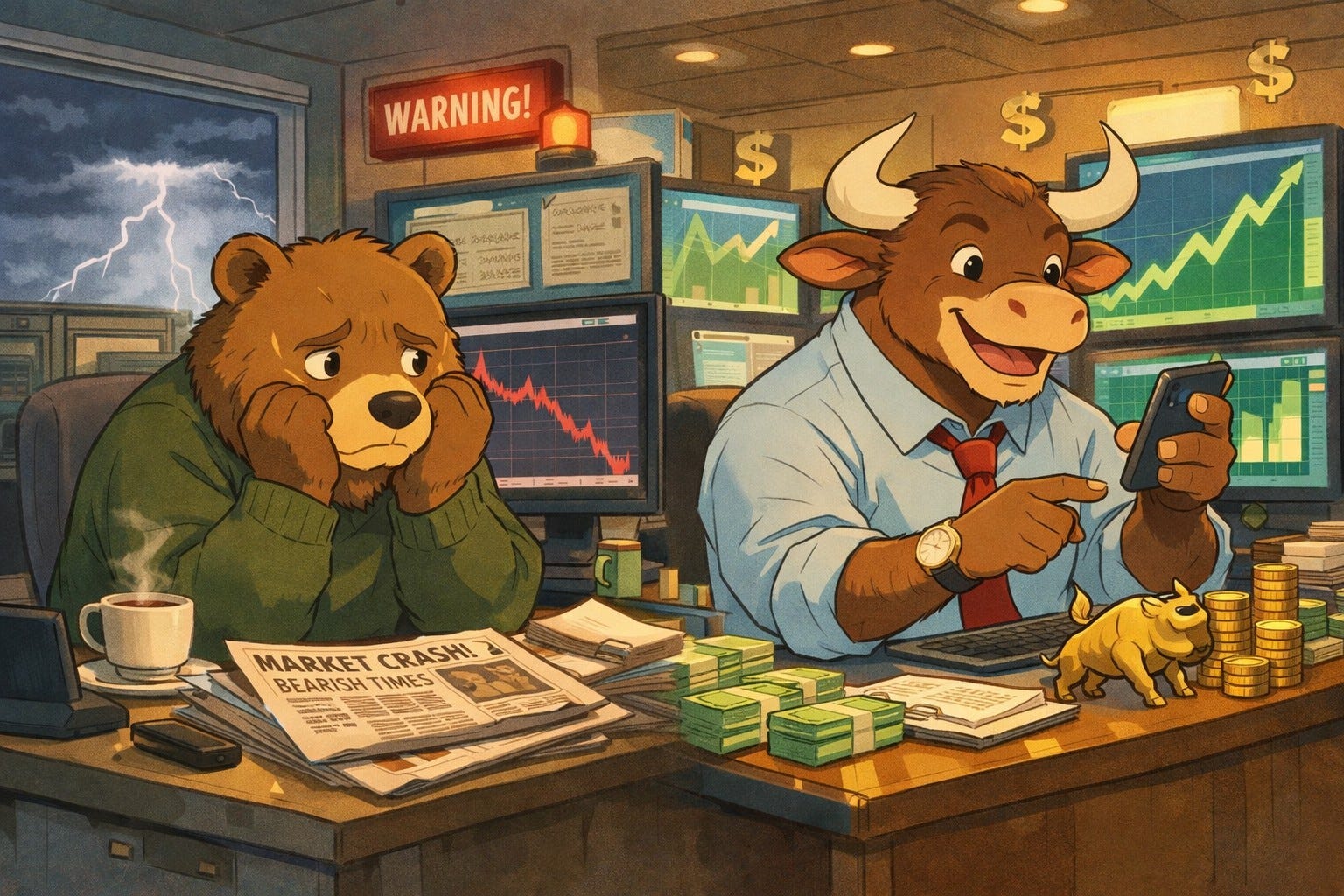
While You Were Waiting For A Crash
On Sunday, one of our fellow Zero Hedge contributors ran a post titled, “It Feels Like We’re Days Away From The Crash”.
That was hardly the only bearish take floating around this week. The bond market was supposedly about to break Washington. The AI bubble was supposedly entering its final test. The hyperscaler capex numbers were supposedly getting ugly. The crash was coming. Any day now.
But while a lot of smart people were waiting for a crash, the market did something else: it kept making new highs.
What Actually Happened
By Friday’s close, all three major U.S. indexes had hit record closing highs. The S&P 500 gained 1.43% for the week, the Nasdaq rose 2.39%, and the Dow added 0.9%. The S&P 500 also notched its ninth consecutive weekly gain, its longest streak since December 2023.
The rally wasn’t just some vague animal-spirit melt-up either. It had a very specific driver: earnings and AI infrastructure.
Dell (DELL 0.00%↑) surged 32.8% Friday after raising its full-year profit and revenue forecasts. The broader tech sector climbed 1.87%, chip-related names rallied, and even the software-services index jumped more than 6%, wiping out its losses since late January, when AI-disruption fears had weighed on the group.
That’s been the recurring pattern in this tape. The bearish macro concerns are not imaginary. Oil, inflation, rates, war risk, and market breadth all still matter. But the companies tied to AI infrastructure, defense, power, data centers, semiconductors, optics, software platforms, drones, and space keep giving investors reasons to pay attention.
That was the point of our Thursday night post, “Still Comparing This To The Dot-Com Bubble?”.

The clever 1999 analogy keeps running into actual orders, revenue, earnings, contracts, and infrastructure buildout.
The scoreboard keeps moving.
What We Were Doing Instead
While others were trying to call the top, we were placing defined-risk bullish options trades.
On Tuesday, in “Trade Alert: Stop Trying To Call The Top”, we added exposure to three names tied to the physical AI buildout, including the South Korea / AI memory theme.
The point there was that the thesis was still intact, and we had structures that let us participate with defined risk.
On Wednesday, in “Trade Alert: North Sea Energy And Biotech”, we used two different idea sources: one of Portfolio Armor’s Top Names and one name from our Multibaggers list.

Different buckets, same process: screen the name, check the theme, price the structure, and only swing when the risk/reward lines up.
On Thursday, in “Trade Alert: Drones, Venues, And Software Survivors”, we leaned into three different themes: drones, experiential entertainment / venue technology, and a software name that looked more like an AI beneficiary than an AI casualty.
As we wrote there, leadership keeps rotating through different parts of the AI-adjacent economy: power, photonics, memory, space, defense, drones, data centers, and selectively, software.
Then on Friday, in “Trade Alert: Still Not 1999”, we placed five bullish options bets on names sitting at the intersection of AI infrastructure, semiconductor bottlenecks, and disciplined technical setups.

Disciplined technical setups are how we try to separate tradeable AI-adjacent strength from simple momentum chasing.
Our Market Watchers → Chartmill workflow starts with names highlighted by savvy traders, then waits for Chartmill to tell us when those names pass our RSI and Setup screens. We’re looking for names that are not overextended and also not breaking down—the “just right” zone.
Then we price the options structures using Black-Scholes so we know whether we’re getting in at a good price relative to fair value.
If the trade fills, great. If it doesn’t, we move on.
Plenty of fish in the sea.
The Exits Tell The Story
The other side of the process showed up in our weekly “Exits” post.

This week, we had one stock trim and twelve options exits. All twelve options exits were winners.
Our losing options exits tend to collect on OpEx days, because our pre-set exit orders get us out of most of our winners before expiration. That’s an important part of the process. We’re not waiting around hoping to pick the perfect top. We place the exit orders ahead of time, and when the trades work, the profits hit automatically.
We sold another tranche of Sivers Semiconductors (SIVEF) for a 240% gain, while keeping some exposure.
BlackBerry (BB 0.00%↑) and Velo3D (VELO 0.00%↑) were partial call exits: 202% and 239% gains, respectively. In both cases, we sold half after a large move, locked in a win, and left the rest open.
Redwire (RDW 0.00%↑) was the next step in that same process. After selling half last week for a 208% gain, we sold the second half this week for a 515% gain.
Applied Digital (APLD 0.00%↑) and Riot Platforms (RIOT 0.00%↑) were full combo exits, with gains of 476% and 547%, respectively.
Short-call buybacks and put-spread exits harvested premium, reduced risk, and in the hybrid trades left the higher-upside long-call side alive for the next move.
Abivax was a good example. When we entered that hybrid combo, the max gain was capped at $2,035 if the short call finished in-the-money, and the max loss was $1,115. After buying back the short call and exiting the put spread, the remaining long call is now uncapped, and our max loss has dropped to $655.
That’s the machinery of the strategy doing its job.
The Point Isn’t To Be Perma-Bullish
We know markets can correct. They always do eventually.
That’s why Portfolio Armor exists in the first place: our core business was helping investors hedge. If you’re worried about a crash, we have tools for that.

But there is a difference between managing crash risk and spending your time waiting for the market to validate your bearish thesis.
This week, while some traders waited for the top to arrive, we kept doing what has worked: scanning for names where the story, the screens, and the setup line up; structuring trades to define risk; pricing them against fair value; and letting pre-set exit orders harvest profits when the trades move our way.
The market can always crash later.
This week, it didn’t.
So we got back to work.
Great article...thanks for being a voice of reason on ZH!
Btw, interesting that oil is showing up so much in this week's Top 10. I'm surprised Trump hasn't mentioned the idea of an Export Tax or similar to replace his global tariffs pressure vector. Also seems win-win for the election cycle.
I had Grok sketch out something based on some constraints and neo-classical economic theory:
Policy Proposal: Using U.S. Oil Export Policy for Domestic Price Relief (Transient Framework)
As the world’s largest oil producer (~13.5 million barrels/day) amid ongoing global supply shocks (Russia, Gulf/Hormuz disruptions), the U.S. has a unique short-term opportunity to lower domestic fuel prices without heavy long-term distortions.
Core Mechanism: Implement a modest temporary export tax or fee on U.S. crude oil. This creates a wedge between world and domestic prices, diverting more barrels to the U.S. market and capturing terms-of-trade gains from foreign buyers. Revenue can directly fund consumer relief.
Complementary Tools:
* Federal gas tax holiday (suspend 18.4¢/gal gasoline / 24.4¢/gal diesel) for immediate pump-level relief with high pass-through.
* Tax deduction for purchases of domestically produced oil/gas from U.S.-taxpaying companies. This incentivizes refiners and users to prioritize American supply, supporting domestic producers while lowering their net cost.
Economic Logic (6–18 Month Window): In the current tight global market, reduced exports tighten world prices further while shielding U.S. consumers. The approach exploits America’s scale for revenue recycling and domestic preference. Production effects remain limited short-term due to existing drilled wells and high prices. After the shock passes, the measures can sunset to avoid discouraging long-run investment.
This hybrid is administratively feasible, targets relief efficiently, and aligns incentives toward U.S. energy strength during a transient window of opportunity.