

After The Tech Wreck
The Nasdaq Composite fell 5.5% Thursday—its worst session since April 4, 2025, during the selloff following Trump’s “Liberation Day” tariffs.
The damage in leading AI names was much worse. Micron and Advanced Micro Devices each fell about 17% Thursday, Lam Research fell 16%, and Nvidia lost 9%. The normalized chart below tracks their stock prices alongside the Nasdaq from October 6 through Friday, with every series starting at 100:
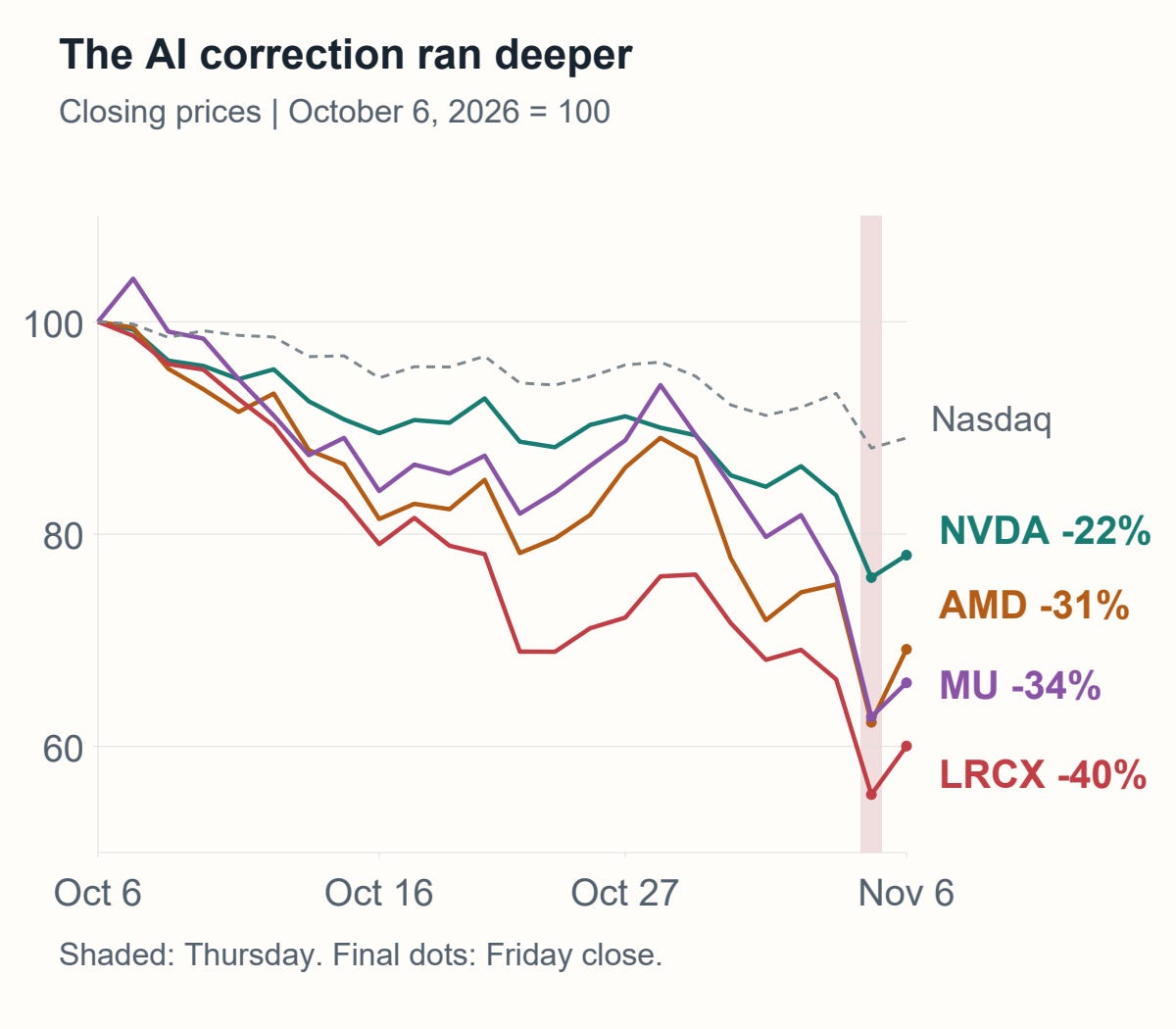
Friday’s 1.1% rebound left the Nasdaq down about 3% for the week. The jury’s still out on whether that was the beginning of a recovery or a pause before a continued correction.
The prospect of delays in data-center construction sharpened an existing financing problem: projects need to start generating revenue while the cost of funding them keeps running. The Wall Street Journal reported that stock-picking hedge funds unwound positions in October at their fastest pace in over a decade, with firms also cutting staff before Thursday’s selloff intensified.
The Buildout Continues
Friday brought a concrete example of the buildout changing hands: Google acquired Crusoe’s Wyoming data-center site after Crusoe finished predevelopment work. The investment returns from AI will depend in part on who owns the infrastructure and how much they pay to finance it.
Friday’s October jobs report showed 165,000 additional payroll jobs and 4.1% unemployment. For investors in capital-intensive businesses, the question remains how growing demand turns into cash—and how much financing it takes to get there.
Our response has been to look for early recoveries in businesses whose investment cases hold up, alongside companies approaching catalysts that can change their value. This week’s trades ranged from an emerging-market consumer platform to cancer diagnostics and bladder-cancer immunotherapy.
How We Traded It
Monday: We opened three healthcare trades: a Top Names selection serving drug development and two biotech catalyst ideas from our own research. All three filled. Our Monday alert explains the investment cases and original plans.

Tuesday: Our Fundamental Early Recovery screen identified an emerging-market consumer platform after its shares started turning higher. Our bullish setup combined that improving price action with stronger operating results and higher profitability guidance. The recovery alert explains the screen and the setup.

Wednesday: A cancer-diagnostics company first found through our Market Watchers list also appeared among our Top Names. We added a short-term earnings trade alongside the longer-dated position we’d opened in August. Our two-signal alert explains why the combination brought us back.

Thursday: Buying Into The Selloff
Thursday: Our morning healthcare alert proposed three trades: two revised Multibaggers ideas whose orders hadn’t filled the prior week, plus a Market Watchers idea.

Later, we published a rare second trade alert, Blood In The Streets, after a high-conviction name from our watchlist plummeted more than 20% on the day. The crash gave us an opportunity to add a trade at a significantly lower entry price.

That alert also reminded risk-averse investors about our hedging tools. Our iPhone app scans for the optimal puts and collars to protect stocks and ETFs at the lowest possible cost. Enter what you own and the largest decline you’re willing to accept, and the app does the rest. Tap the illustration below to see the app:

On the web, Portfolio Armor Basic includes those individual-position hedging tools and our daily Top Names. Premium adds portfolio construction that combines our Top Names with optimal hedges, using the investment amount and maximum six-month decline you choose.
The graphic below compares historical return illustrations for our three approaches to investing:

Friday’s Biotech Entry
Friday: We opened another bullish trade in a biotech business ahead of earnings. Our Friday alert explains the business case and why we considered the opportunity worth the earnings risk.

This Week’s Exits
We completed three trades this week—one gain and two losses—and made 24 partial exits.
Our exits post collects this week’s results:

Our 283 trades fully exited in 2026 through November 6th averaged 20.4% on original maximum risk. Larger average gains on winners drove the positive overall result:

The 52.0% annualized figure is a historical equal-risk illustration assuming continuous deployment, without compounding. Our full exits record shows the individual outcomes.
Biotech Gets A Bid
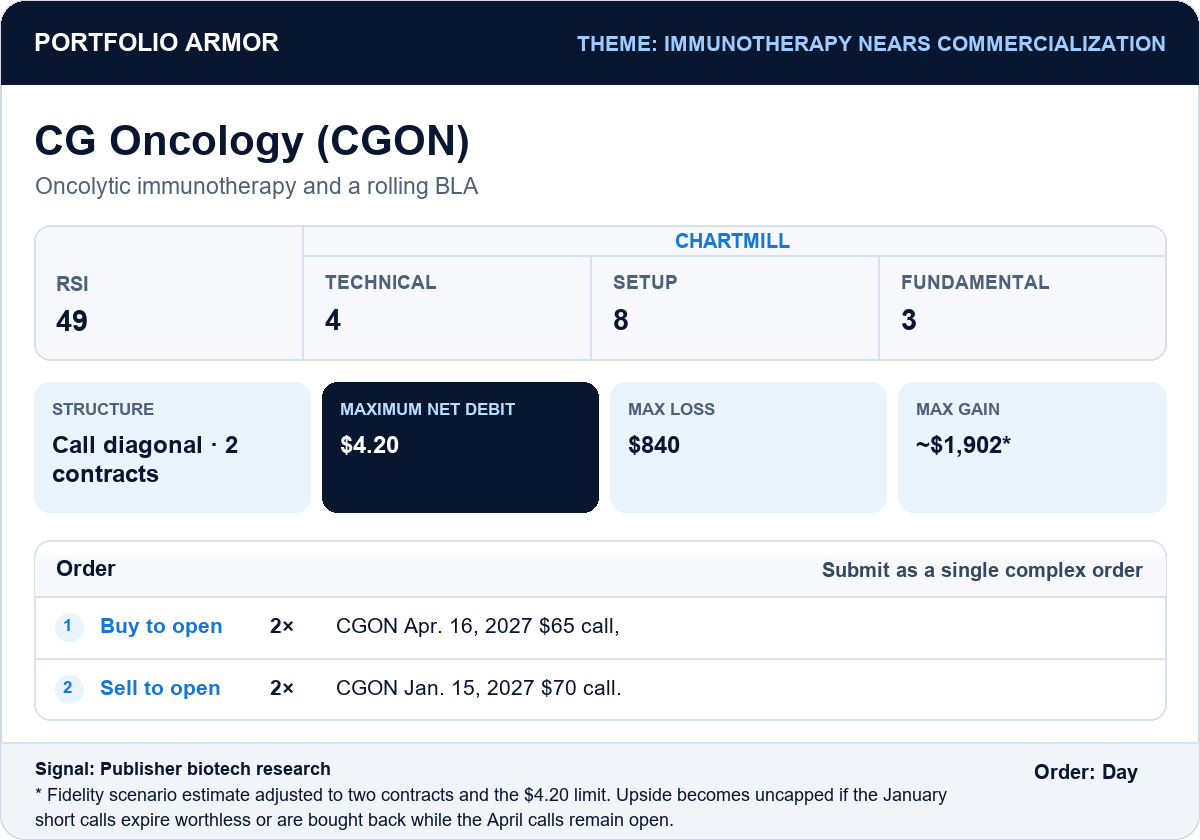
One silver lining this week was biotech. One of our Monday trades was CG Oncology (CGON), which is developing cretostimogene, an immunotherapy for bladder cancer. We entered a call diagonal at a $4.00 net debit. Monday’s original entry card shows the published $4.20 maximum and that day’s Chartmill ratings:

In its Friday business update, CG Oncology said it expects topline results from its Phase 3 PIVOT-006 trial this month, additional clinical data in December, and completion of its initial biologics-license application in the fourth quarter. Those are distinct opportunities for new information to change the market’s assessment of the company. Our original January short-call and April long-call expirations extend beyond that expected sequence.
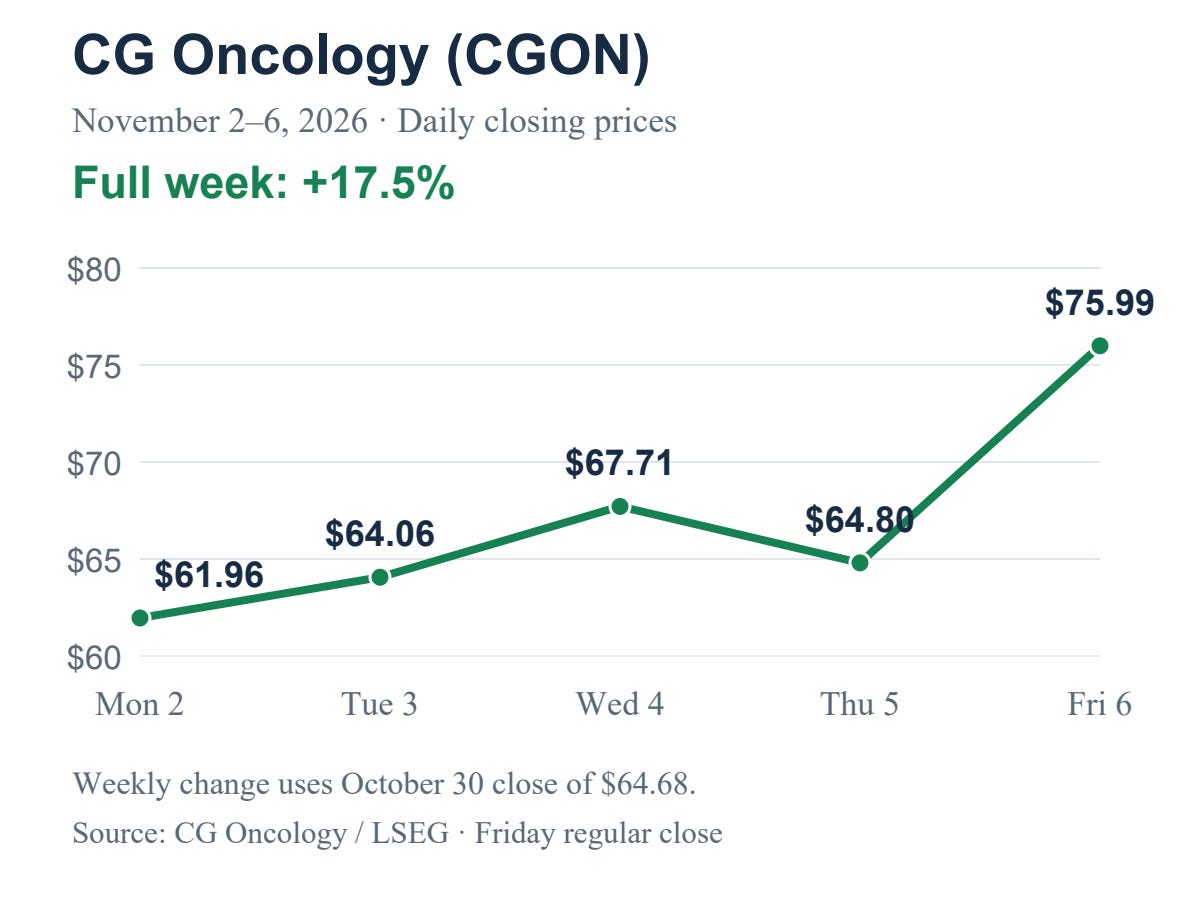
CGON closed Friday at $75.99, up 17% for the day and 17% for the week. The five-session chart below tracks its share price.
What We’re Watching Next
The October inflation report is due Tuesday, November 10th, at 8:30 a.m. Eastern. It will give investors another reading on the price pressures facing consumers and businesses. CG Oncology’s expected November data are another concrete checkpoint. Across our watchlist, we’ll also be looking for stronger operating results to meet improving price action, and for option prices that leave enough potential reward for the risk.
We’ll also use the early-recovery screens we developed to look for the best names showing signs of bottoming. The aim is to get back into strong businesses early in a turn, while much of the potential recovery still lies ahead.
New to our alerts? Our scheduled new-entry alerts go out before the market opens and before we enter the trades ourselves. Paid subscribers get the company research, exact orders and ongoing management. Subscribe for our next trades, or choose a free subscription for public posts.
Our Start Here page explains the service and includes a public sample alert: