


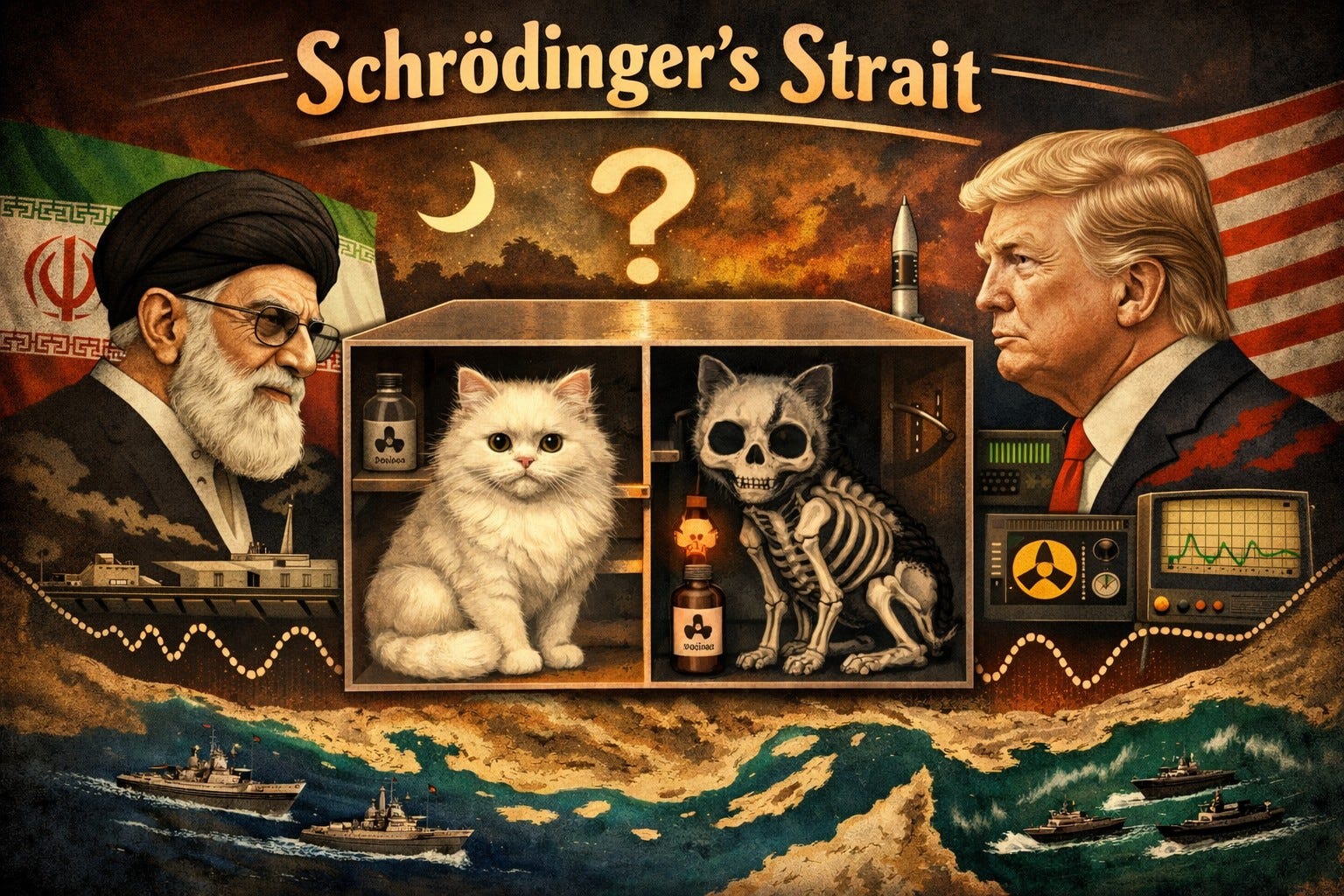
Schrödinger’s Strait
Over the weekend, the Strait of Hormuz became Schrödinger’s Strait: open and closed at the same time, depending on which headline you were reading.
On Friday, markets traded as if the Iran war was winding down cleanly. Iran said the Strait was open to commercial shipping during the ceasefire, Trump said he expected a deal with Iran “soon,” oil fell, and stocks rallied. By Sunday evening, Brent was back up sharply and stock futures were lower, after new friction around the U.S. blockade and Iran’s threats to respond. Reuters reported over the weekend that U.S. forces had turned back vessels under the blockade rules, that Iran warned the Gulf and Gulf of Oman would not be secure if its ports were threatened, and that the U.S. enforcement zone extends east into the Gulf of Oman.
That sounds like chaos, but there’s a logic to it.
Reflexivity With Warships
What Trump appears to be doing here—whether consciously or not—is something that looks a lot like George Soros’s principle of reflexivity.
Soros’s basic idea was that markets don’t just passively reflect reality; they can also change it. Prices move, expectations shift, financing conditions tighten or loosen, and those moves feed back into the real economy and even into political decisions.
That’s especially relevant in a war centered on oil flows, shipping lanes, and financial pressure.
Iran’s Lever
Iran’s preferred lever has been obvious for weeks: threaten the Strait of Hormuz, raise oil prices, spook global markets, and put pressure on Washington through the U.S. economy.
Higher crude means higher gasoline prices, and higher gasoline prices are one of the fastest ways to create political pain for an American president.
That leverage is real, because oil is globally priced and higher crude still means higher gasoline prices for American consumers. But it is also less direct than it would be for countries more dependent on Gulf barrels. The U.S. imports about 30%-35% of its crude oil demand, but 60%-62% of those imports come from Canada. That doesn’t make Washington immune, but it does mean Tehran’s strongest market weapon is still blunter against the United States than against much of the rest of the world.
That is Tehran’s most obvious form of reflexive pressure. It doesn’t need to destroy a U.S. carrier group to hurt Washington. It just needs to make markets believe supply is at risk.
Trump’s Lever
Trump’s pressure campaign has been different. Much more of it has been in the physical world.
First, there’s the blockade itself. It’s not a general closure of the Strait. It’s a targeted effort to stop Iranian oil sales, block Iranian maritime commerce, and deny Tehran both export earnings and imports flowing through the Gulf. U.S. enforcement boundaries extend east into the Gulf of Oman, which means Washington can exert pressure without having to crowd all its ships into the narrow and dangerous Strait itself.
Second, there’s the pressure that builds as time passes. A blockade doesn’t just reduce cash inflow. It also creates storage problems for a producer.
As Miad Maleki put it in an X post over the weekend, “the oil and gasoline clocks don’t negotiate.”


He wrote that Iran entered the blockade with about 15 million barrels in Kharg storage, roughly 51% full. At a flat production fill rate of 1.9 million barrels per day, that storage would max out in about 8 days. Even with aggressive upstream throttling, he said, the ceiling would still be hit in about 20 days. After that, wells may have to be shut in, risking permanent reservoir damage.
That’s the point. As time passes, Tehran has to think not just about lost revenue, but about storage, field management, and what happens if production has to be curtailed under pressure.
The Market As Battlefield
And that’s where reflexivity comes in.
If Iran can push oil high enough, long enough, it can create pressure on Trump through markets and through consumer prices. But if Trump can keep oil from rising too much—through his own rhetoric, through repeated hints of imminent talks, through confidence that the conflict will end soon—then he can blunt Iran’s pressure on the U.S. economy while continuing to squeeze Iran physically through the blockade.
In other words, the market itself becomes part of the battlefield.
If crude stays lower than Tehran wants, Trump buys time. Lower oil prices mean less pressure from American drivers, less political pressure on the White House, and more room to keep the blockade in place. If crude spikes, the reverse happens: Tehran’s leverage rises, not because it has sunk the U.S. Navy, but because it has raised the domestic economic cost of continuing the campaign.
Competing Narrative Power
That’s a reflexive struggle. Each side is trying to shape expectations in the market because those expectations feed back into the real-world balance of leverage.
You can see a weaker version of the same idea in the X account posting as Iranian parliament speaker Mohammad Bagher Ghalibaf.

The account’s line about “vibe-trading digital oil” captures the intuition that market narratives can matter. But that’s the problem for Tehran and its online partisans: they don’t have the same firepower on that front.
The U.S. president can move markets with a sentence. He can hint at talks, hint at peace, hint at imminent success, and each of those hints can put downward pressure on oil. Tehran can threaten, but Trump has the larger megaphone, the larger navy, and the stronger balance sheet.
Pressure On Tehran’s Internal Fault Lines
There may be another reflexive loop at work too: one inside Iran itself.
Reuters reported last month that cracks were already emerging inside Iran’s leadership, with backlash against President Pezeshkian and visible splits in the hierarchy. More recent reporting and analysis via the Wall Street Journal suggest the same basic divide still exists in a different form: pragmatic political figures willing to explore a deal versus harder-line IRGC-aligned elements that see compromise as surrender.
That matters because Trump’s public optimism about talks may be doing more than moving oil futures. It may also be widening that divide.
If he keeps signaling that a deal is close, that relief is possible, and that the economic squeeze can end quickly if Tehran compromises, he increases the pressure on Iran’s more pragmatic camp to press for an accommodation. At the same time, every such statement puts harder-liners in the position of either tolerating a deal they dislike or openly owning the economic pain that comes from blocking it.
That doesn’t mean Trump is consciously running a Soros seminar on statecraft. But it does mean the same mechanism may be operating in two arenas at once: in markets, where lower oil reduces pressure on Washington, and inside Iran, where the prospect of relief may intensify conflict between pragmatists and zealots.
Bessent, Soros, And The Loop
There’s another layer to this too. Scott Bessent spent years working for George Soros before becoming Treasury secretary. That doesn’t prove some grand deliberate Sorosian strategy inside the administration. But it does make it harder to dismiss the possibility that at least some people around Trump understand that markets are not just scoreboards here. They’re instruments.
And that may be the most important point.
People often talk as if the economic side of a war is separate from the military side. In this conflict, it isn’t. The blockade affects real barrels, real ships, and real storage tanks. But expectations about the conflict affect oil prices, and oil prices affect political room for maneuver. That is the loop. That is the reflexivity.
Who Has The Better Feedback Loop?
Iran tries to weaponize the threat of disruption. Trump tries to weaponize confidence that disruption won’t last.
So far, that second strategy has worked better than many expected. On Friday, the market traded as if the war’s economic effects were already beginning to unwind. By the weekend, it was revising that view again as enforcement, retaliation threats, and renewed uncertainty around Hormuz pushed oil back up. But if Trump can keep the market leaning toward “deal soon” while the blockade keeps physically strangling Iran’s trade, then Tehran is the side caught in the worse feedback loop.
Tehran needs higher oil to raise pressure on Washington. Washington needs lower oil to keep raising pressure on Tehran.
That’s not just military strategy. It’s reflexivity with warships.
To see how we’ve been trading the uncertainty emanating from the Strait of Hormuz, you can read our latest Exits post below.
