



“The Door To Doom”
On Saturday, Zero Hedge highlighted a note by Bank of America (BAC 0.00%↑) CIO Michael Hartnett (“‘Door To Doom Has Opened’ As Hartnett Spots ‘Obvious Echo’ To 1999 And 2009”). Hartnett’s argument, in short, is that the “door to doom” has opened because long-end Treasury yields have broken above key levels, inflation is still running hot, and stocks—especially tech and semiconductors—are behaving like late-stage bubble assets.
Hartnett sees echoes of 1999 and 2009 in the way stocks and bond yields are rising together, but his “Door To Doom” phrasing is reminiscent of an ‘80s horror movie.
Hartnett also points to semiconductor stocks trading far above their 200-day moving averages, market concentration, collapsing volatility, and political pressure from inflation as warning signs that the current boom loop may be close to exhaustion.
Our view: the AI buildout may produce pullbacks and crowded trades, but the valuation picture, earnings base, and deflationary potential of the technology make this setup very different from 1999.
The AI Boom Isn’t The Dot-Com Bubble
The comparison breaks down where it matters most: valuation, earnings, and the real-world consequences of the technology being built.
Start With Valuation
The cleanest rebuttal to the “this is 1999” argument is Micron (MU 0.00%↑) .
Micron is one of the key memory suppliers behind the AI buildout. High-bandwidth memory is essential for AI accelerators, and memory demand has tightened as AI infrastructure spending has grown.
And yet Micron’s valuation looks nothing like dot-com-era Cisco Systems (CSCO 0.00%↑).
Micron recently traded at a single-digit forward P/E, with some current estimates putting it around 7x–8x forward earnings.
Now compare that with Cisco near the top of the dot-com bubble. In January 2000, Forbes noted that Wall Street expected Cisco to earn $0.99 per share for the fiscal year ending July 2000. At $108 per share, that put Cisco at about 109 times forward earnings.
Cisco 2000 was a triple-digit forward-P/E stock priced as if the future had already arrived. Micron today is a key AI-infrastructure supplier trading at a fraction of that valuation.
If you use the PEG ratio (Price/Earnings divided by Growth rate), famously popularized by Peter Lynch, Micron looks even cheaper. Lynch considered stocks with PEG ratios of 1 to be fairly valued.
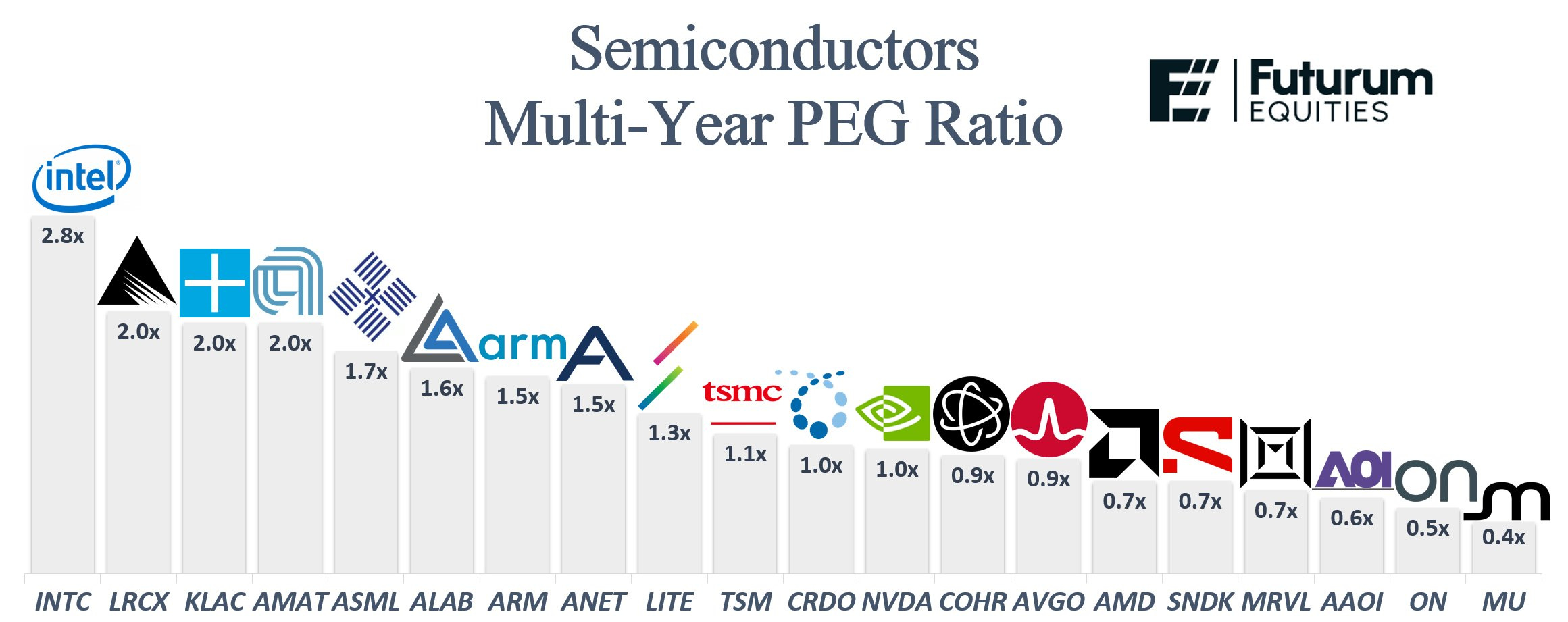
At a PEG of 0.4, Micron is actually cheap.
Even Cisco Isn’t Cisco 2000
It’s also worth comparing Cisco then to Cisco now.
Today’s Cisco is actually participating in the AI infrastructure buildout. It just reported record quarterly revenue of $15.84 billion, raised its full-year revenue forecast to $62.8 billion–$63 billion, and lifted its expected AI infrastructure orders for fiscal 2026 to $9 billion. After that move, Cisco trades around 19x–23x forward earnings, depending on the source—not 109x.
So even the actual Cisco, after an AI-driven re-rating, is not priced like Cisco in 2000.
The valuation setup for key AI suppliers today is nothing like the dot-com era.
AI Is Not Just Inflationary Capex
The bearish AI argument usually stops at the buildout.
Data centers need power. Power needs turbines, transformers, substations, grid upgrades, cooling, and land. That part is inflationary, at least during the buildout phase.
But that’s only half the story. The fruits of the AI boom should be deflationary in many cases.
AI agents will perform digital work at lower cost. Robots will perform physical tasks at lower cost. Automated factories will produce goods with less labor, less waste, and less downtime. AI-assisted engineering, coding, drug discovery, logistics, customer service, finance, compliance, manufacturing, and design should all push in the same direction: more output per unit of labor and capital.
That’s what productivity does.
The market is not paying for GPUs because investors like acronyms. It is paying for the possibility that intelligence, labor, design, testing, logistics, and production all get cheaper.
That’s a productivity shock, not 1999-style vaporware.
Inflation Can Moderate
The inflation scare is real, but the bearish case depends on the latest impulse becoming durable.
There are reasons to doubt that.
A large part of the recent inflation pressure has come from energy. Energy shocks can be brutal, but they are not the same as an entrenched wage-price spiral. If Gulf risk eases, if oil flows normalize, or if gasoline simply stops rising at the recent pace, headline inflation can cool quickly.
Tariff pass-through may also be running out of runway. Goldman Sachs (GS 0.00%↑) has estimated that 72% of tariff costs had already passed through to consumer prices after 12 months, and expects core goods inflation to decelerate sharply by December 2026 as that passthrough cycle fades. Goldman’s base case also has core PCE at 2.5% by December 2026 and 1.9% by December 2027.
Productivity Is Part Of The Inflation Story
Labor-market pressure is not what it was in 2021 or 2022. Supply chains are no longer in the same pandemic-era chaos. AI and automation are beginning to attack cost structures directly. And if energy is the main problem, more energy supply, more grid investment, and more efficiency are part of the solution.
The better question is whether the latest inflation impulse is the start of a new regime, or another shock that gets absorbed as supply adjusts and productivity improves.
We think the second outcome is more likely.
Bubbles Don’t Trade At 8x Forward Earnings
The world needs more compute. More memory (hence Micron’s low price relative to its forward earnings). More photonics. More electricity. More cooling. More grid capacity. More semiconductor equipment. More automated factories. More robotics. More data-center infrastructure.
That is where we have been focusing our trades, on the physical bottlenecks.

How We’re Trading It
We are bullish on the AI buildout, but we are not building trades that require a straight line higher. We’ve been structuring trades with defined risk and enough time for the thesis to work.
In many cases, we’re using options tenors several months out. That gives the trade time to survive a correction, an earnings wobble, or a temporary macro scare.
In some structures, we include short call financing legs. When the stock pulls back, those short calls can often be bought-to-close for a fraction of what we collected when selling-to-open them. That reduces risk, uncaps our potential upside, and leaves us with longer-dated bullish exposure still intact.
Structure Matters When Timing Is Imperfect
If you’re bullish but wrong on timing, structure matters. If you’re bullish but get a near-term correction first, structure matters. If the AI buildout continues but the market has a risk-off month, structure matters.
The goal is not to predict every squiggle.
The goal is to keep bullish exposure alive when the thesis is intact, while defining the downside in advance.
The Better Analogy
The dot-com bubble gave us plenty of real companies. Amazon (AMZN 0.00%↑) was real. Cisco was real. The internet was real.
The problem was price.
Investors paid so much for some of those companies that even strong business performance couldn’t save the stocks for years. The dot-com bubble wasn’t a bubble because share prices went up; it was a bubble because they became untethered from any reasonable multiple of future earnings.
That’s not the case now.
When a critical AI supplier trades at a single-digit forward P/E, it is not Cisco at 109 times forward earnings. When AI can lower the cost of labor, services, manufacturing, logistics, and design, it is not just an inflationary capex boom. And when trades are structured with defined risk and enough time, a pullback is not necessarily the end of the thesis.
Bullish Or Bearish, Have A Plan
If you’re bullish on the AI buildout, you can join us in our next bullish trade here on the Portfolio Armor Substack.
If you’re bearish, or just worried about downside risk, you can use the Portfolio Armor website or iPhone app to scan for the optimal hedges to protect your portfolio:

This market will pull back. It may shake out late buyers. But the AI buildout is real. The real “Door To Doom” is staying on the sidelines and missing out on it.