

Not Walking Away
Our fellow Zero Hedge contributor, “Quoth the Raven” (QTR) published a post tonight called “Walking Away”, explaining why he decided to stop trading and focus instead on what he sees as his real edge: researching markets, identifying themes, and communicating ideas. His basic point is a good one: being right and making money are not the same thing.
He’s right about that.
In fact, walking away from active trading is probably the right decision for most people.
Why Most People Shouldn’t Trade
The first problem is politics.
Most of us are political or ideological people, whether we admit it or not. That’s especially true of Zero Hedge readers, who often have strong views about the Fed, deficits, wars, tariffs, immigration, regulation, corruption, the administrative state, and whichever politician happens to be in office.
That’s fine. But if you bring that into your trading, you’re already in trouble.
You can’t start with the premise—conscious or unconscious—that you don’t like the current President, his policies are wrong, and therefore the market is going to tank. That’s how you end up doing what Paul Krugman did after Trump was elected in 2016, when stocks initially sagged and he suggested the first-pass answer for when markets would recover was “never”.
That wasn’t analysis. That was political preference wearing a lab coat.
Conservatives can make the same mistake in the other direction. So can libertarians, gold bugs, tech bulls, China bears, AI skeptics, Bitcoin maximalists, and everyone else with a worldview.
The market doesn’t care what you want to be true.
Being Right Still Isn’t Enough
Suppose you clear that first hurdle. You can separate your politics from your trading. You can look at what is actually happening, not what you wish were happening.
You still have another problem: the market is parimutuel.
You can have a correct thesis and still lose money because everyone else already figured it out first. If the thesis is already priced in, you’re not early. You’re exit liquidity.
That’s one of the reasons obvious trades can be so dangerous. “Nvidia is central to AI” was true. It was also obvious. At certain prices, being right about Nvidia no longer gave you an edge.
The edge is not just knowing something true. The edge is finding something true that the market hasn’t fully priced in yet.
That’s harder.
Options Make It Harder Still
Options add another layer.
Now it’s not enough to be right. It’s not enough for your rightness to be underpriced. You also have to get the timing right.
Options expire.
If your thesis starts working after your long calls expire, congratulations: you were right and lost money. If implied volatility collapses after an event whose outcome you predicted correctly, you can still lose money. If you buy calls too far out-of-the-money, or pay too much for them, time decay can bleed you out while the stock grinds sideways.
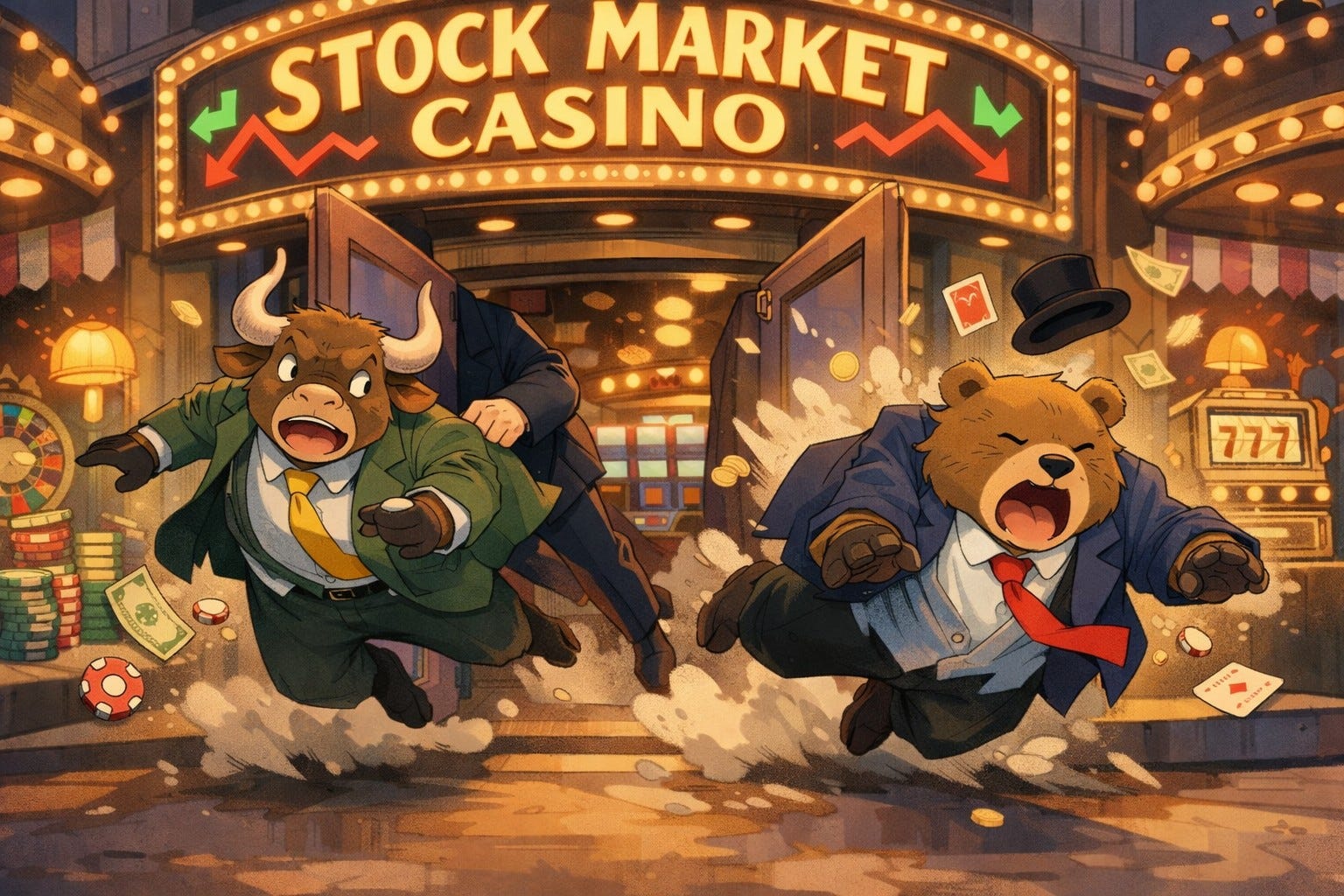
The Casino Test
QTR also mentions sports betting and the broader gambling culture around markets. That’s another useful distinction. We enjoy sports betting too, but we know we don’t have a serious edge there.
So we place $10 bets for entertainment (we have a longshot bet on Norway winning the World Cup).
We don’t risk meaningful money on it because we’re not pretending we have an edge we don’t have.
That’s the test most traders fail. They confuse interest with edge. They enjoy the game, so they convince themselves they’re good at it.
Markets are very good at charging tuition for that lesson.
Why We’re Not Walking Away
So why aren’t we walking away?
Because we do have edges.
One edge is psychological: we can separate what we believe, or what we want to happen, from what is actually happening. We don’t flip bearish because the candidate we voted for lost. We don’t ignore a bull market because we dislike the man in the White House. We don’t wait for the sky to fall when the tape is rewarding specific themes right now.
Another edge is sourcing.
We have Portfolio Armor’s Top Names, which have nearly doubled the performance of the market since late 2022, as you can see at that link.
We also have our Market Watchers X list, including the Multibaggers subset: traders and investors with multiple documented 100%+ winners. So we’re starting with a strong pool of ideas.
Another edge is screening.
We use technical screens to avoid two common traps: falling knives and overextended names. We want stocks in our Goldilocks zone—not breaking down, not too stretched, and still tied to a live theme.
Another edge is structure.
We’ve spent years refining multiple options structures that let us use volatility and time decay to our advantage. The goal is to finance bullish exposure, define risk, and give the trade room to work.
And another edge is pricing.
We use Black-Scholes as a baseline, Bjerksund-Stensland as an American-style option check, and Cox-Ross-Rubinstein binomial tree modeling when early exercise, dividends, or other path-sensitive issues could matter. We use CBOE implied volatility inputs, model the structures, and try to enter at prices at or below fair value.
That last edge is available to everyone.
Those models are freely available online (we linked to them all above). You can apply them yourself. You can check whether the option structure you’re about to enter is attractive relative to fair value.
We’d be willing to bet most traders don’t.
We’d be willing to bet QTR never did it consistently (or ever?) either.
Why? Because it adds work. More steps. More friction. More reasons not to hit the button.
And if you’re not willing to do that work, active trading probably isn’t for you.
Our Results Are Public
We post our exits publicly, win or lose. Full transparency, always. You can find our most recent weekly Exits post here; you can find a spreadsheet of our last 680+ trade exits since July of 2024 here.

We’re not winning every trade. No one does. But we’ve been winning more often than we lose, and our average winner has been significantly larger than our average loser.
That’s not magic. It’s not vibes. It’s work.
Find the themes. Source the names. Screen the charts. Price the structures. Define the exits. Take the fills the market gives you. Enter your pre-set exit orders. Track the results.
Then do it again.
That’s the game.
Work Or Walk Away
QTR walking away from active trading is not a failure. It’s probably wisdom.
If your edge is research and writing, do that. If your edge is identifying themes but not executing trades, own that. If trading makes you worse—more emotional, more impulsive, more distracted—stop.
Most people should.
We’re not walking away because trading is working for us.
But it works because we treat it like work.
After we hit send on this post, we’re going to catch the final quarter of today’s NBA Finals game (We’ve got the Knicks money line at +250).* Then, we’re going to spend hours researching our next trades. Expect that alert in your inbox Thursday morning.
*Update: we won.


I want to thank you. Not because you’ve made me rich but because you have explained markets to me…and really well. I have an accounting/law background so I don’t think I’m an idiot, but coming into investing I’ve realized that there are games being played I didn’t understand. Whether or not I’m understanding them better now is to be seen, but the fact that I see them now is in no small part because I’ve subscribed to you. Maybe it’s your background as a short seller and being skeptical but I’ve found your takes to be honest and refreshing. We’re about the same age (I’m almost 44) and whenever you write or speak I feel like I’m listening to somebody who cares to get it right. I almost feel like you’re letting us know you’re not trading daily because you think you’re letting us down. You’re not. You’re awesome. God loves you. Keep doing what you’re doing. You’re dominating and you’ll never lose me as a subscriber as long as you are yourself
I often wonder how many ZH writers are really in the market, other than maybe a 401k or mutual funds.
Anyway, hands down this is the best newsletter/turn-key system that I'm aware of. I have several systems/portfolios that I use, but most times I check my Top 10 account I have a smile on my face. The Black Box really knows what it's picking!