


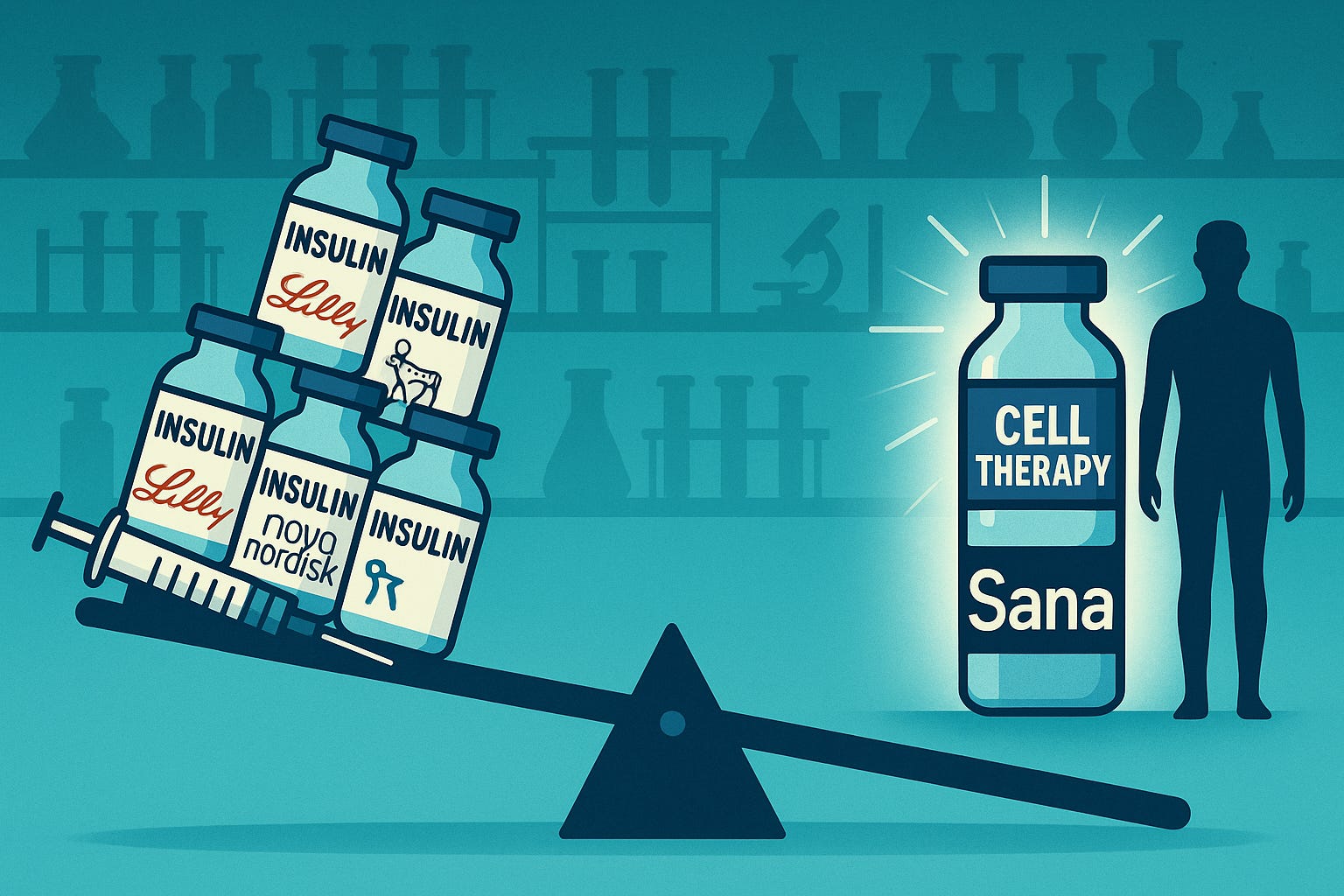
Follow-Up: Sana Biotechnology
6-Month Data, +150 % Rally, and Morgan Stanley’s New Overweight Call
In a public post in May (“The End Of The T1 Diabetes Industry?”), I wrote about Sana Biotechnology (SANA), a biotech that is developing a potential cure for type 1 diabetes. Here’s an update on developments since.
1. Quick Recap of the May 19 Thesis
Functional-cure potential. Sana’s hypo-immune (HIP) edits let donor islet cells make insulin without triggering rejection—no immunosuppression required.
Moat = immune stealth. Removing MHC I/II and adding “don’t-eat-me” CD47 is the core advantage.
Industry disruption. If HIP-edited, stem-cell–derived islets (program SC451) scale, legacy diabetes franchises at Novo Nordisk (NVO 0.00%↑), Eli Lilly (LLY 0.00%↑), DexCom (DXCM 0.00%↑), Insulet (PODD 0.00%↑), etc., may be at risk.
(See original post for full details.)
2. Stock Performance Since the Post

In under eight weeks, SANA has nearly tripled, reflecting a shift from speculative promise to emerging proof-of-concept.
3. Six-Month Human Data (June 23)
“Cells survived, secreted insulin, and responded to meals six months after transplant—without immunosuppression and with no safety issues.” GlobeNewswire
Editor’s note (August 18, 2026): UP421 was a low-dose safety and immune-evasion study, not a test of insulin independence. The transplanted cells produced meal-responsive insulin without immunosuppression, but the patient continued using exogenous insulin; Sana said the study wasn’t intended to improve glycemic control or reduce insulin use. The accomplishment was human proof of immune evasion—not a clinical cure. Sana’s therapeutic-dose, stem-cell-derived SC451 program is the next step intended to test whether the approach can normalize glucose without insulin.
Why it matters
Durability: Continued C-peptide production and meal-stimulated spikes confirm functional beta-cell activity.
Immune evasion: Graft survival without immunosuppression provides human proof of concept for the HIP edits.
Safety: No cell- or procedure-related adverse events.
Path forward: Longer follow-up of UP421; IND for the therapeutic-dose, stem-cell-derived SC451 candidate targeted for 2026.
4. Morgan Stanley Joins the Bull Camp (July 2)
Initiation: Overweight rating, $12 price target (~3× Friday’s close).
Rationale: Six- and 12-week human data “de-risk the platform”; broad cell-engineering pipeline offers additional upside. Investing.com
5. What Could Move the Stock Next

6. Bottom Line
Data + Duration: The six-month update converts “interesting science” into early evidence of sustained graft survival and function.
Momentum: A ~150 % rally since May 19 shows the market is starting to price in that shift.
Institutional validation: Morgan Stanley’s fresh Overweight adds credibility—and a higher-quality buyer base.
If you sized SANA small after the May post, the thesis is tracking; consider letting winners run while watching for pullbacks to add. New capital? Size cautiously—it’s still a single-patient read-out—but the upside/skew remains attractive as more data roll in. And if you’re long legacy diabetes treatment companies, consider hedging them. Although Sana is aiming to cure T1 diabetes, its treatment could potentially impact the market for management of some forms of T2 diabetes as well (e.g., insulin therapy). As a reminder, you can use Portfolio Armor’s website or iPhone app to scan for cost-effective hedges.
