



AI Apocalypse
AI-related momentum names got hammered Thursday.
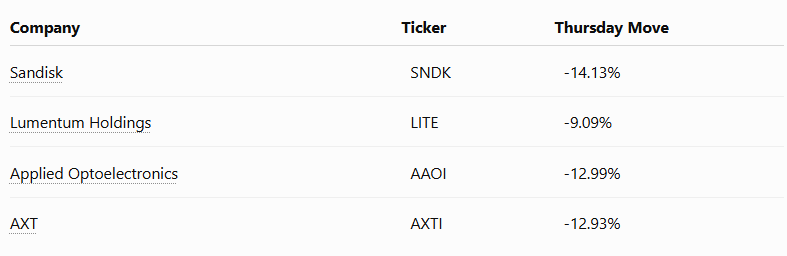
Memory, photonics, optical networking, semiconductor equipment, power, and AI-infrastructure names were a sea of red. Some of these stocks had already sold off before Thursday, but Thursday turned the pullback into a momentum apocalypse.
The putative reason was familiar: the AI buildout had run too far, too fast. Concerns about excess AI compute, stretched valuations, co-packaged optics delays, and future capex digestion all got bundled into one big bearish trade.
That’s the surface explanation. The more interesting story is the chronology behind it.
We Warned About This Last Month
A lot of the recent AI-hardware FUD was sparked by two SemiAnalysis reports last month.
SemiAnalysis is Dylan Patel’s semiconductor and AI research firm. It covers the AI supply chain: chips, packaging, networking, optics, memory, datacenters, and infrastructure. Its work reaches institutional investors, and in crowded trades, institutional narratives can move prices.
After the second SemiAnalysis report hit in June, we published “Reject The FUD” on ZeroHedge. The Portfolio Armor version was included in this trade alert:

Here’s the key passage from that post:
Markets aren’t populated by disinterested monks.
Plenty of institutions missed parts of the AI-infrastructure rally, and some of them would welcome better entry points.
It appears one of the parties looking for better entry points was SemiAnalysis itself.
SemiAnalysis Gets Its Entry Points
On June 30th, Tema launched the Tema Photonics & Optical ETF (LAZR 0.00%↑), in research partnership with SemiAnalysis. Two of its top holdings:
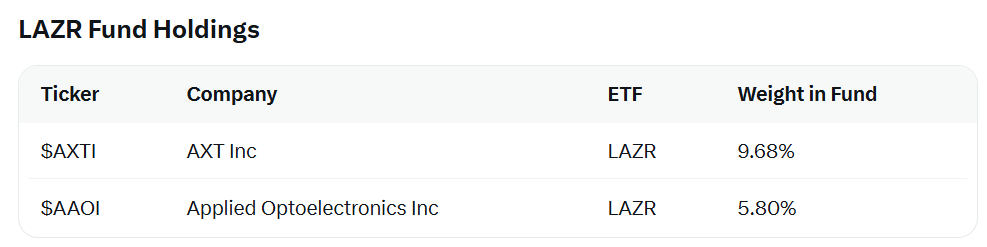
Tema launched the Tema Memory ETF (DISK) the same day, also in research partnership with SemiAnalysis. Two of its top holdings:
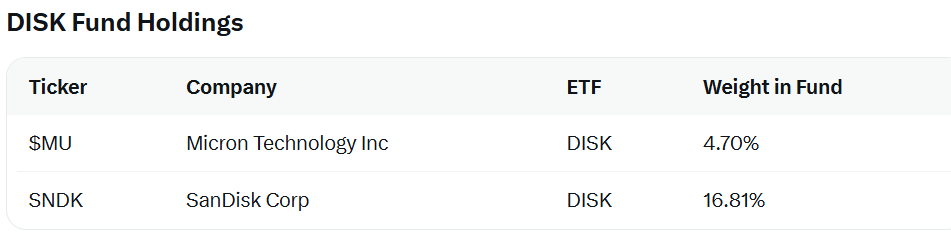
The sequence is simple:
SemiAnalysis published bearish AI-hardware research last month, including work on co-packaged optics and related names.
Memory, photonics, and AI-infrastructure stocks sold off hard.
Tema launched two SemiAnalysis-linked ETFs on June 30.
Those ETFs bought exposure to the same baskets, including several names hit by the selloff.
That chronology doesn’t need much embroidery. A research shop whose bearish reports poured cold water on a hot trade ended up linked to ETFs buying that same trade after the reset.
Investors can draw their own conclusions.
The Incentives Flipped
Before the pullback, institutions that missed the AI-hardware rally had an obvious problem: chase vertical charts or wait for lower prices.
After the pullback, the incentives look different. Better entry points are here. The institutions and funds that wanted exposure now have it, or at least have a cleaner shot at building it.
That matters because narratives follow positioning. When investors want in, bearish concerns get amplified. Once they’re in, the same investors have an incentive to emphasize the long-term bull case again.
We may have seen an early hint of that overseas. Korea bounced on Friday, with SK Hynix and Samsung Electronics rallying after the U.S. momentum flush. Korea is one of the purest global expressions of the AI-memory trade, so that rebound is worth watching when U.S. markets reopen.
How We Traded It
We got back into Micron, and three other AI-related names on Thursday.

One of the other three names we got back into in that alert: Sandisk (SNDK 0.00%↑). Nice to know one of the top research shops shares our bullishness on those names.
Of course, it’s not our first rodeo with either name:
4-leg combo on SanDisk (SNDK -13.92%↓). Entered at a net debit of $1.78 on 12/4/2025; exited the Mar ’26 250–270 call spread at $16.00 on 1/15/2026; exited the Mar ’26 180–175 put spread at a net debit of $0.20 on 1/21/2026. Profit: 788% on premium outlay (188% on max risk).
4-leg combo on Micron Technology (MU -6.25%↓). Entered at a net debit of $2.62 on 3/3/2026; exited the put spread at a net debit of $0.20 on 4/8/2026; exited the call spread at a net credit of $16.00 on 5/5/2026. Profit: 504% (return on max risk: 173%). Signal: PA Top Names.
Evidence Over Fear
We’ll keep separating evidence from fear.
The evidence still says the AI buildout is real. Memory, storage, optics, power, cooling, and data-center infrastructure remain bottlenecks. The better-positioned companies are generating rapidly ramping revenue and earnings from that demand.
The FUD says every pullback is the beginning of the end.
We’ll let logic, evidence, and price guide our trades.
What I know for sure is that AI is real this time.
What worries me is, of course, timing. Humans love to screw up a good thing.